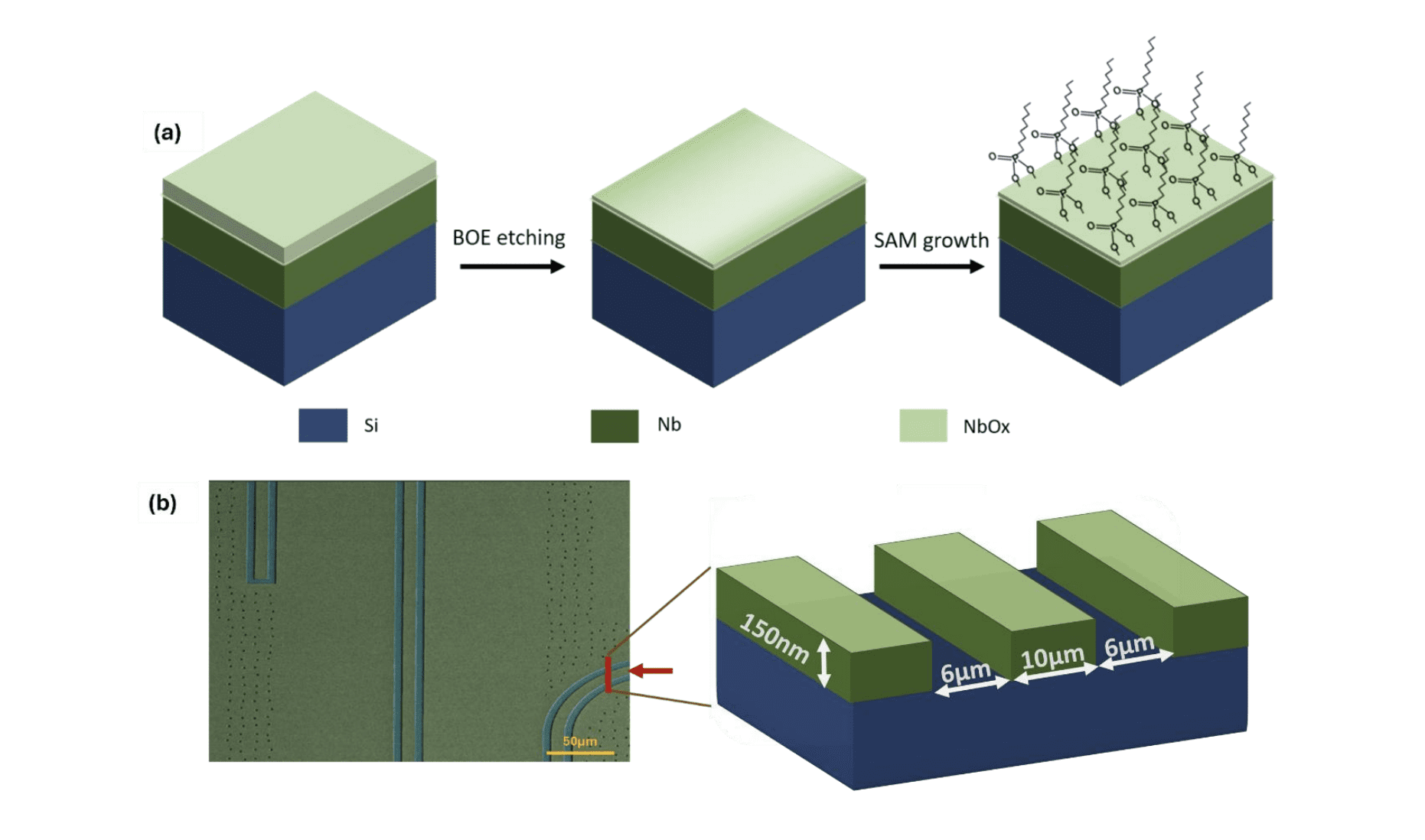
Loss of quantum information represents a major hurdle in building powerful quantum computers, and a key source of this loss stems from unwanted energy dissipation within superconducting circuits. Harsh and colleagues at Delft University of Technology, along with collaborators, now demonstrate a significant advance in maintaining the delicate quantum states of these circuits by addressing the formation of surface oxides on niobium, a commonly used superconducting material. The team successfully applies a passivation technique using self-assembling organic molecules, effectively suppressing oxide regrowth and dramatically improving the stability of superconducting resonators over several days of air exposure. This method reduces energy loss by a substantial margin, offering a pathway towards building more robust and reliable quantum devices, and potentially enabling the large-scale fabrication of quantum computing components where long-term performance is essential.
Niobium Resonator Loss Mechanisms and Characterisation
This document details a comprehensive investigation into the sources of loss in niobium (Nb) superconducting resonators, and how these losses limit performance. The research focuses on understanding and mitigating loss mechanisms, particularly those related to oxide regrowth and the presence of two-level systems (TLS). Researchers combined experimental techniques, such as X-ray photoelectron spectroscopy (XPS) and microwave resonator measurements, with theoretical analysis to pinpoint the origins of loss and explore strategies for improvement. XPS was used to analyze the chemical composition and oxidation states of the Nb surfaces, identifying the presence of oxides like niobium pentoxide and their role in energy dissipation.
Microwave resonator measurements characterized the performance of high-quality Nb resonators by measuring their quality factor as a function of frequency and temperature. The team investigated key loss mechanisms, including oxide regrowth after initial removal and the influence of two-level systems, defects and impurities that absorb microwave energy. Detailed XPS analysis confirmed the presence of niobium pentoxide as a primary oxide species, and angle-resolved XPS probed the depth distribution of these oxides. Accurate determination of attenuation lengths was crucial for interpreting the XPS data.
Measurements of the resonator’s quality factor as a function of temperature and frequency helped identify the dominant loss mechanisms. Analysis of the relationship between the resonator’s internal quality factor and the number of photons revealed distinct loss channels, each characterized by a different critical photon number. The research identified two distinct loss channels: one associated with oxide regrowth and another associated with the SAM passivation layer. Specific critical photon numbers were reported for each loss channel, and data from multiple resonator samples demonstrated the consistency of the findings.
Niobium Passivation Stabilizes Superconducting Quantum Circuits
Researchers demonstrate a significant advancement in maintaining the coherence of superconducting circuits by suppressing energy-dissipating losses. The team focused on mitigating two-level system (TLS) losses, which arise from the formation of native oxides on metal surfaces, and achieved remarkable stability through a novel passivation technique. They successfully grew alkyl-phosphonate self-assembled monolayers (SAMs) on niobium thin films after removing existing oxides, effectively preventing oxide regrowth and maintaining circuit performance over extended periods. Experiments revealed a stark contrast between passivated and un-passivated niobium resonators at extremely low temperatures, 10 millikelvin; un-passivated resonators experienced an approximately 80% increase in loss at single-photon power levels, indicating rapid degradation, whereas SAM-passivated resonators maintained excellent temporal stability.
By employing a two-component TLS model, scientists discerned distinct loss channels for each resonator type and quantified the characteristic TLS loss of the SAMs to be approximately 5×10 -7. This precise measurement is, to their knowledge, a previously unreported value and crucial for future circuit optimization. Surface characterization studies, including ellipsometry and water contact angle measurements, confirmed the quality of the phosphonate monolayer coatings. Ellipsometry yielded a measured film thickness of 1. 2±0.
2 nanometers, consistent with a well-ordered molecular monolayer. Water contact angle measurements demonstrated a transition from a hydrophilic surface, with a contact angle of 42°±2° after oxide removal, to a hydrophobic surface, with a contact angle of 103°±1° after SAM passivation, confirming successful monolayer formation. These findings suggest that this passivation methodology offers a promising route toward industrial-scale fabrication of quantum circuits, particularly where long-term device stability is critical, and paves the way for reducing dielectric losses in future niobium-based quantum circuitry.
Alkyl-Phosphonates Stabilize Niobium Superconducting Resonators
This research demonstrates successful passivation of niobium superconducting resonators using self-assembled monolayers of alkyl-phosphonates, significantly improving their long-term stability. The study reveals distinct loss mechanisms in both un-passivated and passivated resonators; un-passivated devices exhibit loss attributable to regrown niobium oxide, while passivated devices show loss dominated by the passivation layer itself. Through this analysis, researchers quantified the characteristic loss associated with the self-assembled monolayer to be approximately 5×10 -7. The improved stability of the passivated resonators, maintained over six days of air exposure, is attributed to the enhanced hydrophobicity of the surface and the suppression of oxide regrowth, effectively limiting the accumulation of defects. While the passivation method enhances temporal stability, the absolute quality factor remains lower than that of the un-passivated reference, suggesting potential for further optimization. Future work will focus on quantifying residual oxide at the interface and exploring alternative molecular designs to further reduce intrinsic losses and enhance resonator performance.
👉 More information
🗞 High temporal stability of niobium superconducting resonators by surface passivation with organophosphonate self-assembled monolayers
🧠 ArXiv: https://arxiv.org/abs/2508.15957