Simulating complex physical phenomena relies on accurately solving the equations that govern them, and a particularly challenging class of these are transport equations, which describe the movement of particles or energy, and appear in diverse fields from plasma physics to molecular dynamics. Julien Zylberman from Sorbonne Université, Thibault Fredon and Nuno F. Loureiro from the Plasma Science and Fusion Center, along with colleagues, now present a new quantum algorithm that dramatically improves the efficiency of solving these equations. Their method, based on a technique called Trotter decomposition, significantly reduces the number of computational steps required, potentially unlocking the ability to simulate far more complex transport phenomena than previously possible. This advance promises to accelerate research in areas like fusion energy, where understanding particle transport within plasmas is crucial, and offers a pathway towards modelling intricate systems including chaotic dynamics.
Quantum Algorithm Accelerates Transport Equation Solutions
A new quantum algorithm efficiently solves transport equations, offering a potential speedup over classical methods. This research focuses on a technique using the Trotter decomposition, a method for approximating how systems evolve over time, to reduce computational steps needed for a given accuracy. The primary objective is to develop and analyse a quantum algorithm that solves transport equations with fewer steps than classical approaches, involving formulating the equation in a quantum framework and optimising quantum resource usage.
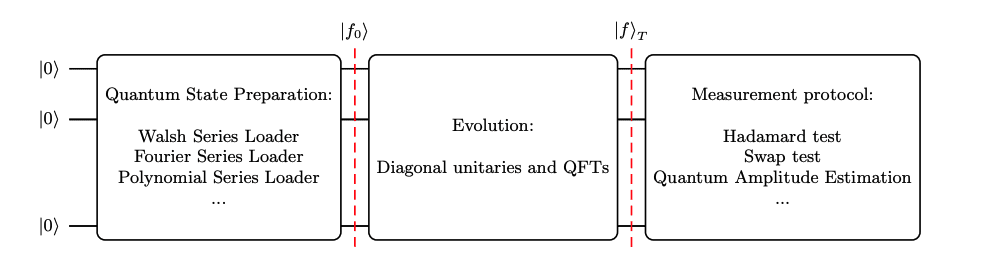
The team addresses the multidimensional transport equation, a fundamental equation in many areas of physics, using a quantum numerical scheme that prepares a quantum state, evolves it according to the equation, and measures relevant properties. This evolution step combines a high-order finite difference method with a time-splitting technique, approximating the solution over time, and novel mathematical analysis bounds the different sources of error.
Explicit Error Bounds for Product Formula Schemes
This work presents a detailed analysis of the error introduced by a numerical scheme used to solve transport equations. The analysis focuses on a product formula, a method for approximating the solution over time, and aims to determine an explicit error bound, indicating how the error changes as the spatial grid and time step are refined. The core idea is to decompose the error into different terms, identifying the dominant factors that contribute to inaccuracy. The analysis. To achieve a desired level of accuracy, the number of time steps should scale with the square of the final time, and the spatial grid spacing should scale with the square root of the accuracy, allowing the error to be made arbitrarily small by refining the grid and time step.
Vector Norms Speed Quantum Simulations
This research introduces a new quantum numerical scheme for solving the multidimensional transport equation, involving preparing a quantum state, evolving it according to the equation, and measuring relevant properties, combining a high-order finite difference approach with a time-splitting technique. Crucially, the analysis demonstrates that using vector norm analysis for approximations requires significantly fewer computational steps than traditional methods, potentially reducing the resources needed for simulations.
The researchers validated their approach through numerical simulations, including solving a non-linear equation via its associated equation, and demonstrated its feasibility on real quantum hardware for a one-dimensional equation. These results suggest a practical framework for efficiently simulating transport phenomena on quantum computers, with potential applications in fields like plasma physics, molecular gas dynamics, and chaotic systems. However, implementing these schemes on current quantum devices remains a challenge.
👉 More information
🗞 Trotter-based quantum algorithm for solving transport equations with exponentially fewer time-steps
🧠 ArXiv: https://arxiv.org/abs/2508.15691