Electron transfer, a fundamental process in biology and materials science, remains notoriously difficult to simulate accurately, particularly within complex, noisy environments. Marvin Gajewski, Alejandro D. Somoza, and colleagues at the German Aerospace Center (DLR), along with collaborators from HQS Quantum Simulations GmbH, now demonstrate a scalable approach to modelling this process using quantum computers. The team successfully simulates electron transfer between a single donor and up to nine acceptor sites on a superconducting processor, leveraging the inherent noise within the system to their advantage. This work reveals a probability of electron transfer that aligns with classical calculations, and importantly, establishes a clear link between hardware capabilities, specifically the number of qubits and gate fidelity, and the ability to accurately simulate complex quantum phenomena, offering a new benchmark for assessing the progress of quantum computing hardware.
Simulating large electronic networks with vibrational environments remains a fundamental challenge, due to the long lifetimes of electronic-vibrational excitations on the picosecond scale. Quantum computers represent a promising platform to simulate the dynamics of open quantum systems, aided by intrinsic hardware-noise, with successful demonstrations of models with two electronic sites. A central theme is the behavior of open quantum systems, where interactions with the environment lead to complex dynamics, including non-Markovian behavior. Significant attention is given to charge and energy transfer, investigating how these processes occur within molecular systems, especially in light-harvesting complexes and organic photovoltaics, and the role of molecular vibrations in facilitating or hindering these processes. Many studies focus on simulating these complex quantum dynamics, both using classical computational methods and increasingly, with quantum computers.
This includes developing algorithms and techniques for efficient and accurate simulation, as well as addressing the challenges of errors that arise when simulating quantum systems on current, noisy quantum computers, with a growing area of research dedicated to mitigating these errors. Spectroscopic methods are also used to probe the underlying quantum dynamics, providing experimental validation and refinement of theoretical models. Key areas of research include understanding non-Markovian dynamics, combining classical and quantum computational methods, developing error mitigation techniques, and using spectroscopic probes to validate theoretical models. Researchers are also investigating materials design, aiming to create materials with optimized charge and energy transfer properties for applications in solar energy, organic electronics, and other fields, while prioritizing understanding the role of quantum coherence and decoherence in enhancing or suppressing charge and energy transfer.
Quantum Simulation Validates Electron Transfer Predictions
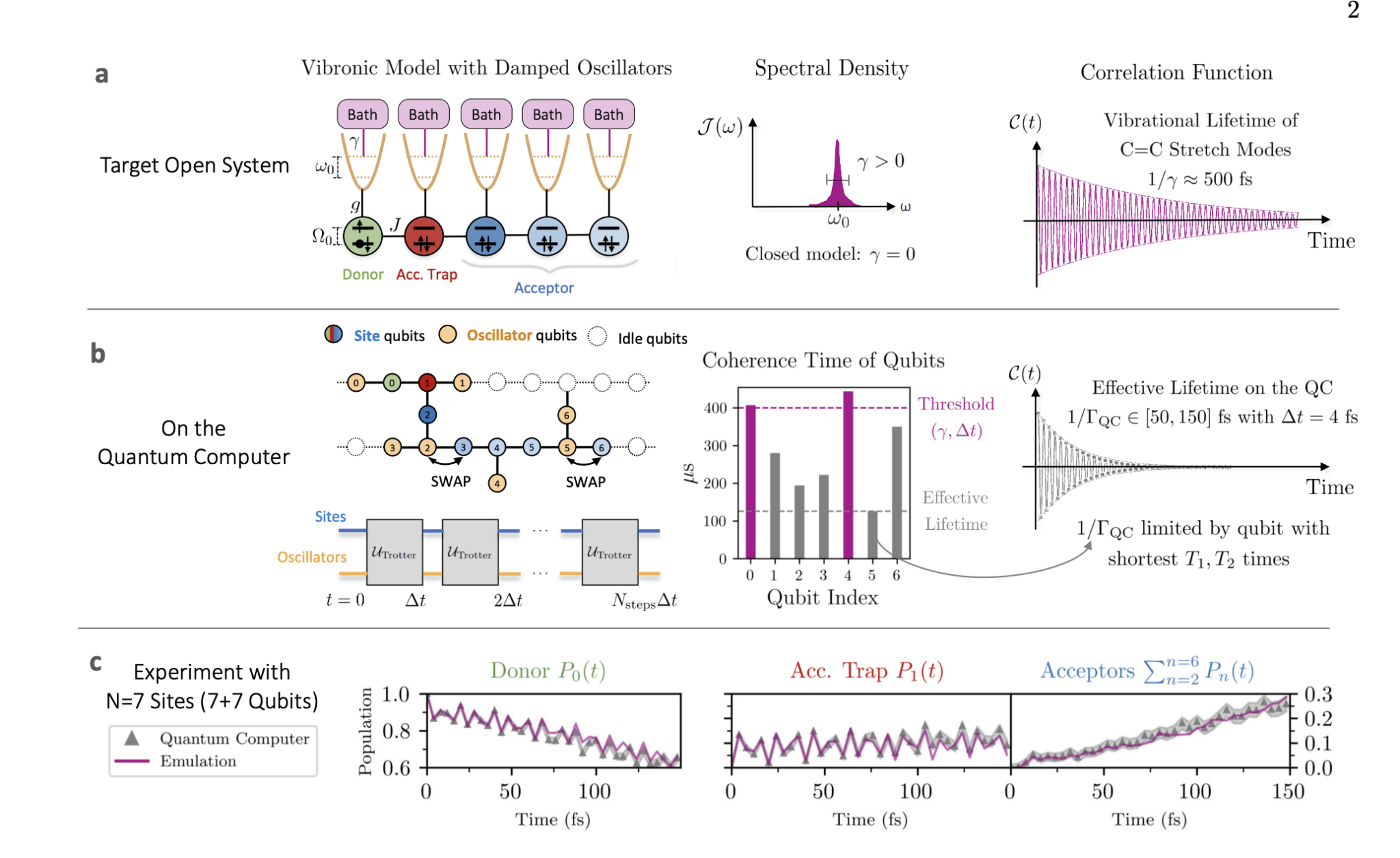
Researchers have achieved a significant breakthrough in simulating complex electronic networks using quantum computers, successfully modeling electron transfer (ET) with a single donor and up to nine acceptor sites. This simulation, performed on a superconducting processor, demonstrates a crucial step towards understanding and optimizing energy transfer processes at the molecular level, with the results revealing a probability of electron transfer that aligns closely with predictions from classical calculations, validating the quantum simulation approach and confirming the identification of electronic and vibronic transfer resonances. The team conducted rigorous experiments, repeating each simulation ten times on different days to account for fluctuations in hardware error rates, ensuring the reliability and consistency of the findings. A key discovery is that the most critical factor for scaling up these simulations is the availability of a large number of qubits connected by high-fidelity gates, coupled with coherence times exceeding a specific threshold dictated by the target open system, which is essential for accurately representing the dynamics of the simulated system. The maximum system size for which the hardware produces accurate results directly quantifies its capacity to generate and sustain entanglement, demonstrating a clear link between hardware performance and the ability to model complex quantum phenomena, and paving the way for designing novel materials with enhanced energy storage and transport properties, offering potential applications in batteries, photovoltaics, and other advanced technologies.
Simulating Vibronic Electron Transfer on Quantum Hardware
This research successfully demonstrates a method for simulating the dynamics of an open quantum system, specifically vibronically assisted electron transfer, on a superconducting quantum computer. By leveraging the inherent damping within the hardware and applying a model-specific error mitigation scheme, the team reproduced vibronic electron transfer in systems ranging from three to ten sites, with the results aligning with classical calculations and accurately resolving the expected transfer probabilities as a function of driving force. This work highlights the potential of quantum computers to model complex quantum phenomena, particularly those involving entanglement, and offers a new approach to hardware design that utilizes native bosonic elements with controllable damping rates. The primary limitation identified is the need for a larger number of qubits connected by high-fidelity gates, alongside improved qubit coherence times, to simulate larger and more complex systems. Future improvements in quantum hardware are expected to enable the simulation of even larger system sizes, potentially addressing industrially relevant challenges such as the design of new energy materials where long-lived correlations are crucial, and providing a benchmark for quantifying the capacity of quantum computers to sustain and scale entanglement.
🗞 Simulating Electron Transfer on Noisy Quantum Computers: A Scalable Approach to Open Quantum Systems
🧠 ArXiv: https://arxiv.org/abs/2508.18141