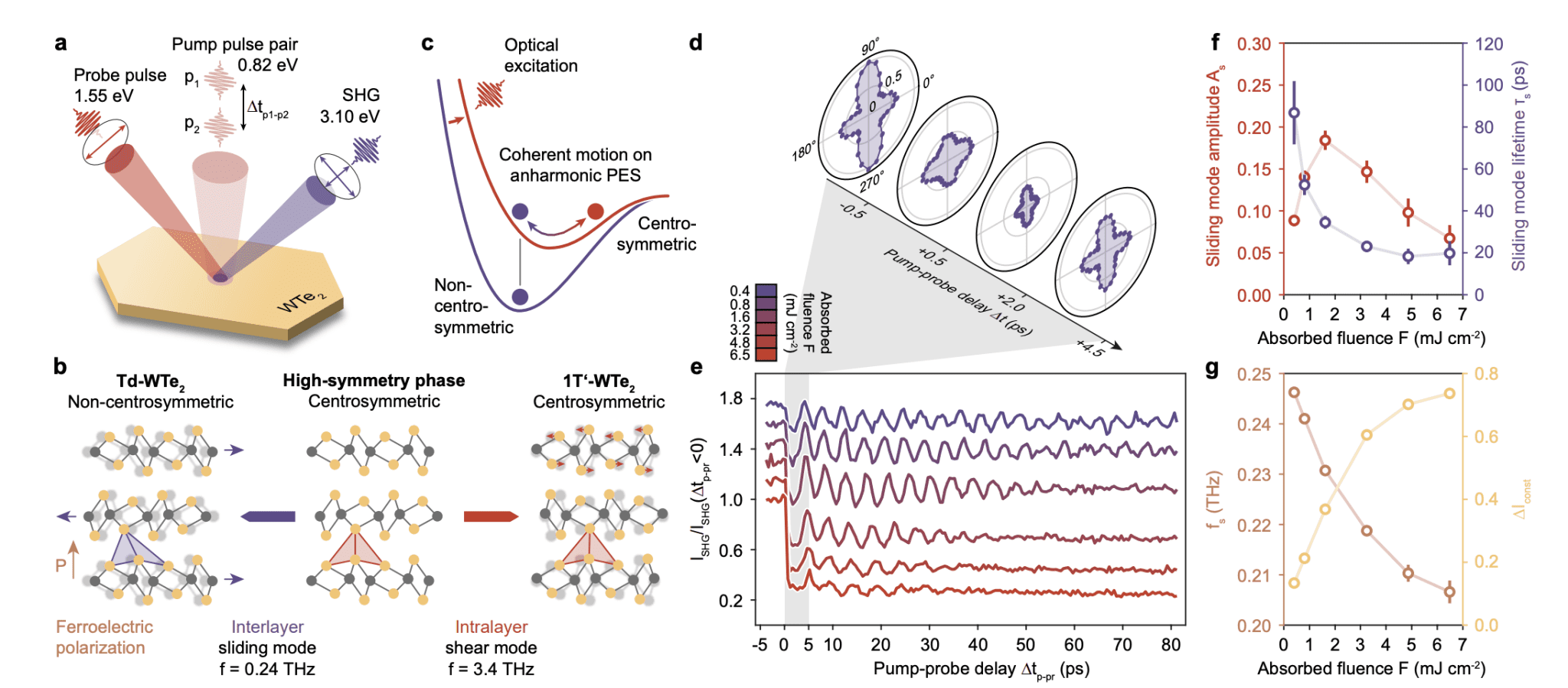
Nonlinear effects typically amplify signals or create instability, but often act as limiting factors in physical systems, suppressing responses below expected levels, much like the failure of Hooke’s law under extreme stress. Jan Gerrit Horstmann from ETH Zurich, Christoph Emeis from Kiel University, and colleagues demonstrate a method to overcome these limitations when controlling lattice vibrations in materials. The team investigates how to drive large-amplitude vibrations, essential for accessing novel states in materials, without hitting a saturation point where the response weakens. By employing a sequential, two-pulse optical technique on the van der Waals ferroelectric Td-WTe, researchers successfully bypass the typical nonlinear bottlenecks, achieving higher vibrational amplitudes and unlocking a new regime for studying the interplay between vibrations and electronic properties, revealing previously hidden behaviour under non-equilibrium conditions.
Nonlinearity is often associated with amplification, instability, or emergent behaviour, where small inputs produce disproportionately large outputs. Yet in many physical systems, nonlinearities act as limiting mechanisms, suppressing the response below linear expectations, as exemplified by the breakdown of Hooke’s law at large forces. These limiting effects become significant when controlling quantum materials with light, where large-amplitude lattice motion is essential for reaching functional states far from equilibrium. Displacive excitation of coherent phonons, a widely used control strategy, typically assumes linearity. This assumption, however, neglects the possibility that strong excitation may trigger nonlinear responses, potentially hindering the desired control. Understanding these nonlinearities is therefore crucial for optimising control protocols and achieving targeted manipulation of quantum materials.
Coherent Phonon Control in WTe2 Material
This research details a comprehensive effort to understand and control phonon dynamics in the material WTe₂, with broader implications for ultrafast materials science and phonon engineering. The primary goal is to investigate the potential for coherent control of phonons in WTe₂ using tailored optical excitation, aiming to manipulate phonon vibrations with light and unlock new functionalities. The research is motivated by a desire to move beyond simply observing phonon dynamics and to actively control them, opening doors for applications in ultrafast information processing, sensing, and energy harvesting. WTe₂ is chosen as a model system due to its unique electronic and structural properties, including a layered structure and potential for topological electronic states.
Its anisotropic crystal structure and strong electron-phonon coupling make it a promising candidate for observing and controlling phonon behaviour. The research relies on density functional theory (DFT) and related methods to calculate the material’s electronic structure, phonon dispersion, and electron-phonon coupling. Researchers demonstrate that WTe₂ exhibits highly anisotropic phonon behaviour due to its layered structure, which plays a crucial role in determining the material’s response to optical excitation. The material possesses strong electron-phonon coupling, essential for controlling phonon dynamics.
Researchers demonstrate the possibility of selectively exciting specific phonon modes in WTe₂ using tailored optical pulses. Calculations reveal complex non-equilibrium phonon dynamics after optical excitation, including energy redistribution among different phonon modes and the formation of hot phonons. The theoretical results suggest that coherent control of phonons in WTe₂ is possible by carefully controlling the amplitude, polarization, and duration of the optical excitation. The research also explores the possibility of activating chiral phonon emission through strain engineering, potentially leading to new functionalities. The importance of considering anharmonic effects in accurately describing phonon dynamics is highlighted.
Sequential Excitation Unlocks Large Phonon Amplitudes
Researchers demonstrate a breakthrough in controlling vibrational motion within the van der Waals ferroelectric material, Td-WTe₂, overcoming limitations that previously restricted the amplitude of lattice vibrations. The team discovered that sequentially exciting a key phonon mode, the interlayer sliding motion governing ferroelectricity, circumvents a saturation effect that typically arises with single, intense optical pulses. Experiments utilizing time-resolved second harmonic generation revealed that this sequential excitation avoids populating counteracting electronic states, enabling significantly higher phonon amplitudes for the same optical energy input. This enhanced lattice response allows for high-amplitude vibrational spectroscopy, unveiling a novel form of anharmonic phonon coupling that emerges only when the system is far from equilibrium.
Specifically, the data shows a strong correlation between the sliding mode’s amplitude, damping, and frequency, directly indicating this new coupling mechanism mediated by coherent nuclear motion. Researchers observed a modulation of the trSHG signal at twice the sliding mode frequency, signaling a strong, lattice-driven modulation of electronic states and nonlinear optical properties, an effect previously obscured by limited vibrational amplitudes. The team traced the amplitude limit of the coherent sliding phonon to the occupation of high-lying electronic states, demonstrating that re-excitation of vibrational coherences following electronic relaxation circumvents this saturation threshold. This approach enables access to nonlinear lattice phenomena and establishes a more general understanding of electron-phonon and phonon-phonon coupling under extreme conditions, opening new possibilities for ultrafast ferroic switching and precise lattice control in quantum materials.
Sustained Vibrations Unlock Material Insights
This research demonstrates that carefully timed, sequential optical pulses can overcome limitations in controlling atomic vibrations within the material tungsten ditelluride. The team discovered that single pulses of light, while initially effective at inducing vibrations, quickly reach a saturation point due to the complex interaction between electrons and these vibrations. By splitting the energy of a single pulse into two, delivered in quick succession, researchers were able to sustain and amplify these vibrations, achieving larger vibrational amplitudes than previously possible. This enhanced control of atomic motion allows for a new form of vibrational spectroscopy, revealing previously hidden details about how these vibrations interact with the material’s electronic properties when far from equilibrium.
The findings suggest this technique is broadly applicable to other materials and could be used to explore novel states of matter and develop faster, more energy-efficient methods for controlling material properties. Researchers acknowledge that understanding how these enhanced vibrations decay over time is crucial for further advancements, and they highlight the importance of amplitude-dependent damping as a key factor influencing both phonon lifetimes and energy transfer. Future work will focus on exploring these decay mechanisms and leveraging this enhanced vibrational control to manipulate both the topology and ferroelectric properties of functional materials.
👉 More information
🗞 Coherent phonon control beyond amplitude saturation
🧠 ArXiv: https://arxiv.org/abs/2508.16422