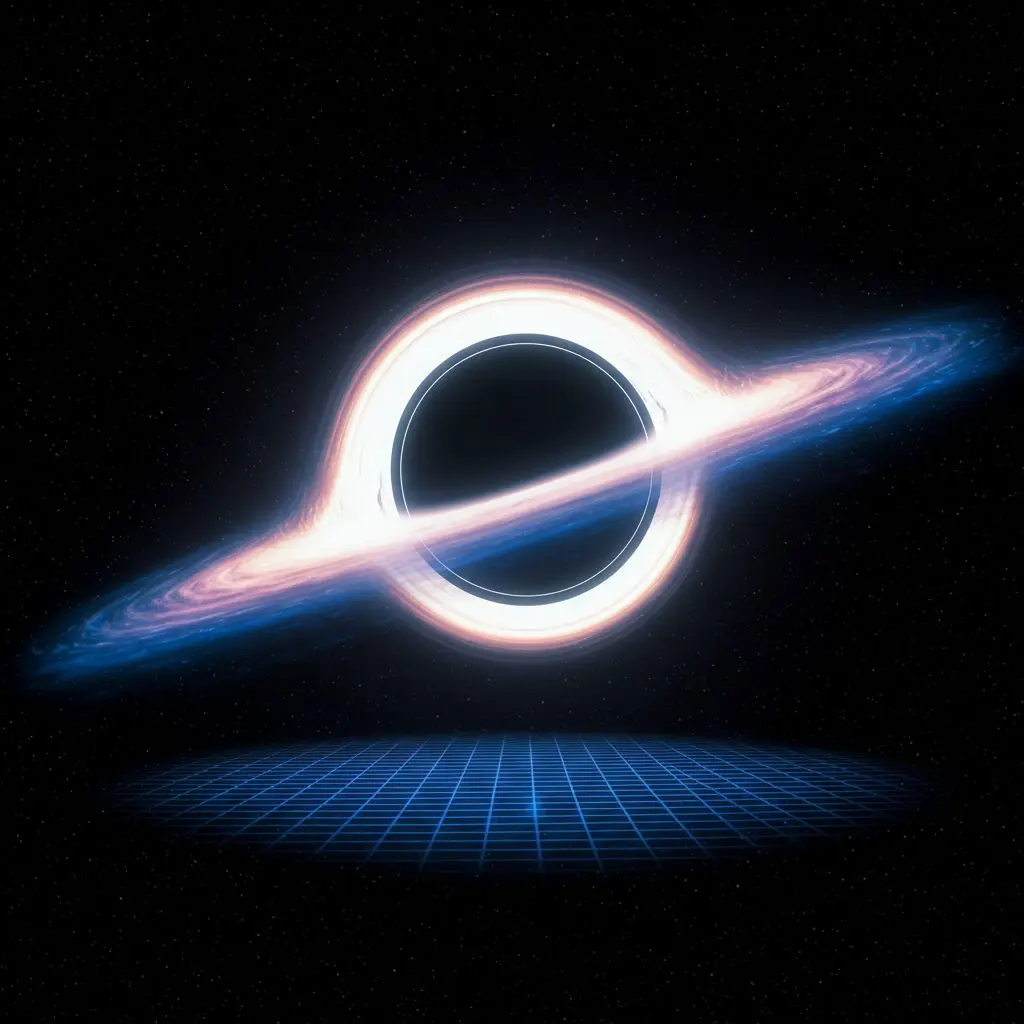
The subtle distortions of light around black holes offer a unique window into the universe’s most extreme environments, and new research focuses on how magnetic fields surrounding these objects influence their observable ‘shadows’. Heena Ali and Sushant G. Ghosh, both from the Centre for Theoretical Physics at Jamia Millia Islamia, alongside Sushant G. Ghosh from the University of KwaZulu-Natal, investigate these effects using detailed modelling of magnetized Kerr black holes. Their work demonstrates that the size and shape of a black hole’s shadow change predictably with the strength of the surrounding magnetic field, creating observable differences from the shadows cast by non-magnetized black holes. This discovery is significant because it provides a potential method for astronomers to not only confirm the existence of magnetic fields around black holes, but also to measure their strength and orientation, offering valuable insights into the powerful forces at play in the strong-gravity regime.
Black Hole Theory and Observational Tests
This extensive collection of research focuses on black hole physics, particularly the observational signatures of these enigmatic objects, theoretical modelling of their behaviour, and rigorous tests of general relativity in extreme gravitational environments. The bibliography encompasses foundational work on black hole solutions, investigations into strong-field gravity, and the thermodynamics of black holes, alongside explorations of alternative theories of gravity and their implications. A significant portion of the research centres on the Event Horizon Telescope (EHT) and its groundbreaking observations of M87* and Sagittarius A*, analysing the resulting images and constraints on black hole parameters. Researchers meticulously study the shape and size of black hole shadows, crucial for validating general relativity, and investigate the complex physics of accretion disks and jets surrounding black holes, which contribute significantly to observed emissions.
The polarization of light around black holes, observed by the EHT, provides additional insights into magnetic fields and plasma environments, while gravitational lensing effects offer a means to study black hole properties. The bibliography also delves into more exotic concepts, including rotating, charged, and non-Kerr black holes, exploring wormholes and alternative solutions to Einstein’s equations. Numerical relativity, perturbation theory, and ray tracing are employed to model black hole behaviour and predict observed images, while magnetohydrodynamics helps understand the behaviour of plasmas and magnetic fields. Quasinormal modes, the characteristic frequencies of black hole oscillations, are also investigated, alongside gravitational wave astronomy, which offers a new window into black hole mergers and tests of general relativity. This research represents a concerted effort to push the boundaries of our understanding of black holes and gravity, combining theoretical modelling, numerical simulations, and observational data.
Photon Trajectories Around Magnetised Kerr Black Holes
Researchers investigate the shadows cast by Magnetised Kerr Black Holes (MKBHs), developing a new approach to determine their properties and distinguish them from standard Kerr black holes. The team begins with the MKBH metric, a mathematical description of spacetime around a rotating black hole permeated by a magnetic field, defined by its mass, spin, and magnetic field strength. This metric accurately models spacetime geometry and possesses bounded ergoregions and a uniform electromagnetic field, providing a more realistic representation of astrophysical black holes. To map the black hole shadows, scientists calculate the paths of photons around the MKBH, a process requiring solutions to complex equations governing light propagation in curved spacetime.
They then use ray-tracing techniques to compute the resulting shadow shapes, carefully accounting for the influence of the magnetic field on photon trajectories, and systematically explore how variations in the black hole’s spin and magnetic field strength alter the shadow’s morphology. Researchers specifically examine how increasing the magnetic field enlarges the shadow and introduces distortions, revealing subtle but measurable differences from non-magnetised black holes. The analysis focuses on quantifying shadow characteristics, including area and oblateness, and generating contour plots to facilitate parameter estimation, essentially creating a map to determine the black hole’s mass, spin, and magnetic field strength from observed shadow properties. Scientists also investigate how the observed shadow changes depending on the observer’s position, demonstrating that distant observers perceive a shadow approaching its theoretical shape, while closer observers detect significant deviations. These detailed calculations and analyses enable researchers to identify observational signatures that could distinguish MKBHs from Kerr black holes, offering a pathway to probe magnetic effects in the strong-gravity regime and test the predictions of general relativity.
Magnetic Fields Distort Black Hole Shadows
Researchers have investigated magnetized Kerr black holes (MKBHs), discovering how external magnetic fields fundamentally alter spacetime geometry and impact the appearance of black hole shadows. These spacetimes, described by the Einstein-Maxwell equations, deviate from the standard Kerr solution and introduce a new parameter, B, quantifying the magnetic field strength. The team demonstrates that increasing the magnetic field parameter B enlarges the black hole shadow while simultaneously creating distortions, particularly noticeable at higher spin rates. Detailed analysis of shadow observables, including area and oblateness, allows for the creation of contour plots that facilitate parameter estimation for MKBHs.
The research shows that the shadow size increases with increasing B, and the distortion is affected by both the black hole’s spin and the observer’s position. For distant observers, the shadow approaches a stable shape, but closer observers perceive significant deviations from the standard Kerr shadow. The findings demonstrate that MKBH shadows encode clear imprints of magnetic deviations, offering a potential method to distinguish Kerr black holes from those with modified spacetime. For a black hole with a mass of 6. 5 x 10 9 solar masses, a magnetic field parameter of B = 0.
1 corresponds to approximately 1. This range of B, up to 0. 3, is considered astrophysically feasible, aligning with estimates derived from jet power and theoretical limits for horizon stability. The research highlights the importance of considering magnetic fields in strong-gravity regimes, as these fields directly contribute to spacetime geometry, unlike previous models that only incorporated magnetic effects through emissivity and opacity. The team’s work provides a framework for measuring the effects of external fields on parameter estimation, shadow morphology, and photon region perturbation, paving the way for more accurate characterization of black holes in the universe.
Magnetic Field Distorts Black Hole Shadows
Researchers have investigated the shadows cast by magnetised Kerr black holes, exploring how the presence of a magnetic field alters their appearance. The team demonstrates that increasing the magnetic field strength enlarges the black hole shadow and introduces distortions, particularly at higher spin rates. These changes in shadow morphology are quantifiable through measurements of shadow area and oblateness, providing a means to estimate the magnetic field strength and spin of the black hole. Importantly, the study reveals that the perceived shadow shape depends on the observer’s position, with distant observers seeing a more standard shadow shape while closer observers detect significant deviations. The findings suggest that the shadows of magnetised Kerr black holes contain information about the magnetic field surrounding them, offering a potential method to distinguish these objects from simpler Kerr black holes and to probe strong gravitational effects.
🗞 Parameter Estimation of Magnetised Kerr Black Holes Using Their Shadows
🧠 ArXiv: https://arxiv.org/abs/2508.15862