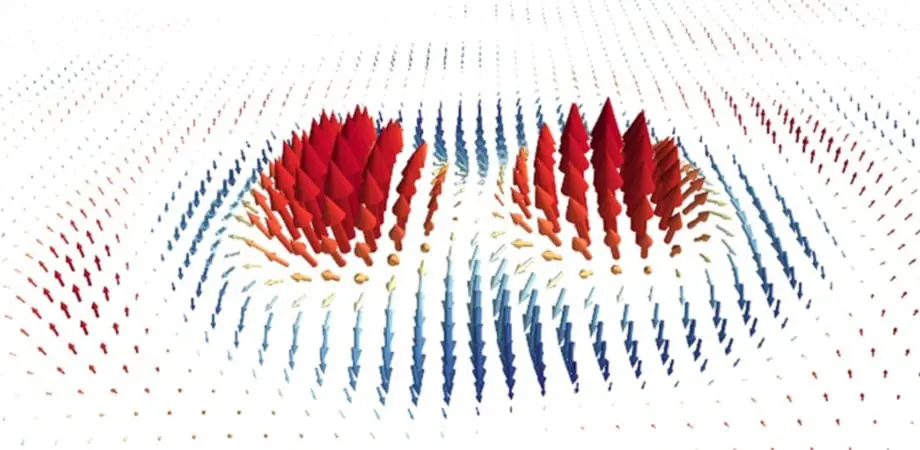
Researchers have made a crucial advancement in understanding complex spin structures at extremely short timescales using a novel technique called time-resolved polarimetric electron microscopy. This method, developed by an international team of scientists including P Dreher, enables the capture of the full electric field of plasmonic waves with unprecedented accuracy.
Plasmons, collective oscillations of electrons in solids, are vital for various applications such as sensing and light harvesting. The team’s innovative approach involves using multiple time-delayed laser pulses of different polarizations to study surface plasmon polaritons, which travel along metal surfaces. By applying this technique to a specific spin texture known as a meron pair, the researchers were able to reconstruct its topological properties and demonstrate its stability despite rapid rotations of electric and magnetic field vectors.
Introduction to Time-Resolved Polarimetric Electron Microscopy
Time-resolved polarimetric electron microscopy is a novel technique developed to study complex spin structures at extremely short timescales, specifically at femtosecond timescales. This method utilizes ultrashort laser pulses to observe the behavior of plasmonic waves, which are collective oscillations of electrons in a solid. Plasmons are crucial for various applications, including sensing, catalysis, and light harvesting. The technique employed by an international research team has pushed the boundaries of time-resolved electron microscopy, allowing for the capture of the full electric field of plasmonic waves with unprecedented accuracy.
The researchers used multiple time-delayed laser pulses of four different polarizations to achieve this level of accuracy. This approach enabled them to investigate a spin texture known as a meron pair, a topological structure where the direction of the spin texture only covers half of a sphere. Unlike skyrmions, whose spin covers the entire sphere, merons are distinct and have been the subject of interest in recent studies. The ability to reconstruct the spin texture from the experiment required the electric and magnetic field vectors of the surface plasmon polaritons, which were either directly measured or calculated based on the electric field’s behavior over time and space.
The study demonstrated that the spin texture remains stable throughout the plasmonic pulse, despite the fast rotation of the electric and magnetic field vectors. This stability is crucial for understanding the topological properties of these structures, such as the Chern number, which describes the number of times the spin texture maps onto a sphere. In this case, the Chern number was found to be one, indicating the presence of a meron pair. The research team’s findings have significant implications for the study of complex surface plasmon polariton fields and their topological properties, particularly at the nanoscale.
The technique developed by the researchers is not limited to meron pairs and can be applied to other complex surface plasmon polariton fields. Understanding these fields and their topological properties is essential for maintaining the stability of materials and devices, especially at the nanoscale where topological protection plays a critical role. The ability to accurately reconstruct the full electric and magnetic fields of surface plasmon polaritons opens new possibilities for exploring the topological properties of electromagnetic near fields, which may have important implications for future technologies.
Spin Textures and Topological Properties
Spin textures, such as meron pairs, are complex structures that exhibit unique topological properties. These properties are characterized by the Chern number, which describes the number of times the spin texture maps onto a sphere. In the case of meron pairs, the Chern number is one, indicating that the spin texture only covers half of a sphere. The study of these spin textures is crucial for understanding their behavior and stability, particularly at the nanoscale. The researchers’ ability to reconstruct the spin texture from the experiment required a deep understanding of the electric and magnetic field vectors of the surface plasmon polaritons.
The topological properties of spin textures are essential for maintaining the stability of materials and devices. At the nanoscale, topological protection can help prevent the degradation of materials and devices due to external factors such as temperature or magnetic fields. The study of spin textures and their topological properties is an active area of research, with potential applications in the development of new materials and devices with unique properties. The researchers’ findings have contributed significantly to this field, demonstrating the importance of understanding the behavior of complex surface plasmon polariton fields and their topological properties.
The reconstruction of the spin texture from the experiment required a precise understanding of the electric and magnetic field vectors of the surface plasmon polaritons. The researchers used multiple time-delayed laser pulses of four different polarizations to capture the full electric field of these waves. This approach enabled them to calculate the magnetic field vectors based on the electric field’s behavior over time and space. The resulting spin texture was found to be stable throughout the duration of the plasmonic pulse, despite the fast rotation of the electric and magnetic field vectors.
The study of spin textures and their topological properties has significant implications for the development of new materials and devices. The ability to control and manipulate these structures could lead to the creation of materials with unique properties, such as enhanced stability or novel optical properties. The researchers’ findings have demonstrated the importance of understanding the behavior of complex surface plasmon polariton fields and their topological properties, particularly at the nanoscale.
Applications of Time-Resolved Polarimetric Electron Microscopy
The development of time-resolved polarimetric electron microscopy has significant implications for various fields, including materials science, physics, and engineering. The ability to study complex spin structures at extremely short timescales could lead to a deeper understanding of the behavior of materials and devices at the nanoscale. This knowledge could be used to develop new materials and devices with unique properties, such as enhanced stability or novel optical properties.
The technique developed by the researchers could be applied to various areas, including the study of magnetic materials, superconductors, and topological insulators. The ability to reconstruct the spin texture from the experiment could provide valuable insights into the behavior of these materials, particularly at the nanoscale. The researchers’ findings have demonstrated the importance of understanding the topological properties of complex surface plasmon polariton fields, which could lead to the development of new devices with unique properties.
The study of spin textures and their topological properties is an active area of research, with potential applications in the development of new materials and devices. The ability to control and manipulate these structures could lead to the creation of materials with enhanced stability or novel optical properties. The researchers’ findings have contributed significantly to this field, demonstrating the importance of understanding the behavior of complex surface plasmon polariton fields and their topological properties.
The development of time-resolved polarimetric electron microscopy has opened new possibilities for exploring the topological properties of electromagnetic near fields. This knowledge could be used to develop new devices with unique properties, such as enhanced stability or novel optical properties. The researchers’ findings have significant implications for various fields, including materials science, physics, and engineering, and could lead to the development of new materials and devices with unique properties.
Future Directions and Implications
Studying complex spin structures at extremely short timescales has significant implications for various fields, including materials science, physics, and engineering. The ability to reconstruct the spin texture from the experiment could provide valuable insights into the behavior of materials and devices at the nanoscale. The researchers’ findings have demonstrated the importance of understanding the topological properties of complex surface plasmon polariton fields, which could lead to the development of new devices with unique properties.
The technique developed by the researchers could be applied to various areas, including the study of magnetic materials, superconductors, and topological insulators. The ability to control and manipulate spin textures could lead to the creation of materials with enhanced stability or novel optical properties. The researchers’ findings have contributed significantly to this field, demonstrating the importance of understanding the behavior of complex surface plasmon polariton fields and their topological properties.
The development of time-resolved polarimetric electron microscopy has opened new possibilities for exploring the topological properties of electromagnetic near fields. This knowledge could be used to develop new devices with unique properties, such as enhanced stability or novel optical properties. The researchers’ findings have significant implications for various fields, including materials science, physics, and engineering, and could lead to the development of new materials and devices with unique properties.
The study of spin textures and their topological properties is an active area of research, with potential applications in the development of new materials and devices. The ability to control and manipulate these structures could lead to the creation of materials with enhanced stability or novel optical properties. The researchers’ findings have demonstrated the importance of understanding the behavior of complex surface plasmon polariton fields and their topological properties, particularly at the nanoscale.
Conclusion
In conclusion, the development of time-resolved polarimetric electron microscopy has significant implications for various fields, including materials science, physics, and engineering. The ability to study complex spin structures at extremely short timescales could lead to a deeper understanding of the behavior of materials and devices at the nanoscale. The researchers’ findings have demonstrated the importance of understanding the topological properties of complex surface plasmon polariton fields, which could lead to the development of new devices with unique properties.
The technique developed by the researchers could be applied to various areas, including the study of magnetic materials, superconductors, and topological insulators. The ability to control and manipulate spin textures could lead to the creation of materials with enhanced stability or novel optical properties. The researchers’ findings have contributed significantly to this field, demonstrating the importance of understanding the behavior of complex surface plasmon polariton fields and their topological properties.
The study of spin textures and their topological properties is an active area of research, with potential applications in the development of new materials and devices. The ability to control and manipulate these structures could lead to the creation of materials with enhanced stability or novel optical properties. The researchers’ findings have demonstrated the importance of understanding the behavior of complex surface plasmon polariton fields and their topological properties, particularly at the nanoscale.
The development of time-resolved polarimetric electron microscopy has opened new possibilities for exploring the topological properties of electromagnetic near fields. This knowledge could be used to develop new devices with unique properties, such as enhanced stability or novel optical properties. The researchers’ findings have significant implications for various fields, including materials science, physics, and engineering, and could lead to the development of new materials and devices with unique properties.
External Link: Click Here For More