Researchers at Bluefors have made a breakthrough discovery about the thermal noise caused by qubit control lines, a crucial component in quantum computers. In a paper published in PRX Quantum, the team revealed quantitative and device-independent measurements of the power radiated to a quantum processor from its control lines, providing new insights into the impact of this noise on real qubit operations.
The study, led by Bluefors’ Quantum Applications team, used a sensitive thermal detector and a cryogenic blackbody source to measure the radiative heating introduced by five typical qubit control lines. The results show that commonly used cryogenic wiring components provide a sufficiently low level of thermal noise for near-term quantum computing applications. This finding sets the stage for more accurate noise modeling in novel quantum computer interfacing methods, thanks to its device-agnostic approach.
Thermal Noise in Qubit Control Lines: A Fundamental Challenge in Quantum Computing
Quantum computers, with their promise of exponential scaling and unparalleled computational power, are notoriously sensitive to noise. One of the primary sources of this noise is thermal photons that infiltrate the quantum chip, causing qubits to decay. To mitigate this effect, researchers employ shielded environments cooled to ultra-low temperatures near absolute zero. However, this raises a fundamental question: how can information be sent and received while maintaining perfect isolation?
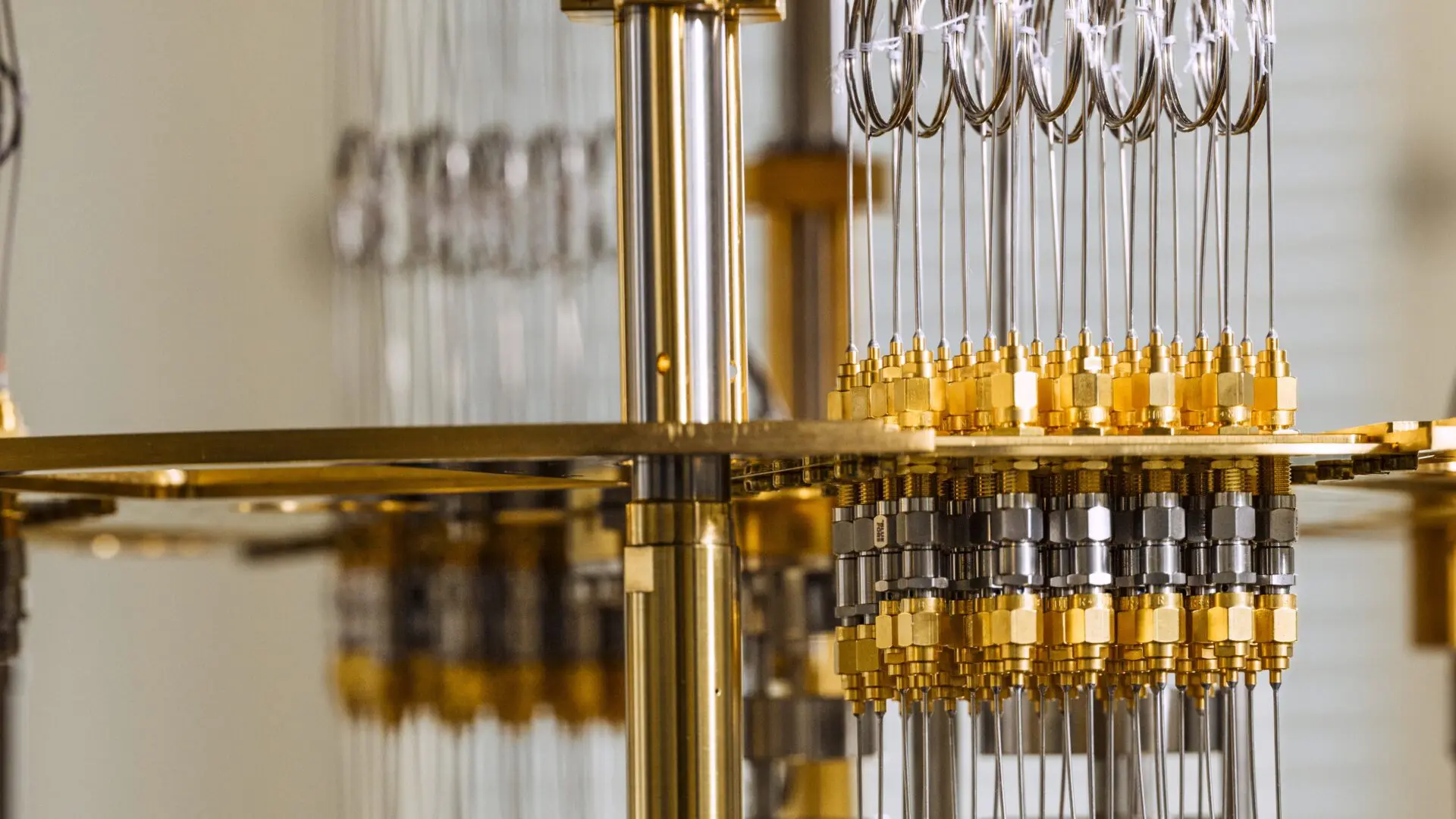
The answer lies in “wiring up” the qubits, which involves transmitting signals across vast temperature gradients to connect with sensitive quantum hardware. These wires must pass through shielding and plug into the quantum device, introducing heat and noise to the system. Even a few excess photons of noise can significantly affect qubit dynamics.
Characterizing Noise in Qubit Control Lines
Accurate measurements of radiative heating from cryogenic wiring have been difficult to acquire with conventional power sensing methods. To address this challenge, researchers from Bluefors’ Quantum Applications team installed a sensitive thermal detector at the coldest stage of the cryogenic system and calibrated its response with a cryogenic blackbody source. The detector used was a coaxially coupled, ultrasensitive nanobolometer, which was calibrated using a Cryogenic Variable-Temperature Noise Source.
The team performed a systematic study to investigate five varieties of typical qubit control lines that spanned the whole temperature range from room temperature to the coldest part of the cryogenic environment at the millikelvin stage. During measurements, the lines were connected to the detector one by one, accurately recording both the steady-state power and dynamic properties of the noise that qubits experience under standard operating conditions.
The experimental results represent a new addition to the literature in the form of a large dataset of noise temperature data for typical drive lines exhibited in unprecedented clarity. This dataset accesses the thermodynamical properties of the lines, including their thermal time constants and heat capacities.
Previous studies measured noise by observing the degradation of specific qubit devices’ performance. In contrast, the new results were obtained using a cryogenic power sensor with a high dynamic range that is agnostic to any specific qubit implementation.
Impact on Qubits and Outlook
The measured thermal latencies of the lines were significantly longer than typical pulse durations in qubit control, and therefore do not pose an issue to quantum algorithms at present. The results from the steady-state measurements were fed to a quantum mechanical model that treats the measurement system and quantum device within the holistic framework of open quantum systems.
Based on this analysis, the researchers inferred the effect of self-heating in the wires during individual control operations on the qubit. Considering steady-state noise levels, it was found that typical single- and two-qubit control operations are not affected significantly. In other words, such operations can still be performed fast and with high fidelity compared to state-of-the-art, with the caveat that the coupling to the qubit must be selected accordingly.
The study shows that commonly used cryogenic wiring components provide a sufficiently low level of thermal noise for near-term quantum computing applications. Furthermore, the results establish an effective method for evaluating emerging technologies to be used inside quantum computers, including flexible wiring, photonic links, or cryo-CMOS electronics.
External Link: Click Here For More