

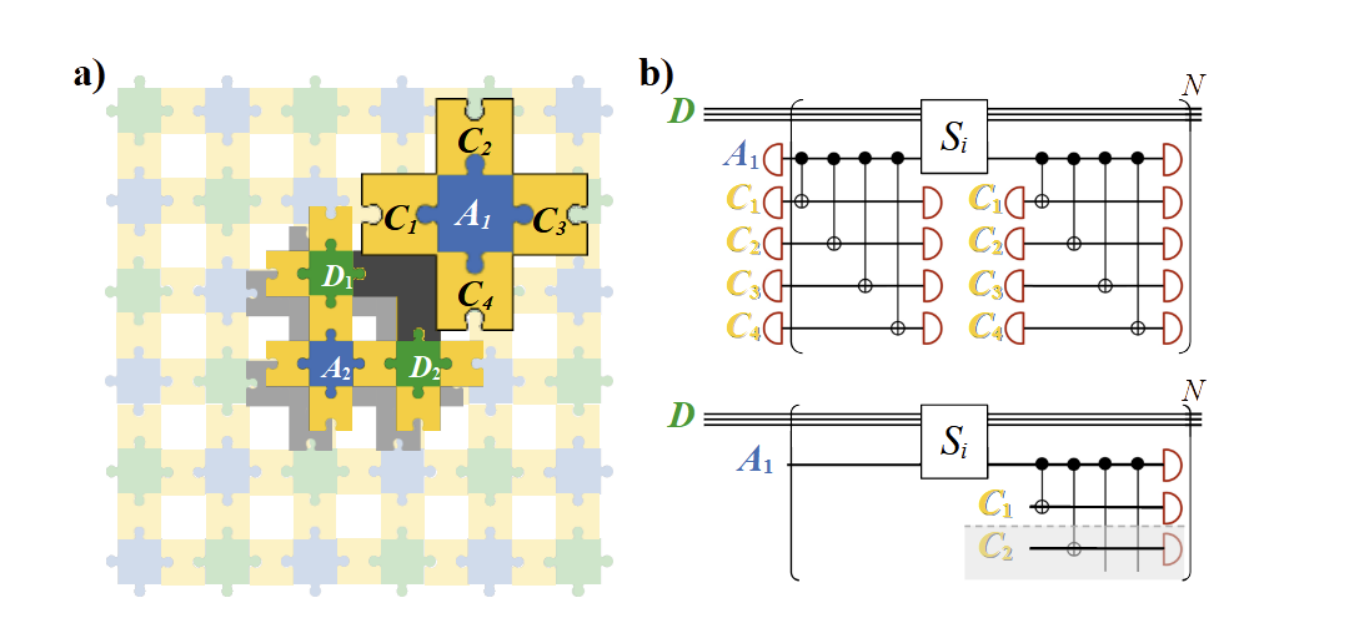
Errors in preparing and measuring qubits represent a major obstacle to building practical quantum technologies, significantly impacting tasks such as quantum algorithms and communication. Jaemin Kim and colleagues at [Institution name(s), not provided in source] now present a new protocol for purifying these noisy quantum operations, effectively reducing errors to negligible levels. The method involves repeatedly performing imperfect quantum operations and distilling out the errors, achieving substantial improvements even with relatively few additional qubits. This purification technique promises to unlock more reliable quantum computation and communication, paving the way for advanced applications with minimal errors in qubit preparation and measurement.
Qubit preparation and measurements contribute significantly to errors in quantum information processing, a challenge particularly critical for tasks such as variational quantum algorithms, quantum error correction, and entanglement distribution through repeaters. This work presents a protocol to purify noisy state preparation and measurement (SPAM), effectively suppressing these errors to an arbitrarily low level. For instance, in realistic scenarios where qubits exhibit error rates around 0. 05 in both preparation and measurement, the protocol can suppress error rates up to 10−3 with a single ancilla and 10−6 with four ancillas. The research demonstrates how to distill error-free SPAM by repeating noisy SPAM operations, offering a pathway to improve the fidelity of quantum computations.
Fragile Qubits and Quantum Error Correction
This research addresses a fundamental challenge in quantum computing: the fragility of qubits and the resulting errors that hinder reliable computation and communication. Quantum systems are incredibly susceptible to noise, which can corrupt the delicate quantum states used to store and process information. Quantum error correction is therefore essential to protect this information and enable practical quantum technologies. The team focuses on mitigating errors arising from the initial preparation and measurement of qubits, known as SPAM errors, which are particularly problematic for building scalable quantum networks.
These networks rely on distributing entanglement, a uniquely quantum connection between particles, over long distances, and SPAM errors degrade the quality of this entanglement. The research explores how to build robust quantum networks by actively correcting these errors. The team’s work builds upon existing concepts in quantum error correction, such as stabilizer codes, and leverages the principles of entanglement swapping to extend the range of quantum communication. Entanglement swapping allows researchers to create entanglement between distant qubits without directly sending them across long distances, but it is vulnerable to errors if the initial qubit states are imperfect.
The research acknowledges that current quantum computers are still in the Noisy Intermediate-Scale Quantum (NISQ) era, meaning they have limited qubit numbers and high error rates. This necessitates the development of error mitigation techniques that can function effectively in the presence of noise. A key innovation presented in the research is a method for purifying noisy measurements, improving the fidelity of entanglement distribution and enabling more reliable quantum networking. The method involves strategically repeating measurements and using multiple qubits to identify and correct errors.
The findings demonstrate that the most efficient way to purify noisy measurements is by using only one additional qubit on each side of the network, minimizing the overhead required for error correction. This purification protocol can be used in conjunction with entanglement swapping to extend the range of entanglement distribution, leading to a significant improvement in the fidelity of entanglement distribution and making it possible to create high-quality entangled pairs over longer distances. By improving the fidelity of entanglement distribution, the research paves the way for building larger and more powerful quantum computers and secure quantum communication, with potential applications in drug discovery, materials science, financial modeling, and cryptography.
Purifying Noisy Qubit States with Repetition
Researchers have developed a novel protocol to significantly reduce errors in quantum information processing, specifically addressing the problem of noisy state preparation and measurements, known as SPAM errors. These errors represent a major obstacle to building practical quantum computers and communication networks, as they degrade the reliability of quantum operations. The team’s approach involves strategically repeating noisy SPAM operations alongside a small number of auxiliary qubits, effectively “purifying” the initial quantum state. Experiments demonstrate that this purification process can dramatically suppress error rates.
The core of the technique involves applying a series of controlled-NOT (CNOT) gates and then selectively accepting only those outcomes where all auxiliary qubit measurements register as zero. The team’s findings show that by repeating this process, the fidelity of the purified quantum state converges towards unity, meaning arbitrarily low error rates are achievable. This purification method is not limited to computation; it also has significant implications for quantum communication, enhancing the performance of quantum repeaters and improving the reliability of entanglement distribution, paving the way for secure and long-distance quantum networks. Importantly, the protocol is designed to be feasible with current superconducting qubit technology, leveraging existing resources and minimizing the need for complex hardware modifications, making it a promising candidate for near-term implementation and widespread adoption.
Distilling Fidelity From Noisy Quantum Operations
The research presents a protocol for purifying noisy state preparation and measurements, commonly known as SPAM errors, which significantly limit the performance of quantum information processing tasks. The team demonstrates that these errors can be effectively suppressed to arbitrarily low levels by repeatedly utilising noisy SPAM operations on auxiliary qubits. Specifically, the protocol leverages the resource of imperfect SPAM to distill higher-fidelity states, achieving substantial error reduction with a relatively small number of additional qubits. The findings are particularly relevant for near-term quantum technologies, such as superconducting quantum processors, where SPAM errors are a major obstacle to reliable computation and communication.
By mitigating these errors, the protocol enables the implementation of essential quantum operations like entanglement distillation and swapping, paving the way for building more robust quantum networks and improving the performance of noisy intermediate-scale quantum (NISQ) algorithms and quantum error correction codes. While the protocol requires additional qubits as a resource, the authors show that a modest number are sufficient to achieve significant improvements in fidelity under realistic conditions. Future research could focus on optimising the protocol to minimise this overhead and exploring its performance in more complex quantum circuits, potentially extending the approach to address other types of errors encountered in quantum systems, further enhancing the reliability of quantum information processing.
🗞 Protocol for Purifying Noisy Preparation and Measurements of Qubits
🧠 ArXiv: https://arxiv.org/abs/2508.16136


