Researchers from the University of Queensland and Dahlem Center for Complex Quantum Systems have proposed the first linear-optics noiseless linear amplifier (NLA) protocol that achieves the maximum success probability bound. The protocol, which modifies the Knill-Laflamme-Milburn near-deterministic teleporter into an amplifier, could revolutionize quantum technology. NLAs, which perform the highest quality amplification under quantum physics rules, are crucial for quantum protocols such as quantum communication and quantum error correction. The team’s research could enhance the efficiency of these protocols, although further research is needed to validate and implement the protocol.
What is the Maximum Success Probability Bound for Noiseless Linear Amplification Using Linear Optics?
The research paper by Joshua J Guanzon, Matthew S Winnel, Deepesh Singh, Austin P Lund, and Timothy C Ralph from the Centre for Quantum Computation and Communication Technology School of Mathematics and Physics at The University of Queensland and Dahlem Center for Complex Quantum Systems Freie Universität Berlin, published on 13 June 2024, discusses the maximum success probability bound for noiseless linear amplification using linear optics. The researchers propose the first linear-optics noiseless linear amplifier (NLA) protocol that asymptotically achieves this success probability bound by modifying the Knill-Laflamme-Milburn near-deterministic teleporter into an amplifier.
An amplifier is a device that increases the amplitude of a signal. The most well-known types are electronic amplifiers, which act on current or voltage through transistors and played a central role in the digital technology revolution. The more recent types are quantum amplifiers, which act on quantum states. It remains to be seen whether they will play a similar role in the upcoming quantum technology revolution.
What is a Noiseless Linear Amplifier (NLA)?
A noiseless linear amplifier (NLA) performs the highest quality amplification allowable under the rules of quantum physics. Unfortunately, these same rules conspire against us via the no-cloning theorem, which constrains NLA operations to the domain of probabilistic processes. Nevertheless, they are useful for a wide variety of quantum protocols with numerous proposals assuming access to an optimal NLA device that performs with the maximum possible success probability.
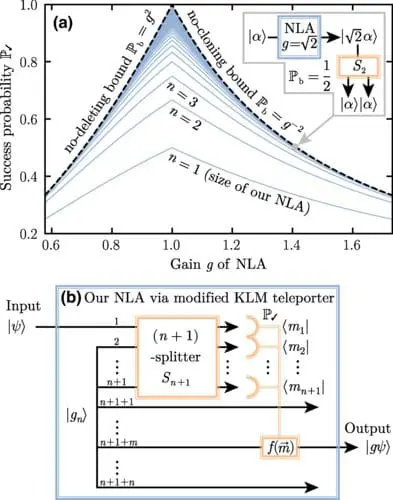
The NLA operation is so powerful that the construction of a deterministic NLA is understood to be impossible. However, it is possible to make probabilistic NLAs with a success probability bound. This is because using a balanced beam splitter, one can produce up to g2 clones of an unknown state. Therefore, to ensure that the no-cloning theorem is not violated, we require that no extra clones are produced on average.
What are the Applications of NLAs?
Despite NLAs being non-deterministic, the unrivaled quality of noiseless amplification means they are often the only path forward for many quantum protocols. This includes applications in quantum communication, quantum repeater networks, quantum entanglement distillation, quantum improved sensing, and quantum error correction. These protocols either presuppose the use of or can be enhanced by a maximally efficient NLA with a success probability equivalent to the bound.
However, it is not apparent how to implement such an efficient NLA in optics, the natural platform for many of these schemes, without strong nonlinear interactions. It was shown in previous research that a maximally efficient NLA could be constructed if we could somehow cause the input light to nondestructively interact with a qubit system, which requires large experimental overheads.
How Can Linear Optical Interactions Achieve the Success Probability Bound?
The researchers prove that linear optical interactions can achieve the success probability bound. There are various methods that can perform the NLA operation with suboptimal success probabilities. The researchers propose the first linear-optics NLA protocol that asymptotically achieves this success probability bound by modifying the Knill-Laflamme-Milburn near-deterministic teleporter into an amplifier.
The input can be any arbitrary single-photon qubit state. The proposal is the Knill-Laflamme-Milburn near-deterministic teleporter, but with the resource state consisting of n single photons entangled among 2n modes being weighted to also amplify the output with gain g. The symmetrical n-1 splitter means nearly all measurements at the photon number-resolving detectors are successful outcomes, except when the total photon number measured is 0 or n-1.
What is the Significance of this Research?
This research is significant as it proposes the first linear-optics NLA protocol that asymptotically achieves the maximum success probability bound. This could potentially revolutionize the field of quantum technology, similar to how electronic amplifiers played a central role in the digital technology revolution. The proposed protocol could enhance the efficiency of various quantum protocols, including quantum communication, quantum repeater networks, quantum entanglement distillation, quantum improved sensing, and quantum error correction. However, further research and experimentation are required to validate and implement this protocol.
Publication Date: 2024-06-13
Authors: Joshua J. Guanzon, Matthew S. Winnel, Deepesh Singh, Austin P. Lund, et al.
Source: PRX Quantum 5, 020359
DOI: https://doi.org/10.1103/PRXQuantum.5.020359