

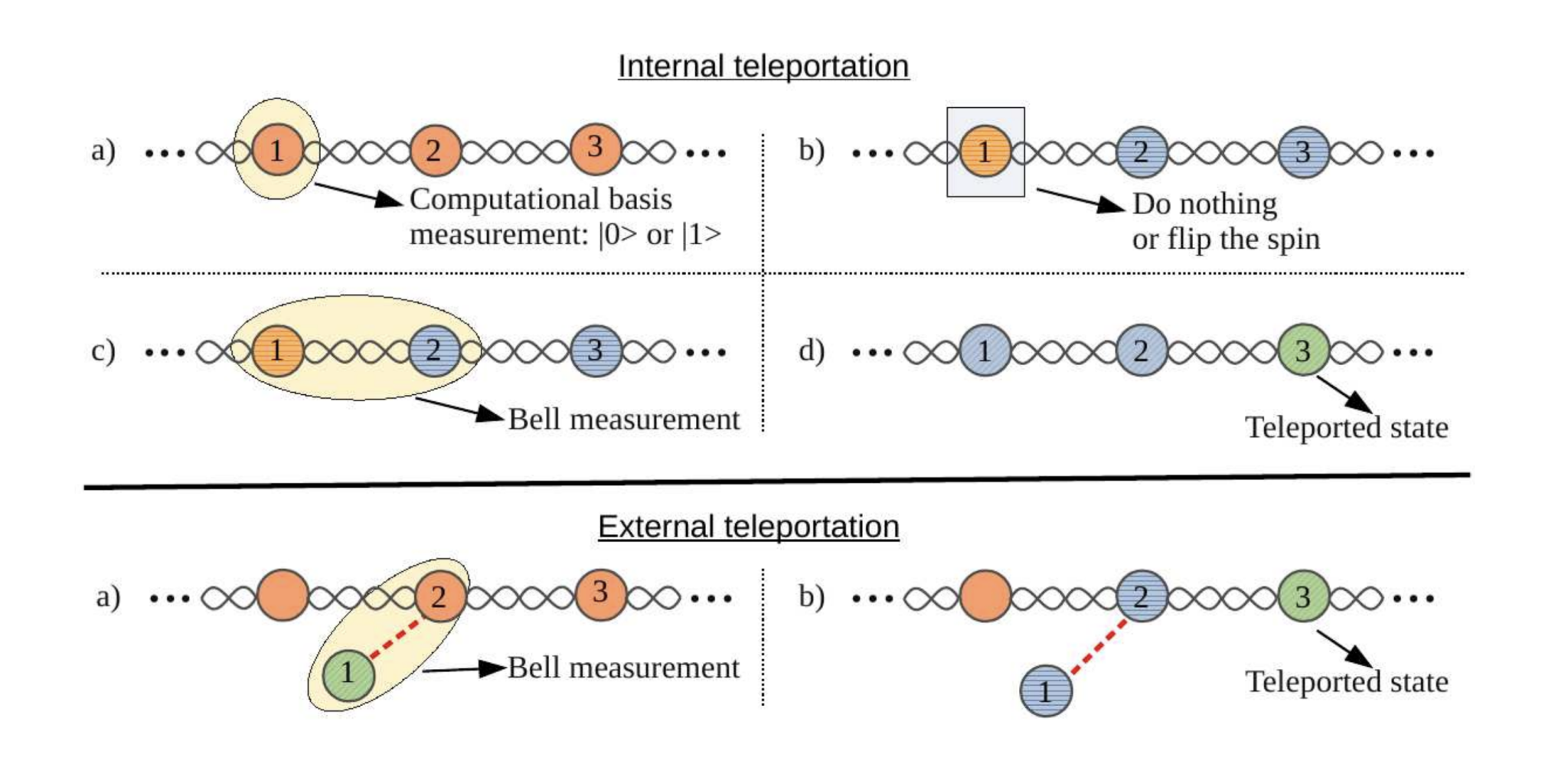
Identifying quantum critical points, those precise moments where materials undergo dramatic changes in behaviour, presents a significant challenge in condensed matter physics, typically requiring extremely large and carefully controlled systems. Now, researchers led by G. A. P. Ribeiro and Gustavo Rigolin, both from Universidade Federal de São Carlos, demonstrate a novel method for pinpointing these critical points using the principles of quantum teleportation. Their work reveals that accurate detection is possible even with relatively small chains of just ten quantum bits and at finite temperatures, a considerable advancement over existing techniques. This breakthrough offers a pathway to explore quantum criticality in more accessible systems, potentially accelerating the discovery of new quantum materials and technologies.
Using spin chains comprising approximately ten qubits and maintained in equilibrium with a thermal reservoir, the team demonstrates the ability to pinpoint critical points with an error of only a few percent for several models, including the XXZ, XX, XY, and Ising models. This is significant because identifying quantum phase transitions and their critical points is typically challenging in realistic conditions with limited system size and at non-zero temperatures.
Teleportation Detects Quantum Critical Points Accurately
This breakthrough centers on utilizing “teleportation-based” detectors, which leverage the principles of quantum teleportation to assess a system’s behavior. The experiments reveal that these detectors can estimate the location of quantum critical points with an accuracy of only a few percent, despite not requiring the infinite spin chains typically assumed in theoretical models. This represents a significant advancement, as it allows for the study of quantum phenomena in more realistic, finite-sized systems.
The core of this technique involves examining how effectively quantum information can be “teleported” between neighboring spins within the chain. Researchers found that the efficiency of this teleportation process undergoes substantial changes precisely at the quantum critical point, providing a clear signal for its location. By analyzing these changes, the team could reliably identify the critical point even with limited data and in systems far from the idealized conditions often used in theoretical calculations.
This achievement opens new avenues for exploring quantum materials and understanding the complex behavior of matter at the quantum level, potentially impacting fields like materials science and quantum computing. Furthermore, the study confirms that the method functions effectively not only for internal teleportation, where the teleported qubit originates within the spin chain, but also for external teleportation, where the qubit comes from outside the system. This adaptability enhances the practicality of the technique and broadens its potential applications for characterizing a wider range of quantum systems and materials. The results demonstrate a robust and accurate method for identifying quantum critical points, even in complex and realistic scenarios, paving the way for future advancements in quantum materials research.
Teleportation Pinpoints Quantum Critical Points Accurately
The research demonstrates that quantum teleportation-based methods can accurately estimate the location of quantum critical points. Accuracy improves with larger chain lengths and lower temperatures, and extrapolation to zero temperature further refines the estimates of critical point locations. The findings suggest that these techniques could be valuable for characterizing quantum phase transitions in experimental systems where achieving infinite chain lengths or absolute zero temperatures is impractical.
The research focused on local models with only nearest-neighbor interactions, and the authors suggest that extending these methods to systems with longer-range interactions represents a promising avenue for future work.
🗞 Teleportation based detection of quantum critical points using small spin chains
🧠 ArXiv: https://arxiv.org/abs/2508.15936


