

Thermally activated delayed fluorescence (TADF) offers a promising route to highly efficient organic light-emitting diodes, but accurately predicting the behaviour of these materials remains a significant challenge. Researchers Yue He and Daniel Escudero, both from KU Leuven, have developed a new kinetic model that overcomes limitations in existing approaches. Their work addresses the fact that many TADF emitters exhibit complex behaviours not fully explained by conventional models, and introduces a framework that incorporates the influence of higher energy states and vibronic coupling. By successfully predicting the performance of two representative materials, this new model, called KinLuv, demonstrates the importance of these often-overlooked effects and provides a crucial tool for designing future generations of high-performance TADF emitters.
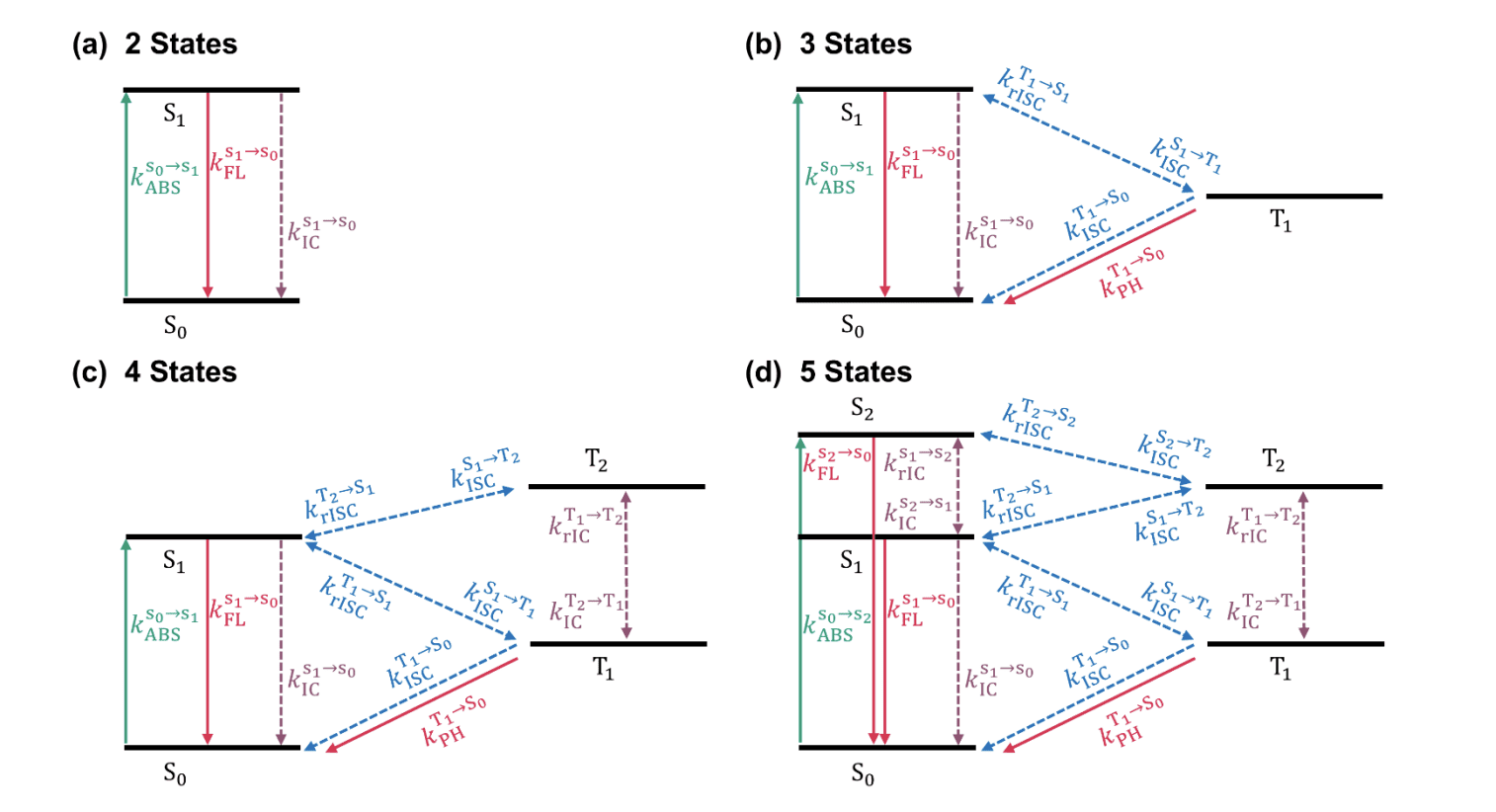
The lack of kinetic models that incorporate vibronic coupling effects and high-lying excited states has long limited the systematic understanding and rational design of these materials. To address this, researchers developed KinLuv, an extended multistate kinetic model that includes higher-lying excited states, such as S2 and T2, and accounts for Herzberg-Teller (HT) vibronic coupling in the rate constant calculations. When applied to two representative thermally activated delayed fluorescence (TADF) emitters, namely DOBNA and DiKTa, KinLuv successfully predicts photoluminescence quantum yields (PLQY) and prompt/delayed fluorescence lifetimes in good agreement with reported experimental results. These findings highlight that incorporating HT vibronic coupling significantly improves the accuracy of kinetic modelling for TADF materials, offering a pathway towards more informed material design.
Predicting Intersystem Crossing with CHT Theory
This document provides supplementary information for research focusing on the photophysical properties of two organic molecules, DOBNA and DiKTa, likely used in organic light-emitting diodes (OLEDs) or similar applications. The research investigates the mechanisms of intersystem crossing (ISC) and radiationless decay, crucial processes for understanding light emission efficiency. The study employs quantum chemical calculations and theoretical modeling to predict and interpret photophysical behavior, utilizing concepts such as Condon-Herzberg-Teller (CHT) theory, which describes the influence of vibrational modes on electronic spectra, Duschinsky rotation, which accounts for the mixing of electronic states due to vibrational motion, spin-vibronic coupling, which drives ISC, and Huang-Rhys (HR) factors, which quantify the strength of vibronic coupling. The document outlines the quantum chemical methods and basis sets used for calculations, and mentions software packages like Gaussian, ORCA, Multiwfn, and VESTA for calculations and visualization.
KinLuv, a custom kinetic modeling tool, simulates the excitation and decay kinetics of the molecules, allowing for a detailed understanding of the energy transfer pathways. Detailed analysis of the vibrational modes of both molecules is presented, including identification of key vibrational frequencies, calculation of HR factors and reorganization energies, and visualization of the vibrational modes. Spin-Orbit Coupling Matrix Elements (SOCMEs) are calculated to determine the ISC rate, showing how these elements change with vibrational motion. The document presents kinetic modeling using multi-state models with varying numbers of states to capture the complexity of energy transfer pathways, and includes fitted parameters obtained from simulating decay curves.
The study provides a comprehensive understanding of the factors governing ISC in these molecules, including the role of specific vibrational modes and spin-orbit coupling. The results highlight the importance of vibronic coupling in promoting ISC and influencing the photophysical properties of the molecules, and validate the accuracy of the computational methods and theoretical models used. The insights gained from this study can be used to rationally design new organic materials with improved photophysical properties for use in OLEDs and other optoelectronic devices.
KinLuv Model Accurately Predicts TADF Performance
Researchers have developed KinLuv, a new kinetic model that significantly improves the understanding of thermally activated delayed fluorescence (TADF), a promising mechanism for organic light-emitting diodes (OLEDs). Existing models often rely on simplified representations of excited states, limiting their ability to accurately predict and explain the behavior of complex TADF materials. This new approach addresses this limitation by incorporating the influence of higher-lying excited states, specifically S2 and T2, and crucially, by accounting for Herzberg-Teller (HT) vibronic coupling effects in rate constant calculations. The team successfully applied KinLuv to two representative TADF emitters, namely DOBNA and DiKTa, demonstrating its ability to predict photoluminescence quantum yields (PLQY) and prompt/delayed fluorescence lifetimes with excellent agreement to reported experimental results.
Previous models often underestimated reverse intersystem crossing (rISC) rates, particularly for molecules like DABNA-1 and BNOO, due to the neglect of HT vibronic coupling. KinLuv overcomes this by accurately calculating rate constants, providing a more realistic representation of the complex energy transfer processes within TADF materials. These findings demonstrate that incorporating HT vibronic coupling and higher-lying excited states is essential for quantitatively modeling TADF mechanisms. The improved accuracy of KinLuv enables a more sophisticated understanding of TADF processes, paving the way for the rational design of high-performance emitters with enhanced efficiency and color purity.
Vibronic Coupling Enhances TADF Emission Prediction
This study introduces KinLuv, a new computational model designed to more accurately simulate the behaviour of thermally activated delayed fluorescence (TADF) emitters. The model extends existing kinetic frameworks by incorporating higher energy excited states and, crucially, the effects of vibronic coupling, which arises from the interaction between electronic and vibrational energy levels. When applied to two representative TADF materials, DOBNA and DiKTa, KinLuv successfully predicts both photoluminescence yields and fluorescence lifetimes, demonstrating improved agreement with experimental results. The findings emphasize that vibronic coupling and consideration of higher excited states are essential for a complete understanding of TADF mechanisms.
While simplified models may suffice for some materials like DOBNA, the research reveals that more complex models are necessary to accurately describe the behaviour of emitters like DiKTa, where faster processes involving higher energy states play a significant role. The authors acknowledge that the model’s accuracy is dependent on the specific material studied and that further refinement may be needed for broader applicability. Future work will likely focus on extending the model to a wider range of TADF emitters and developing in silico protocols for the rational design of high-performance materials.
👉 More information
🗞 Universal Multistate Kinetic Models for the In-Silico Discovery of Thermally Activated Delayed Fluorescence Emitters
🧠 ArXiv: https://arxiv.org/abs/2508.16436


