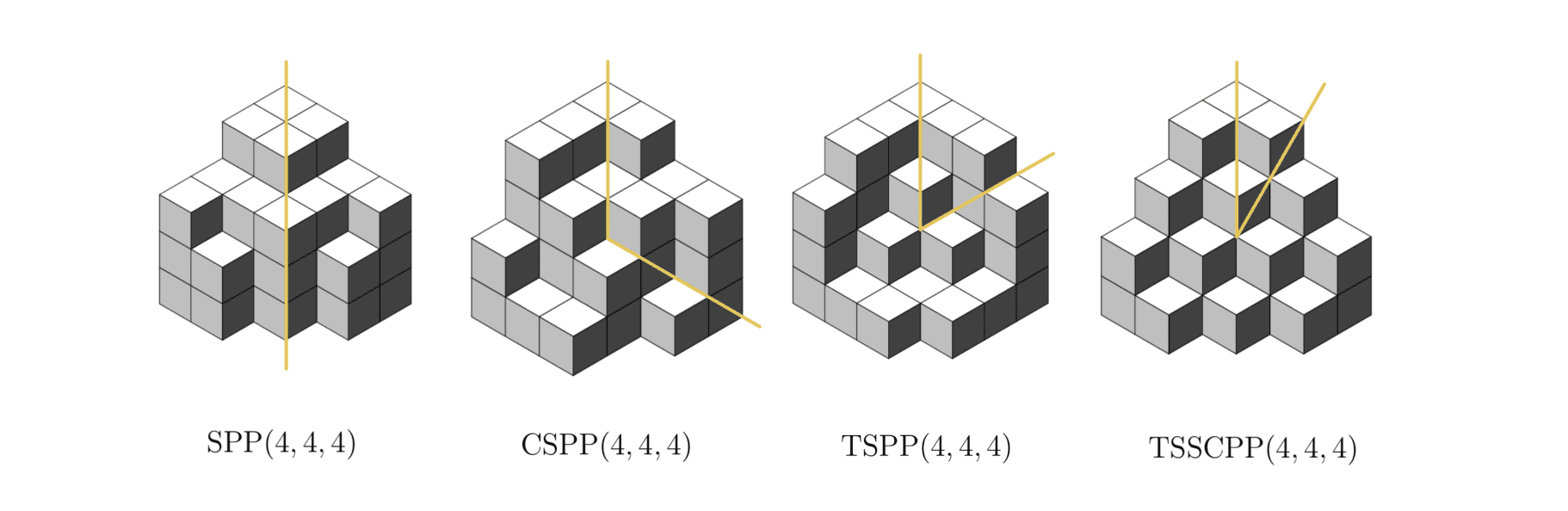
Graphical objects called webs provide a powerful, combinatorial method for classifying tensor invariants, and recent work by Gaetz, Pechenik, and Pfannerer, alongside Jessica Striker and Swanson, established a link between rotation-invariant webs and fluctuating tableaux. Building on this foundation, Ashleigh Adams and Jessica Striker investigate webs associated with specific symmetry classes of plane partitions, identifying the corresponding oscillating tableaux that describe them. This research extends the established bijection between webs and plane partitions to encompass these symmetry classes, and importantly, demonstrates a projection from invariants to a simplified form for webs originating from these classes. The findings offer new insights into the relationships between combinatorial structures and tensor representations, potentially streamlining calculations in areas like theoretical physics and mathematics.
Promotion plays a key role in the study of plane partitions, and researchers have previously established a connection between plane partitions and Uq(sl4)-webs, graphical representations of mathematical objects. By determining the corresponding oscillating tableaux, they classified these webs, and this work extends that understanding by identifying the oscillating tableaux associated with plane partitions possessing specific symmetries. The research demonstrates that invariants, mathematical quantities that remain unchanged under certain transformations, can be projected from complex Uq(sl4) webs to simpler forms for webs originating from these symmetry classes.
Symmetry and Structure in Plane Partitions
This research delves into the intricate world of plane partitions, webs, and plabic graphs, exploring their connections to representation theory and symmetry. Plane partitions are arrangements of numbers in rows, and understanding their symmetry classes is a central problem in combinatorics. Webs are graphical tools used to represent elements in quantum groups, offering a powerful way to study algebraic structures. Plabic graphs, a specific type of graph embedded in a plane, are used to construct webs, and hourglass plabic graphs are particularly useful for building bases for representation theory.
This work investigates how these concepts intertwine, focusing on how plabic graphs and webs can be used to construct bases and study symmetry classes. The paper details how hourglass plabic graphs are used to construct bases for representation theory, explaining their construction and relationship to webs. It explores how different symmetry classes correspond to different types of web bases, demonstrating the role of promotion in understanding the structure of these bases. Concrete examples illustrate how these techniques can be applied to specific problems, including projections from Uq(sl4) to Uq(sl3) and Uq(sl2). The research provides a detailed construction of web bases, establishes a clear connection between web bases and symmetry classes of plane partitions, and demonstrates the role of promotion in understanding the structure of web bases and their connections to cyclic sieving phenomena. Further research could explore generalizations to other Lie algebras, connections to dimer models, applications to mathematical physics, computational aspects of constructing web bases, categorification of the results, and connections to cluster algebras.
Plane Partitions and Uq(sl4)-Web Correspondence
Researchers have established a remarkable connection between plane partitions and Uq(sl4)-webs, graphical representations of mathematical objects. These webs, viewed as hourglass plabic graphs, provide a combinatorial way to classify tensor invariants, and the team discovered specific web bases for particular invariants. This work builds upon previous findings demonstrating a correspondence between webs and oscillating tableaux, where rotating a web corresponds to a process called tableau promotion. The team extended this correspondence by determining the oscillating tableaux associated with plane partitions exhibiting certain symmetries, revealing deeper connections within these mathematical structures.
A key achievement is the demonstration of a projection that simplifies complex mathematical objects while preserving essential information. Specifically, they identified the boundary words, mathematical descriptions of the web’s edges, for four symmetry classes of plane partitions. Furthermore, the researchers constructed an algorithm that maps Uq(sl4)-invariants to either Uq(sl2) or Uq(sl3) invariants, depending on the symmetry class of the associated plane partition. This map effectively reduces the complexity of the original problem by transforming it into a simpler, more manageable form, offering a visual and intuitive understanding of the underlying mathematical relationships. This work opens avenues for exploring dynamical actions on tableaux and characterizing collections of Uq(sl4) representations that restrict to smaller representations.
Webs, Tableaux and Tensor Invariant Simplification
This research expands upon recent work establishing connections between webs, graphical tools for representing tensor invariants, and oscillating tableaux, a combinatorial object with links to plane partitions. The authors demonstrate how to find the specific oscillating tableaux that correspond to plane partitions within defined symmetry classes. Importantly, they also prove the existence of a projection that maps invariants arising from these symmetry classes of webs to a simpler form. This projection offers a way to reduce complexity when studying these mathematical objects. The findings build upon a framework where webs provide a tangible, combinatorial method for classifying and computing tensor invariants, both in classical and quantum settings.
By linking webs to oscillating tableaux and plane partitions, the research provides new insights into the underlying structure of these invariants and offers alternative approaches to their analysis. The authors acknowledge that their work relies on a specific convention for constructing webs, and refer readers to previous publications for conversions between these conventions. Future research could explore the implications of this projection for simplifying calculations and potentially extending these results to a wider range of symmetry classes and web types.
👉 More information
🗞 Webification of symmetry classes of plane partitions
🧠 ArXiv: https://arxiv.org/abs/2508.16565