Researchers have successfully mapped a 50-spin qubit network, a significant development in quantum computing and quantum sensing. The team used high-resolution correlated sensing schemes and a single nitrogen-vacancy center in diamond to identify spin-chains throughout the network. This mapping could increase the number of available spin qubits for quantum simulations and may find applications in nanoscale imaging of complex spin systems. The researchers’ methods could also help overcome the challenge of spectral crowding, which causes overlapping signals and ambiguity in assigning signals to individual spins and their interactions.
What is the Significance of Mapping a 50-Spin Qubit Network?
The article discusses a significant development in the field of quantum computing and quantum sensing. A team of researchers has successfully mapped a network of 50 coupled spins using high-resolution correlated sensing schemes. This was achieved using a single nitrogen-vacancy center in diamond. The development of concatenated double-resonance sequences was crucial in identifying spin-chains throughout the network. These chains revealed the characteristic spin frequencies and their interconnections with high spectral resolution. This mapping can be used to increase the number of available spin qubits for quantum simulations. Additionally, the methods developed might find applications in nanoscale imaging of complex spin systems external to the host crystal.
The mapping of a 50-spin qubit network is a significant advancement in the field of quantum computing. The ability to map larger spin networks can be a precursor for quantum simulations that are currently intractable. It would provide a precise understanding of the noise environment of spin-qubit registers and might contribute towards efforts to image complex spin systems outside of the host material. A key challenge for mapping larger networks is spectral crowding, which causes overlapping signals and introduces ambiguity in the assignment of signals to individual spins and the interactions between them.
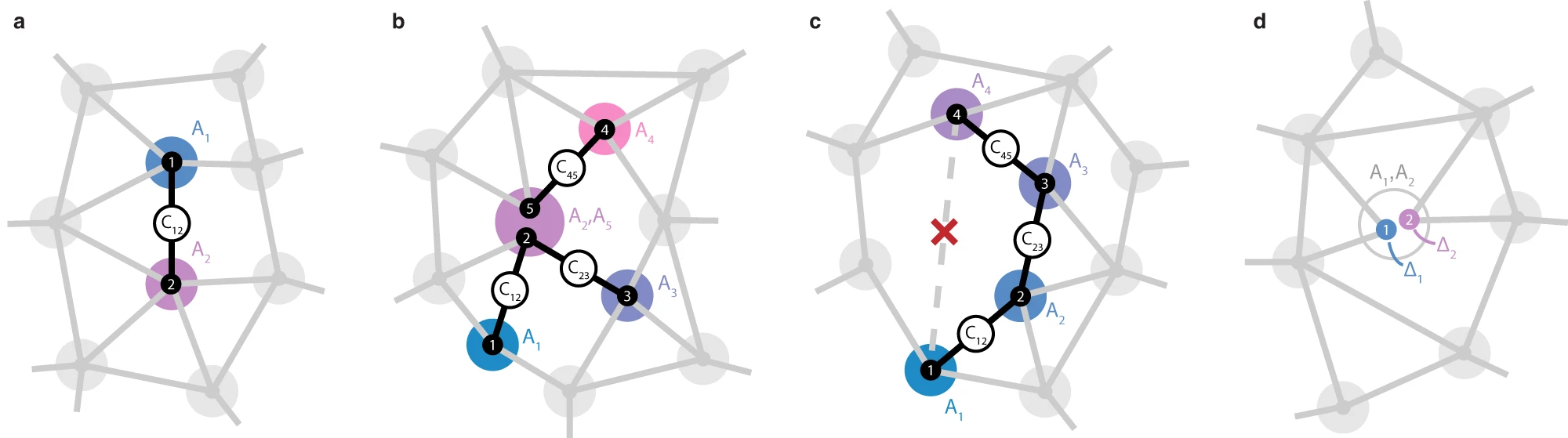
The researchers developed correlated sensing sequences that measure both the network connectivity and the characteristic spin frequencies with high spectral resolution. These sequences were applied to map a 50-nuclear-spin network comprised of 1225 spin-spin interactions in the vicinity of a nitrogen-vacancy (NV) center in diamond. The key concept of the method is to concatenate double-resonance sequences to measure chains of coupled spins through the network. This mapping of spin chains removes ambiguity about how the spins are connected and enables the sensing of spins that are farther away from the electron spin-sensor in spectrally crowded regions.
How Does This Development Impact Quantum Simulations and Sensing?
The successful mapping of a 50-spin qubit network opens up new opportunities for quantum simulations by increasing the number of available spin qubits. Quantum simulations of many-body physics, as well as quantum networks where the nuclear spins provide qubits for quantum memory, entanglement distillation, and error correction, are emerging applications of this development. The ability to map larger spin networks can be a precursor for quantum simulations that are currently intractable. It would provide a precise understanding of the noise environment of spin-qubit registers and might contribute towards efforts to image complex spin systems outside of the host material.
The researchers’ methods are applicable to a wide variety of systems and might inspire future methods to magnetically image complex samples such as individual molecules or proteins. The results significantly increase the size and complexity of the accessible spin network. The development of concatenated double-resonance sequences was crucial in identifying spin-chains throughout the network. These chains revealed the characteristic spin frequencies and their interconnections with high spectral resolution.
The mapping of spin chains removes ambiguity about how the spins are connected and enables the sensing of spins that are farther away from the electron spin-sensor in spectrally crowded regions. This is a significant advancement in the field of quantum sensing, as it allows for the sensing and control of multiple nuclear spins surrounding a single electron spin defect. This additional network of coupled spins provides a qubit register for quantum information processing as well as a test bed for nanoscale magnetic resonance imaging.
What are the Challenges and Future Applications of This Development?
A key challenge for mapping larger networks is spectral crowding, which causes overlapping signals and introduces ambiguity in the assignment of signals to individual spins and the interactions between them. The researchers developed correlated sensing sequences that measure both the network connectivity and the characteristic spin frequencies with high spectral resolution. These sequences were applied to map a 50-nuclear-spin network comprised of 1225 spin-spin interactions in the vicinity of a nitrogen-vacancy (NV) center in diamond.
The successful mapping of a 50-spin qubit network opens up new opportunities for quantum simulations by increasing the number of available spin qubits. Additionally, the methods developed might find applications in nanoscale imaging of complex spin systems external to the host crystal. The researchers’ methods are applicable to a wide variety of systems and might inspire future methods to magnetically image complex samples such as individual molecules or proteins.
The ability to map larger spin networks can be a precursor for quantum simulations that are currently intractable. It would provide a precise understanding of the noise environment of spin-qubit registers and might contribute towards efforts to image complex spin systems outside of the host material. This development is a significant step forward in the field of quantum computing and quantum sensing, and it is expected to have far-reaching implications in these areas.
Publication Date: 2024-03-05
Authors: G. L. van de Stolpe, Dominic Kwiatkowski, C. E. Bradley, J. Randall, et al.
Source: Nature Communications
DOI: https://doi.org/10.1038/s41467-024-46075-4