

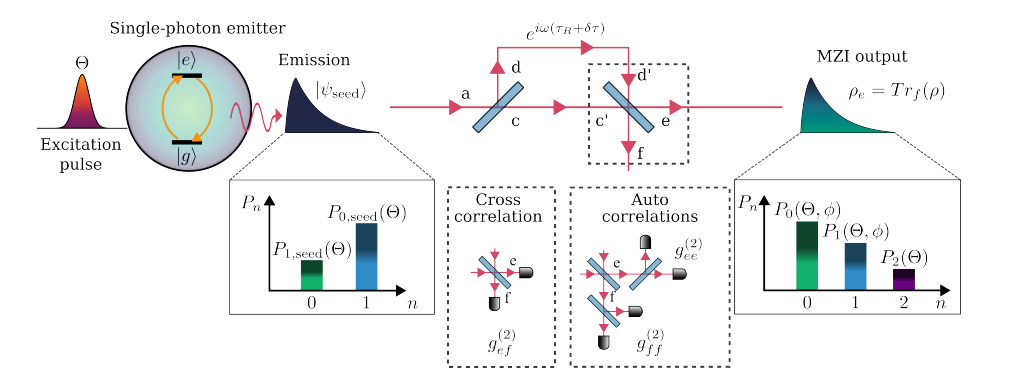
Controlling the number of photons generated by a light source is a fundamental challenge in quantum technology, with significant implications for applications ranging from secure communication to advanced sensing, yet creating light sources that reliably produce specific numbers of photons has remained a challenging goal. Now, Sang Kyu Kim, Finley, and colleagues at the Walter Schottky Institut and the Technische Universität München, working with Elena del Valle and Carlos Antón-Solanas from the Universidad Autónoma de Madrid, demonstrate a new method for precisely shaping the probabilities of different photon numbers. Their approach uses a carefully designed optical setup to manipulate single photons, creating a source that deterministically generates vacuum, single-photon, and two-photon states, and dynamically transitions between different emission patterns. This all-optical technique, which relies on readily available components, offers a scalable pathway towards creating on-demand, multi-photon resources essential for quantum computing, enhanced sensing, and the development of long-distance quantum networks.
Single Photons From Solid-State Emitters
This collection of research papers comprehensively covers the field of quantum optics, quantum information, and solid-state quantum emitters, such as quantum dots. The central focus is on generating, manipulating, and detecting single photons and entangled photons using these solid-state systems. The bibliography also encompasses quantum optics principles, quantum information processing techniques, and the development of integrated photonic circuits. The extensive number of citations indicates a mature and rapidly evolving research area with significant ongoing investigation. The research explores key areas including the fundamental theory of light, non-classical light sources like squeezed light and entangled photons, and the behaviour of light in confined spaces through cavity quantum electrodynamics.
Researchers are actively working on improving the quality and performance of quantum dots and other solid-state defects as sources of single photons through advanced material growth and device fabrication techniques. The collection highlights the importance of quantum information processing and communication, including quantum key distribution, quantum repeaters, and quantum computation. Researchers are developing photonic quantum circuits and integrating them onto chips to create compact and scalable quantum systems, with a focus on linear optical quantum computing and boson sampling. Furthermore, the development of integrated photonics and nanophotonics, including waveguides, resonators, photonic crystals, and silicon photonics, is emphasized to control and manipulate light at the nanoscale.
Single-photon detection is another crucial aspect, with research focusing on superconducting nanowire single-photon detectors, avalanche photodiodes, and transition edge sensors. Current trends emphasize the integration of quantum emitters and detectors onto chips, the use of solid-state systems for practical quantum devices, and the development of advanced characterization techniques. The research demonstrates a balanced approach, combining theoretical studies with experimental demonstrations, and promises revolutionary new technologies in quantum communication and computation.
Deterministic Photon Control with Unbalanced Interferometers
Researchers have developed a new technique for precisely controlling the generation of single and multiple photons using a quantum dot and a Mach-Zehnder interferometer. This method allows for the deterministic creation of specific photon states, including vacuum, single-photon, and two-photon combinations, on demand. Unlike previous approaches that often relied on probabilistic generation or post-selection, this technique offers precise control over the emitted light. The innovation lies in the interferometer’s deliberately unbalanced configuration, where unequal path lengths manipulate the probabilities of generating different numbers of photons.
By tuning the excitation pulse area and the interferometer’s phase, researchers can shape the photon statistics, transitioning between scenarios where photons are spread apart and scenarios where they cluster together. This control is achieved through the interference of light, where constructive and destructive interference amplify or cancel out certain photon states. Importantly, the method relies on readily available components and linear optics, making it scalable and compatible with existing photonic integrated circuits. Researchers demonstrated the ability to generate tailored photon states and purify them, effectively filtering out unwanted photons. Looking ahead, the team proposes using two quantum dots to unlock even greater control over photon generation, enabling the creation of complex quantum states essential for certain quantum computing algorithms and enhancing single-photon filtering capabilities. The entire process avoids complex measurements, making it a robust and efficient method for generating few-photon resources.
Deterministic Two-Photon Generation with Linear Optics
Researchers have achieved a significant breakthrough in controlling light by demonstrating a method to deterministically generate states containing up to two photons using only linear optical components and a single-photon source. This contrasts with previous approaches that relied on complex nonlinear processes or probabilistic methods, which often limited scalability and fidelity. The team’s method utilizes a carefully designed Mach-Zehnder interferometer to manipulate the quantum state of light emitted from a resonantly driven quantum dot. The core innovation lies in the interferometer’s ability to combine vacuum, single-photon, and two-photon interference effects.
By precisely tuning both the excitation of the quantum dot and the phase within the interferometer, researchers can deterministically control the probabilities of finding zero, one, or two photons in the output beam. This level of control is crucial for advanced quantum technologies, as many protocols require specific, well-defined photon states. Measurements reveal a dynamic transition from antibunching to strong bunching of photons, demonstrating the ability to engineer photon statistics. Importantly, the team’s approach avoids probabilistic heralded sources, which introduce uncertainty and reduce efficiency.
Their fully quantum-mechanical model accurately predicts the observed photon statistics, confirming the deterministic nature of the process. The results demonstrate the generation of two-photon states with minimal unwanted higher-order components, representing a substantial improvement over existing methods. This scalable, chip-compatible technique paves the way for developing advanced quantum technologies, including improved quantum sensors, photonic computers, and secure long-distance quantum communication networks.
Tailored Photon States via Deterministic Control
This research demonstrates a new method for precisely controlling the creation of few-photon states, specifically vacuum, single-photon, and two-photon combinations. By combining a single-photon emitter with a carefully designed interferometer, researchers achieve deterministic control over the probabilities of these different states, effectively tailoring the output photon statistics. The system exhibits a tunable transition between anti-bunching and bunching of photons, a behaviour accurately mapped by a fully quantum-mechanical model. This approach represents a significant advance in the generation of tailored photon states, as it requires no post-selection or heralding, simplifying experimental setups.
Researchers acknowledge that the current scheme is limited by the achievable probabilities of the generated states. However, they predict that extending the protocol to incorporate two indistinguishable emitters would substantially expand the range of accessible states, enabling the creation of deterministic NOON states and facilitating single-photon filtering. Because the method relies on standard coherent state preparation and linear optics, it is compatible with existing photonic technologies and potentially scalable for integration into chip-scale circuits, promising advancements in boson sampling, quantum computing, and long-distance quantum communication.
🗞 Deterministic Control of Photon-Number Probabilities via Phase-Controlled Quantum Interference
🧠 ArXiv: https://arxiv.org/abs/2508.15352


