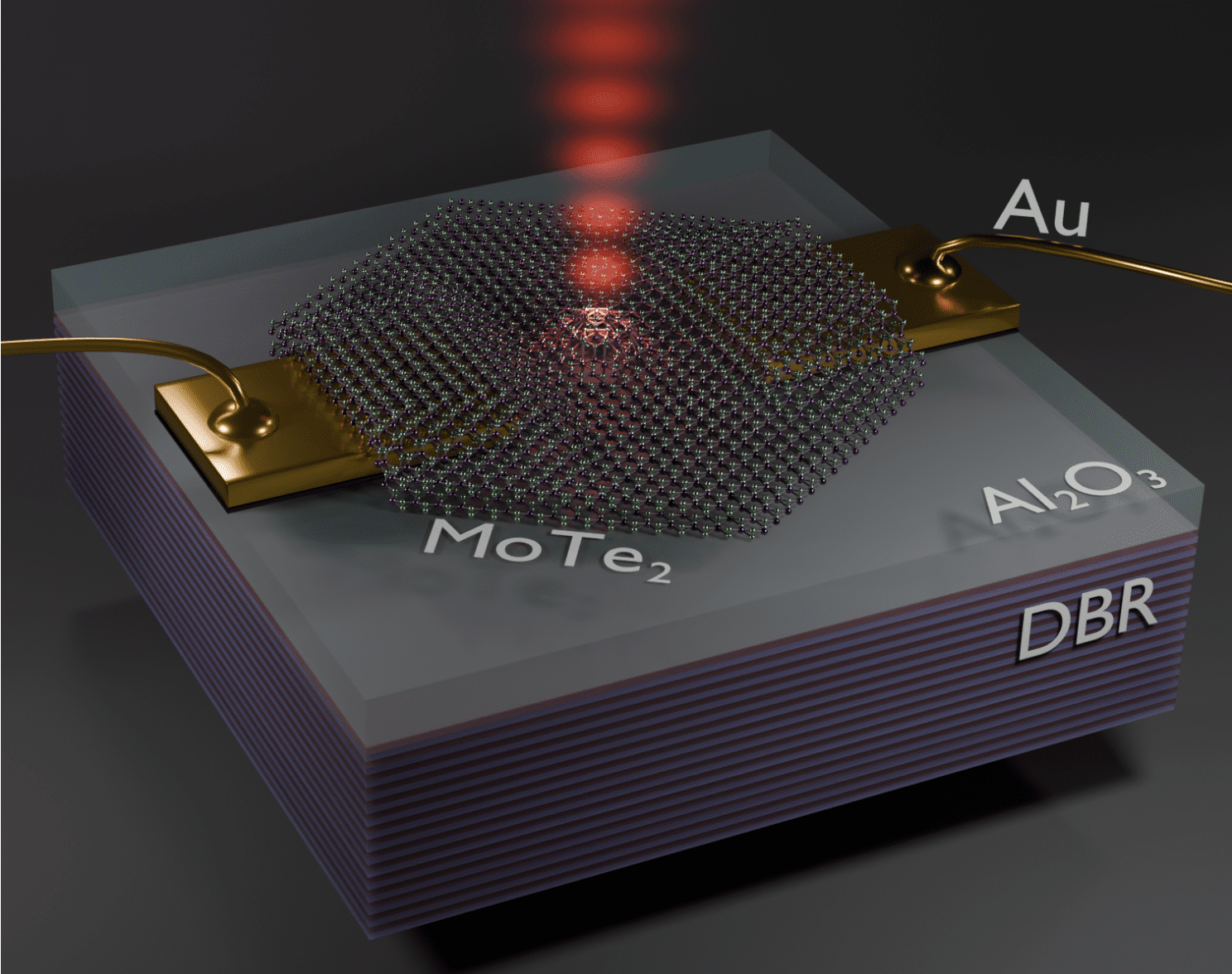
The demand for reliable single-photon sources continues to grow as researchers develop advanced technologies in quantum communication and computation, and a new study details a significant step forward in creating such sources using a novel material platform. Paweł Wyborski, Athanasios Paralikis, Pietro Metuh, and colleagues at the Technical University of Denmark demonstrate a reproducible method for generating near-infrared single-photons from bilayer molybdenum ditelluride, a two-dimensional material with promising optical properties. Their work overcomes previous limitations in spectral range and photon quality, achieving record-breaking indistinguishability, a crucial characteristic for quantum applications, and paving the way for practical, telecom-compatible photonic devices. The team’s innovative approach, which combines strain and defect engineering with electrostatic control, yields high-purity photons with tunable properties and opens new possibilities for long-distance quantum networks and advanced information processing.
Transition metal dichalcogenides (TMDs) offer a promising platform for developing single-photon sources, but their advancement has been hindered by limited spectral range and poor single-photon indistinguishability. This research demonstrates a reproducible and systematic approach for generating near-infrared (1090, 1200 nm) quantum emitters in bilayer MoTe₂ using deterministic strain and defect engineering. These emitters exhibit strong linear polarization (degree of linear polarization 70%), sub-nanosecond lifetimes (τ ⩽450 ps), high single-photon purity (g(2)(0).
Defect Quantum Emitters in 2D Materials
Research into two-dimensional materials has revealed opportunities for creating quantum emitters, tiny sources of individual photons. Scientists are particularly interested in identifying and characterizing these quantum emitters, often originating from defects within the material’s structure, as well as understanding the fundamental properties of excitons and polaritons within these materials. Researchers are also exploring van der Waals heterostructures, created by combining different 2D materials to tailor their optical and electronic properties, and integrating these materials with photonic structures, such as waveguides and cavities, to enhance light-matter interaction and create compact devices. Specific research topics include developing single-photon sources, characterized by their ability to emit individual photons on demand.
This involves techniques to induce and control the creation of emitters, improve their brightness and stability, and accurately characterize their properties using advanced spectroscopic methods. A significant effort is dedicated to characterizing the materials themselves, analyzing defects using techniques like electron microscopy and atomic force microscopy, and probing their properties using Raman and photoluminescence spectroscopy. Device fabrication and integration are also critical areas of research, including coupling 2D materials to waveguides, placing them within optical cavities, and stacking different materials to create heterostructures. Current trends highlight the prominence of tungsten diselenide as a popular material for studying quantum emitters, likely due to its favorable quantum properties. Controlling defects to create and tune emitters is a major focus, and integrating these materials with photonic structures is crucial for creating functional devices. The field is moving towards developing emitters with improved brightness, stability, and indistinguishability, and researchers are increasingly exploring more complex heterostructures to tailor material properties and create new functionalities.
Telecom-Band Single Photons from MoTe₂ Emitters
Researchers have achieved a significant breakthrough in the development of single-photon sources by demonstrating high-performance emitters in bilayer molybdenum ditelluride (MoTe₂). These sources, crucial for long-distance optical communication and quantum computing, operate within the telecom band, a key requirement for compatibility with existing fiber optic infrastructure. The team successfully engineered quantum emitters exhibiting exceptional properties through a combination of strain engineering and defect activation, paving the way for practical quantum photonic technologies. Experiments reveal that these MoTe₂ emitters produce photons in the 1090, 1200 nm range with remarkably short radiative lifetimes of 130, 440 picoseconds.
The emitters also demonstrate strong linear polarization, achieving degrees of linear polarization up to approximately 70%, and exhibit high single-photon purity, confirmed by measurements showing g(2)(0) values less than 0. 1. Furthermore, the emission is nearly transform-limited, with ratios of experimental to transform-limited linewidths as low as 55, indicating minimal environmental disturbances affecting the emitted photons. The most compelling result lies in the demonstration of two-photon interference, a hallmark of indistinguishable photons. Researchers measured a Hong-Ou-Mandel visibility of 10%, and remarkably, achieved up to 40% with post-selection using temporal filtering.
This represents the highest reported indistinguishability for any transition metal dichalcogenide quantum emitter and the first such demonstration in the near-infrared region. These findings establish MoTe₂ as a viable platform for creating tunable, low-noise, high-purity single-photon sources, promising significant advancements in telecom-compatible quantum photonic technologies and opening new avenues for secure communication and quantum computation. The team achieved these results by fabricating a highly reflective substrate and employing directional strain engineering alongside electron-beam-induced defect activation. This precise control over the material properties enabled the creation of stable and spectrally narrow emitters with exceptional performance characteristics, overcoming previous limitations in the field.
High-Purity Single Photons from Molybdenum Ditelluride
This research demonstrates a reproducible method for creating efficient single-photon emitters from bilayer molybdenum ditelluride (MoTe₂). By carefully engineering strain and defects within the material, the team generated emitters operating in the near-infrared region, a crucial wavelength range for telecommunications. These emitters exhibit several key properties, including narrow emission linewidths, fast radiative decay, and high single-photon purity, all essential for practical applications. Notably, the researchers observed two-photon interference, a hallmark of single-photon sources, with a high degree of indistinguishability, exceeding previously reported values for similar materials.
This represents the first demonstration of this phenomenon in MoTe₂-based emitters at near-infrared wavelengths. The achieved results establish MoTe₂ as a promising platform for developing tunable, low-noise single-photon sources suitable for integration into future quantum technologies. Achieving even higher indistinguishability will likely require further advancements, including integrating the emitters with high-quality optical cavities to enhance light emission and exploring more sophisticated excitation techniques to improve brightness and coherence. The authors also investigated the reproducibility of their fabrication method and the impact of different dielectric environments, providing valuable insights for future optimization.
👉 More information
🗞 Toward triggered generation of indistinguishable single-photons from MoTe quantum emitters
🧠 ArXiv: https://arxiv.org/abs/2508.20743