

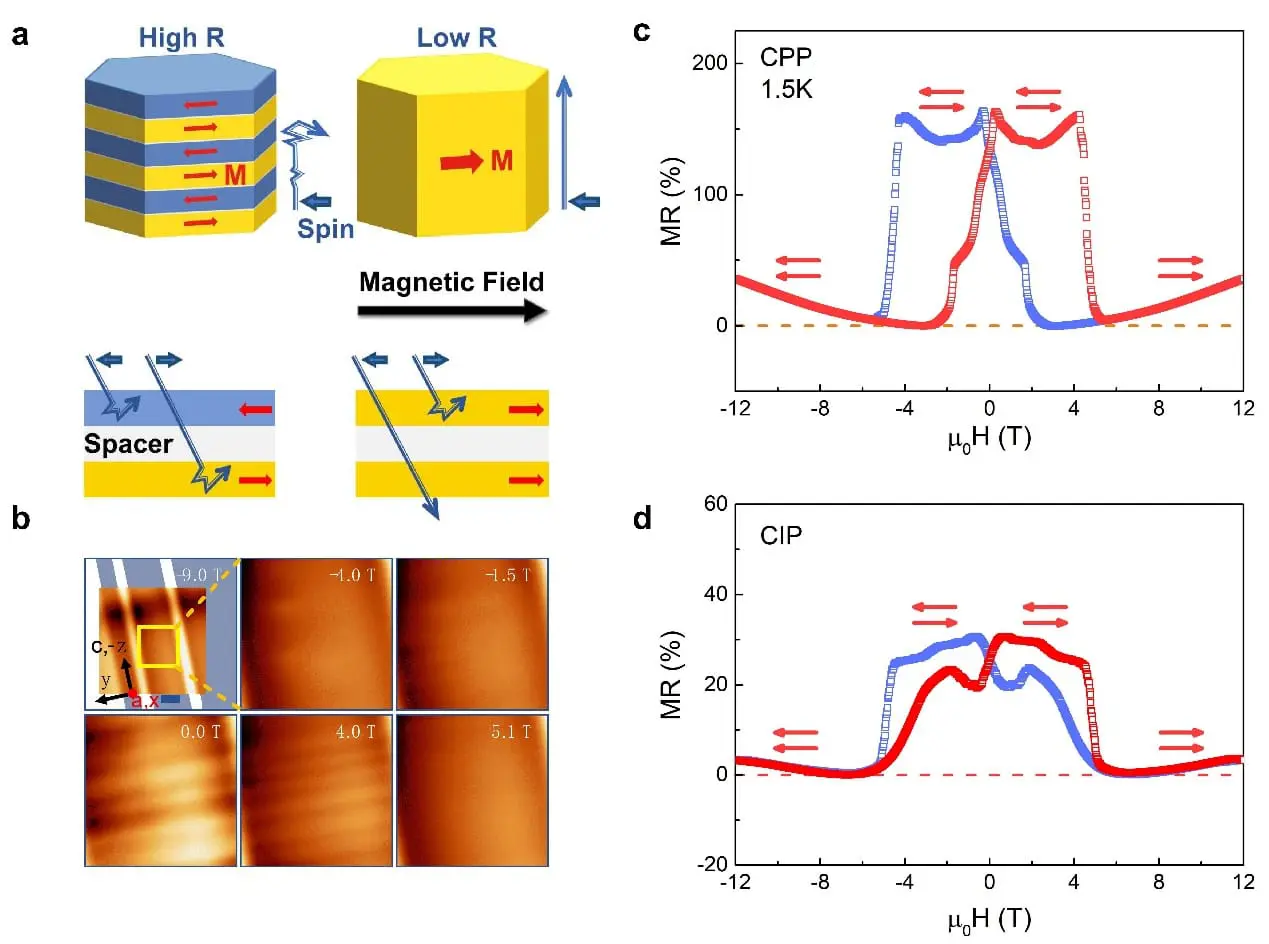
Researchers from the Hefei Institutes of Physical Science at the Chinese Academy of Sciences and National Cheng Kung University have developed a novel spin-valve mechanism using Kagome quantum magnets, eliminating the need for complex fabrication techniques traditionally required in spin-valve structures. Their prototype device, made from the kagome magnet TmMnSn, achieves giant magnetoresistance (GMR) exceeding 160% by inducing a parallel multidomain state through an external magnetic field. This approach leverages unique interlayer interactions in Kagome helimagnets, replicating spin-valve behavior without intricate material stacking. The findings, published in Nature Communications, demonstrate potential for low-power-consumption spintronic devices and offer new avenues for future applications in quantum magnet-based technologies.
Researchers led by Prof. QU Zhe at the Hefei Institutes of Physical Science have developed a novel spin-valve mechanism using kagome quantum magnets, specifically TmMnSn. This advancement eliminates complex fabrication techniques traditionally required in spin-valve structures.
Traditional spin-valve devices rely on trilayer structures with ferromagnetic layers separated by nonmagnetic spacers. These devices modulate spin scattering strength through magnetic orientation control, enabling giant magnetoresistance effects. However, their production involves intricate processes like epitaxial growth or mechanical stacking, which hinder stability and scalability.
The new mechanism leverages the unique interlayer interactions in kagome helimagnets. By applying an external magnetic field, the researchers induced a parallel multidomain state in TmMnSn, replicating spin-valve behavior without complex material stacking. Experimental results showed a giant magnetoresistance effect exceeding 160%, confirmed by magnetic force microscopy imaging.
This discovery offers high tunability for future spintronic applications, potentially leading to low-power-consumption devices based on quantum magnets. The findings were published in Nature Communications, highlighting the potential of kagome helimagnets in advancing spintronics.
Implications for Future Low-Power Spintronic Applications
The novel spin-valve mechanism developed using kagome quantum magnets offers significant potential for advancing low-power spintronic applications. This approach simplifies device fabrication while maintaining high performance by eliminating the need for complex trilayer structures. The ability to achieve giant magnetoresistance exceeding 160% through domain-wall scattering demonstrates the material’s suitability for efficient magnetic sensing and data storage.
The tunability of the spin-valve effect in kagome helimagnets further enhances its applicability, enabling precise control over magnetic properties for diverse spintronic devices. This mechanism addresses scalability challenges and opens new avenues for energy-efficient technologies. The findings underscore the potential of quantum magnetic materials to revolutionise next-generation electronics, providing a robust foundation for future research and development in spintronics.
More information
External Link: Click Here For More


