

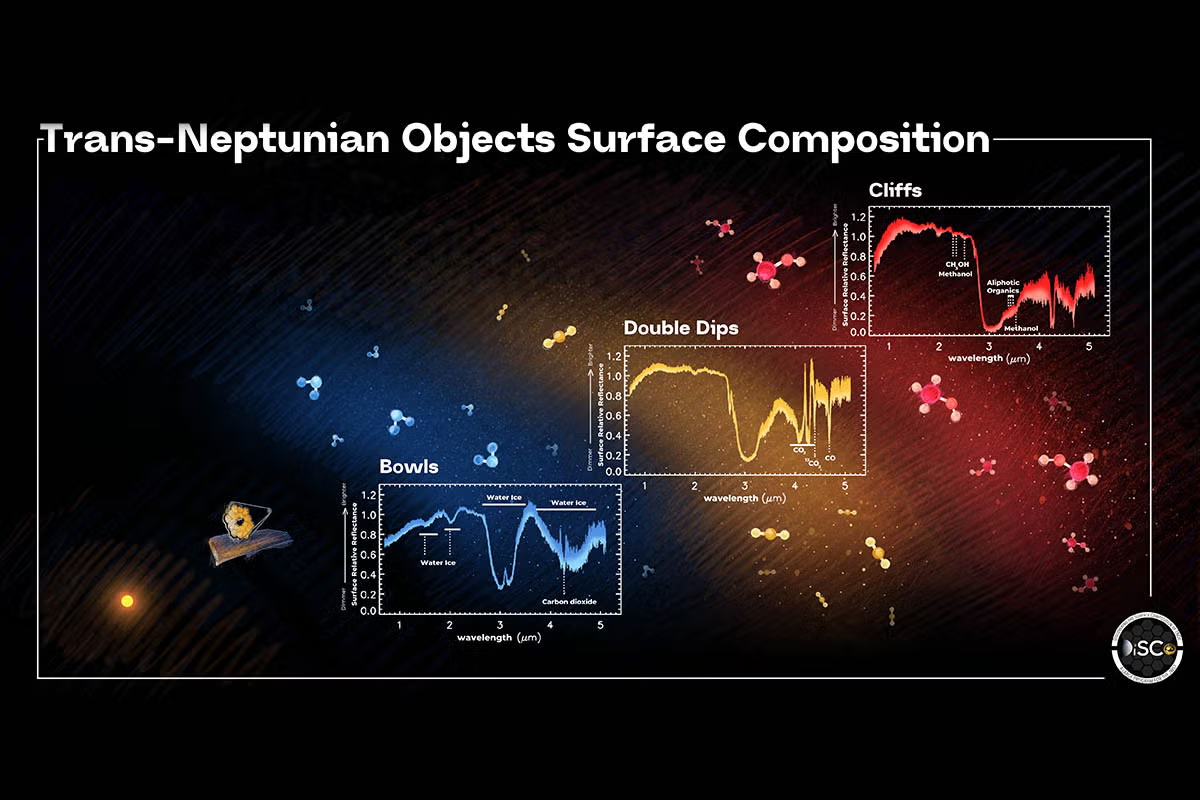
Researchers have made new discoveries about the surfaces of centaurs and trans-Neptunian objects, or TNOs, in our solar system. A team led by Dr. Pinilla-Alonso and including Brittany Harvison and other scientists from institutions such as NASA, the University of Central Florida, and the Space Telescope Science Institute, used advanced technologies to study these distant objects.
They found that some centaurs have unique spectral characteristics that do not fit into existing categories, leading to the definition of a new group called the shallow type. The team also discovered that water ice is not as prevalent on TNO surfaces as previously thought, and that carbon dioxide and other carbon oxides are more common.
This research builds on previous findings by Dr. Pinilla-Alonso and her team, who had discovered the presence of carbon oxides on TNO surfaces. The study was supported by NASA through a grant from the Space Telescope Science Institute.
Researchers conducted an in-depth analysis of the reflectance spectra of 19 Trans-Neptunian Objects (TNOs) using the Hubble Space Telescope. The study revealed three distinct compositional groups. The “ultra-red” group exhibited strong signs of complex organics, methanol, and nitrogen-bearing molecules, resulting in a reddish appearance. The “neutral” group lacked these features and displayed a more balanced color. The “blue” group, in contrast, was rich in water ice and volatile ices, giving it a bluish tint. A notable finding was the prevalence of carbon dioxide (CO₂) and other carbon oxides on TNO surfaces, challenging previous assumptions about their composition, while water ice appeared less abundant.
A parallel study examined five centaurs, also using Hubble’s capabilities. Researchers identified three distinct spectral classes among these objects. The “bowl-type” class was rich in primitive, comet-like dust but contained minimal volatile ices. The “cliff-type” class exhibited greater amounts of water ice and other volatiles. A newly discovered “shallow-type” class showed a unique spectrum, featuring high concentrations of primitive dust with little to no volatiles. This diversity in surface composition highlights the complexity and variability of centaur populations.
The findings from these studies provide critical insights into the composition and diversity of TNOs and centaurs, contributing to a deeper understanding of the solar system’s formation and evolution. The research underscores the significance of carbon oxides in the surface chemistry of these objects, suggesting a more complex interaction of materials than previously thought. Future investigations will aim to uncover the processes responsible for the observed compositional patterns and their implications for the origins and development of these outer solar system bodies. This work represents an important step in expanding knowledge of the small, icy objects that populate the distant reaches of our planetary system.
External Link: Click Here For More


