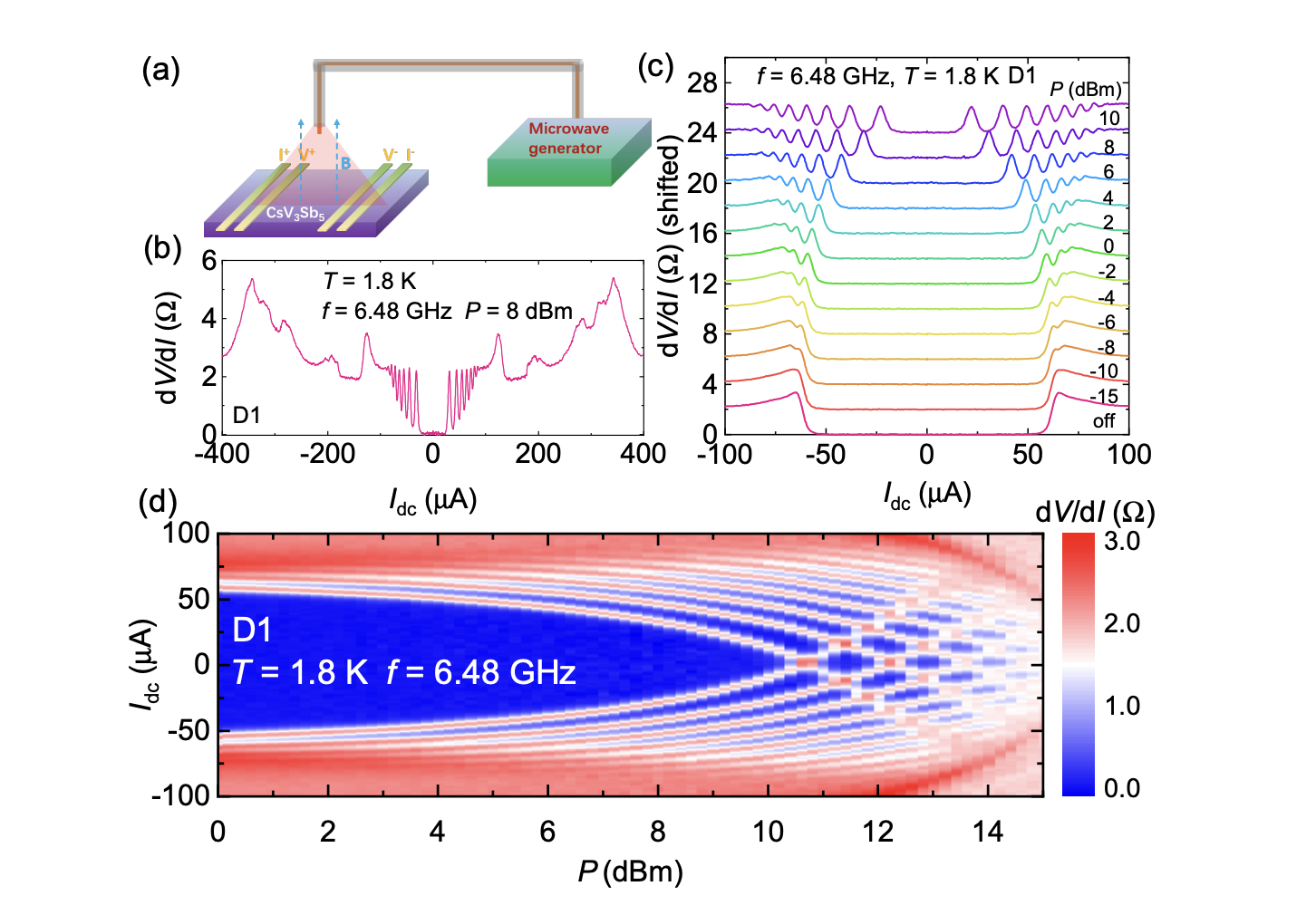
Superconducting materials exhibiting unusual chiral properties are attracting considerable interest, and recent research focuses on Kagome lattice compounds as promising candidates. Tian Le from Zhejiang University, Zhuokai Xu and Ruiya Zhan from Westlake University, and Jinjin Liu from the Beijing Institute of Technology, alongside their colleagues, now demonstrate direct and alternating current Josephson effects within nanoplates of the Kagome compound CsV3Sb5. The team observes patterns and steps characteristic of these effects, and importantly, finds that thermal cycling, repeated heating and cooling, modulates these behaviours. This suggests the Josephson effects originate from shifting superconducting regions within the material, offering new understanding of chiral superconductivity in CsV3Sb5 and potentially paving the way for novel devices based on these unique properties.
Intrinsic Josephson Junctions in Kagome Superconductor CVS
Researchers have uncovered evidence of intrinsic Josephson junctions forming within samples of the Kagome superconductor Cesium Vanadium Sulfide (CVS). These junctions, weak links allowing superconducting current to flow, arise naturally from the complex superconducting state within the material, rather than being artificially created. The team meticulously ruled out alternative explanations, such as thermal strain or normal-state domains, demonstrating that these effects are inherent to the material’s superconducting properties. This discovery provides valuable insight into the unusual electronic behaviour observed in Kagome materials, and the team demonstrated that the Josephson effects are thermally modulated, changing with temperature even at extremely low temperatures, suggesting a dynamically changing superconducting state.
Josephson Effects Reveal Dynamic Superconductivity in CsV3Sb5
Researchers have demonstrated both direct-current and alternating-current Josephson effects within nanoplates of the material CsV3Sb5, confirming the presence of superconducting connections at the nanoscale. These effects were revealed through characteristic Fraunhofer-like patterns and Shapiro steps in electrical measurements, and are demonstrably modulated by temperature changes, suggesting they originate from dynamic superconducting domains within the material. Distinct integer Shapiro steps, with separations corresponding to voltages up to 4. 3 Kelvin, indicate the presence of charge-2e superconductivity, where pairs of electrons carry two units of charge, contrasting with previous observations of charge 4e/6e pairing in similar materials. Further analysis shows that the width and symmetry of voltage maps are altered by thermal cycling, implying a thermal modulation of the effective Josephson junction areas and geometry.
Dynamic Josephson Junctions in Kagome Superconductor
This research demonstrates the presence of intrinsic Josephson effects within nanoplates of the material CsV3Sb5, a Kagome superconductor, as evidenced by Fraunhofer-like patterns and Shapiro steps in electrical measurements. These patterns indicate the formation of Josephson junctions, weak links allowing superconducting current to flow between different regions, within the sample, and are modulated by temperature changes, suggesting these junctions arise from dynamic superconducting domains. These findings contribute to a growing body of evidence supporting the existence of chiral superconductivity in CsV3Sb5, a state where electrons pair in a way that breaks time-reversal symmetry, and position CsV3Sb5 as a promising candidate for developing novel quantum devices.
👉 More information
🗞 Thermomodulated intrinsic Josephson effect in Kagome CsV3Sb5
🧠 ArXiv: https://arxiv.org/abs/2508.16099