Rhombohedral multilayer graphene presents a fascinating frontier in materials science, offering the potential to unlock novel quantum phenomena, and researchers are now charting its complex landscape of electronic behaviour. Jinghao Deng, Jiabin Xie, and Hongyuan Li, all from Cornell University, alongside collaborators including Takashi Taniguchi and Kenji Watanabe at the National Institute for Materials Science, investigate the unusual properties arising when graphene is stacked into six layers. Their work reveals a surprisingly rich phase diagram within this material, demonstrating how an applied electric field can fundamentally alter its electronic structure and induce superconductivity-like behaviour alongside the emergence of distinct magnetic and electric ordering. This discovery not only expands our understanding of correlated electron systems, but also highlights rhombohedral graphene as a promising platform for future quantum technologies due to its ability to host a variety of exotic quantum phases.
This research aims to characterise the properties of this semimetallic state and understand the role of flavour symmetry in determining its behaviour, extending the understanding of correlated electron systems in graphene structures. The study provides new insights into the potential of multilayer graphene for realising novel quantum phenomena and developing advanced electronic devices.
Rhombohedral Graphene Exhibits Correlated and Chern Insulator States
This research demonstrates a rich phase diagram in rhombohedral multilayer graphene, including correlated insulating behaviour that can potentially transition into Chern insulator states. The material displays spontaneous symmetry breaking, leading to the emergence of novel electronic states, and exhibits both magnetic and electric polarization, a rare combination known as multiferroicity, linked to its orbital magnetism and Berry curvature. Superconducting states appear at very low temperatures, around 80 mK, and these different phases, correlated insulator, superconductor, and multiferroic, can be tuned by applying electric and magnetic fields, or by varying the carrier density. Strong orbital magnetism and valley polarization are observed, contributing to unique transport properties.
High-quality rhombohedral multilayer graphene, specifically hexalayer, was fabricated using a deterministic stacking method, and the stacking order was confirmed using Raman spectroscopy and atomic force microscopy. Hall bar devices were fabricated using standard lithographic techniques, incorporating both a top gate and a bottom gate to control carrier density. Longitudinal resistance and Hall resistance were measured as a function of magnetic field, electric field, and carrier density at very low temperatures, down to 150 mK, to observe the superconducting state. Raman spectroscopy was used to characterize the stacking order and quality of the graphene.
Multilayer Graphene Exhibits Robust Superconducting-like State
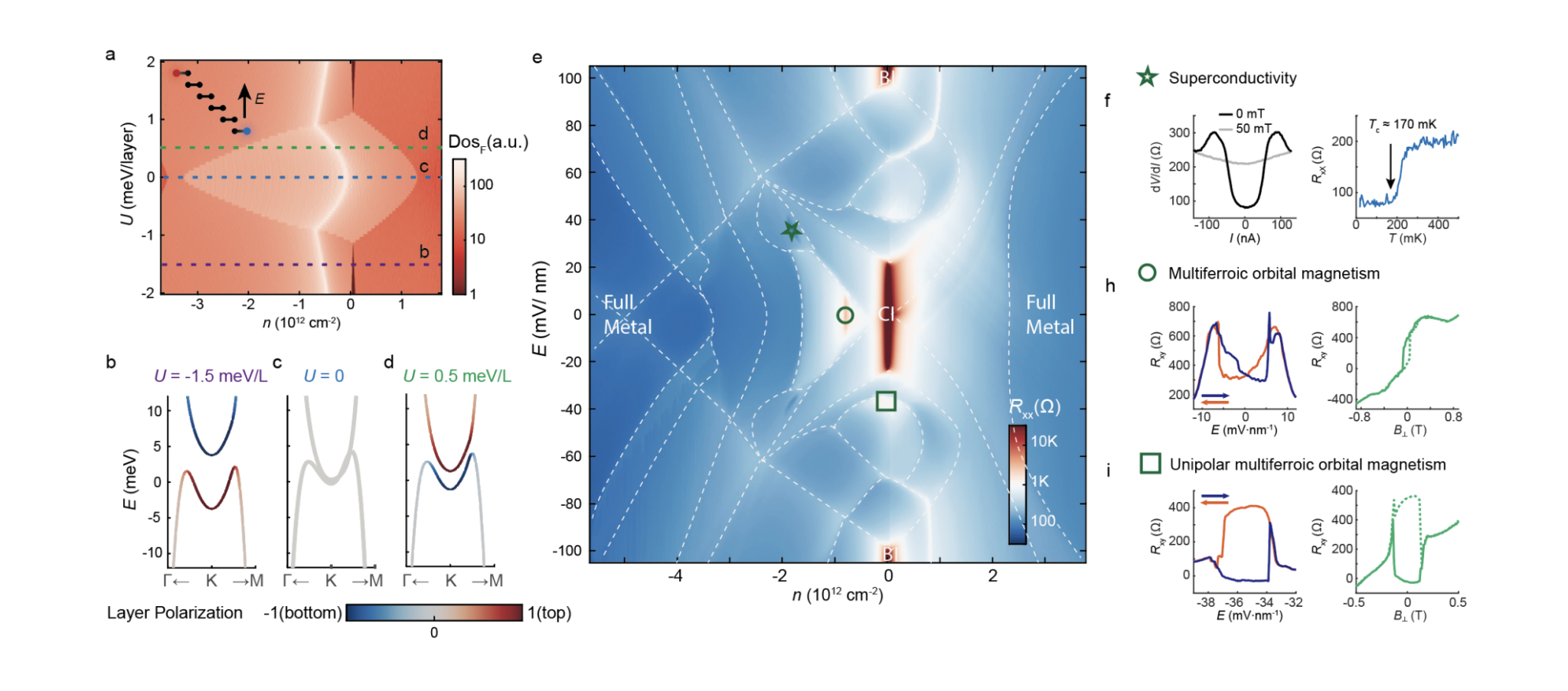
Researchers have discovered a remarkable interplay of quantum phases within rhombohedral multilayer graphene, revealing a rich phase diagram dominated by flavour-symmetry breaking and electric-field control. Experiments demonstrate the emergence of a superconducting-like state confined to a specific region where unique electron and hole Fermi surfaces overlap, exhibiting an onset temperature of approximately 170 mK. This low-resistance state persists remarkably up to an in-plane magnetic field of 6 T, more than an order of magnitude higher than the estimated Pauli limit of 300 mT, suggesting a robust and potentially fragile superconducting behaviour. The team further identified two distinct multiferroic orbital-magnetic phases, expanding our understanding of correlated electron systems.
Detailed analysis reveals that the magnetic hysteresis polarity can be controlled by the electric field, indicating a complex interplay between electric polarization and magnetization. This contrasts with previously reported multiferroicity in pentalayer graphene, where the magnetic hysteresis direction remains insensitive to electric field changes. Researchers observed a characteristic temperature of 1. 5 K for the multiferroic behaviour, and a novel connection between multiferroic order and superconductivity. The confinement of the superconducting state within the region of overlapping Fermi surfaces suggests a dual carrier origin, while the observed electric-field control over magnetic hysteresis opens exciting possibilities for manipulating quantum phases in these materials.
Electric Fields Tune Quantum Phases and Magnetism
This research details a comprehensive investigation into the electronic properties of rhombohedral multilayer materials, revealing a complex phase diagram governed by electric fields and carrier density. The team successfully mapped out regions exhibiting diverse quantum behaviours, including a superconducting-like state and two distinct multiferroic phases, a ferrovalley state and a ferroelectric state displaying reversible magnetic hysteresis. Crucially, they demonstrate an electric-field-driven band inversion, where the roles of electron and hole carriers are switched, fundamentally altering the material’s electronic structure. The study highlights the potential of this material platform to host a variety of quantum phases and correlated electronic states. However, the authors acknowledge certain anomalies observed in their data, specifically deviations from expected band degeneracy and discrepancies with previously proposed magnetic orderings. These observations suggest that the underlying physics may be more intricate than currently understood and require further investigation.
🗞 Superconductivity and Ferroelectric Orbital Magnetism in Semimetallic Rhombohedral Hexalayer Graphene
🧠 ArXiv: https://arxiv.org/abs/2508.15909