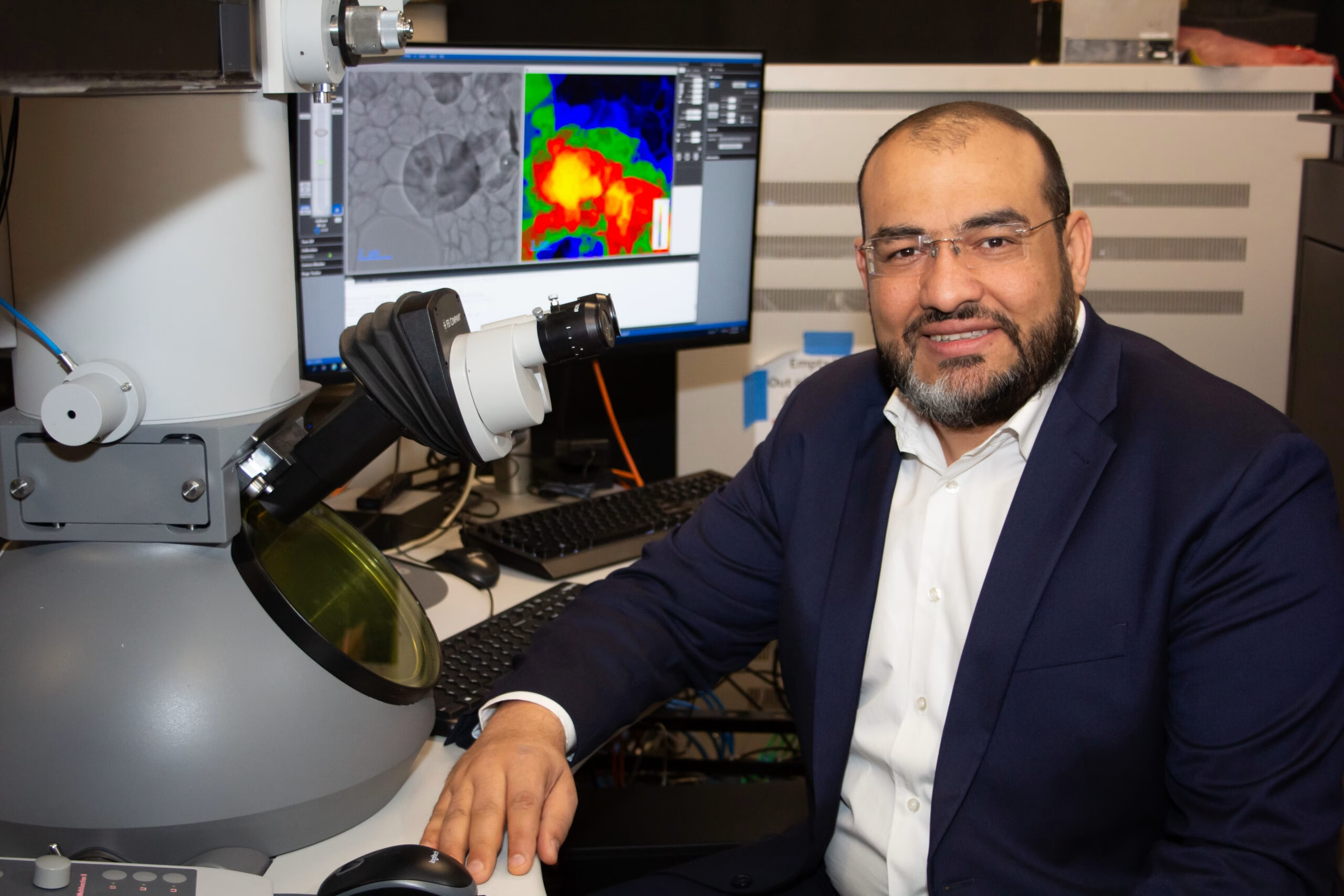
Researchers at the University of Arizona have developed the world’s fastest electron microscope, capable of imaging the motion of electrons in real-time and space. Led by Mohammed Hassan, associate professor of physics and optical sciences, the team has generated the first attosecond electron pulses, allowing for unprecedented temporal resolution. This breakthrough technology, dubbed “attomicroscopy,” can capture the invisible quantum world, enabling scientists to study electronic responses in biological systems, including DNA damage repair mechanisms and molecular electronics.
The microscope builds upon Nobel Prize-winning work by Pierre Agostini, Ferenc Krausz, and Anne L’Huilliere, who generated extreme ultraviolet radiation pulses measured in attoseconds. Hassan’s team used a powerful laser split into two parts: an electron pulse and two ultra-short light pulses. The “pump pulse” energizes the sample, while the “optical gating pulse” creates a brief window for the gated electron pulse to probe the sample.
This innovation has far-reaching implications for physics, chemistry, bioengineering, and materials sciences. As Hassan notes, “With this microscope, we hope the scientific community can understand the quantum physics behind how an electron behaves and how an electron moves.”
Attomicroscopy: Capturing the Invisible Quantum World
The development of the fastest electron microscope to date has been achieved by Mohammed Hassan’s group at the University of Arizona, funded by the W. M. Keck Foundation. This groundbreaking achievement enables the imaging of electron motion in real-time and space, allowing researchers to capture the invisible quantum world.
Attomicroscopy, a term coined by Hassan’s team, is a novel camera that can freeze-frame photograph moving electrons, which travel at incredible speeds, circling the Earth multiple times in a matter of seconds. This technology has far-reaching implications for various fields, including physics, chemistry, bioengineering, and materials sciences.
The Science Behind Attomicroscopy
Transmission electron microscopes are tools used by scientists to magnify objects up to millions of times their actual size, allowing them to observe details too small for traditional light microscopes. Instead of using visible light, these microscopes direct beams of electrons through the sample being studied. The interaction between the electrons and the sample is captured by lenses and detected by a camera sensor, generating detailed images of the sample.
Ultrafast electron microscopes, developed in the 2000s, use lasers to generate pulsed beams of electrons, increasing the microscope’s temporal resolution. The duration of these electron pulses determines the resolution of the transmission electron microscope. Faster pulses result in better image quality.
Overcoming Temporal Resolution Limitations
Previous ultrafast electron microscopes operated by emitting trains of electron pulses at speeds of a few attoseconds. However, scientists were still missing reactions and changes in electrons between these frames as they evolved in real-time. To overcome this limitation, Hassan’s team generated a single attosecond electron pulse, enhancing the microscope’s temporal resolution.
This achievement was inspired by the Nobel Prize-winning work of Pierre Agostini, Ferenc Krausz, and Anne L’Huilliere, who generated the first extreme ultraviolet radiation pulse measurable in attoseconds. By building upon this foundation, Hassan’s team developed a microscope that splits a powerful laser into two parts: a fast electron pulse and two ultra-short light pulses.
Applications of Attomicroscopy
The potential applications of attomicroscopy are vast and varied. In combination with cryo-electron microscopy, it could be used to study the rapid changes in biological samples, such as protein dynamics or cell membrane interactions. Additionally, attomicroscopy may enable researchers to observe ultrafast processes at the atomic level, shedding light on complex chemical reactions.
In the field of materials sciences, attomicroscopy could provide insights into the behavior of electrons in materials, leading to breakthroughs in fields like optoelectronics and nanotechnology. The development of attomicroscopy has opened up new avenues for scientific exploration, promising to revolutionize our understanding of the quantum world.
External Link: Click Here For More