Researchers at QuTech, a collaboration between TU Delft and TNO, have made a significant breakthrough in quantum computing by developing “somersaulting” spin qubits that can efficiently control large semiconductor qubit arrays. This achievement builds upon the 1998 proposal by Loss and DiVincenzo for quantum computation with quantum dots, which remained unimplemented until now. The QuTech team, led by principal investigator Menno Veldhorst, has demonstrated that “hopping gates” are possible, achieving state-of-the-art performance without the need for microwave signals.
The researchers used germanium, a semiconductor material that can rotate spins by itself, to create qubits that can hop between quantum dots. This property allows for effective control of the qubits, with error rates less than a thousand for one-qubit gates and less than a hundred for two-qubit gates. The team’s work, published in Science and Nature Communications, paves the way for simplified control electronics in future quantum processors. Key individuals involved in the research include Chien-An Wang, Floor van Riggelen-Doelman, and Valentin John.
Somersaulting Spin Qubits: A Leap Towards Efficient Quantum Logic
Researchers at QuTech have made a significant breakthrough in the development of universal quantum logic using somersaulting spin qubits. This achievement has the potential to enable efficient control of large semiconductor qubit arrays, bringing us closer to the realization of practical quantum computers.
The Origins of Hopping Spins
The concept of hopping spins as a basis for qubit logic was first proposed by Loss and DiVincenzo in 1998. However, experimental implementation of this idea had remained elusive until now. The researchers at QuTech have successfully demonstrated the feasibility of “hopping gates” with state-of-the-art performance, bridging the gap between theory and experiment.
Simplifying Control Electronics
Qubits based on quantum dots are widely studied as a promising platform for building quantum computers. Typically, these qubits rely on trapping a single electron and applying a large magnetic field to control the spin of the electron using microwave signals. However, the QuTech researchers have shown that no microwave signals are needed; instead, baseband signals and small magnetic fields can achieve universal qubit control. This simplification of control electronics is crucial for operating future quantum processors.
From Hopping to Somersaulting Qubits
Controlling spin requires hopping from dot to dot and a physical mechanism capable of rotating it. Initially, the proposal by Loss and DiVincenzo relied on a specific type of magnet, which proved difficult to realize experimentally. The QuTech researchers have pioneered the use of germanium, a semiconductor that conveniently allows for spin rotations. This is motivated by their previous work published in Nature Communications, where they demonstrated that germanium can serve as a platform for hopping of spin qubits.
The key difference between hopping and somersaulting qubits lies in the unique property of germanium. When electron spins hop from one quantum dot to another, they experience a torque that makes them somersault, allowing researchers to control the qubits effectively. This property enables the creation of very good qubits with error rates less than a thousand for one-qubit gates and less than a hundred for two-qubit gates.
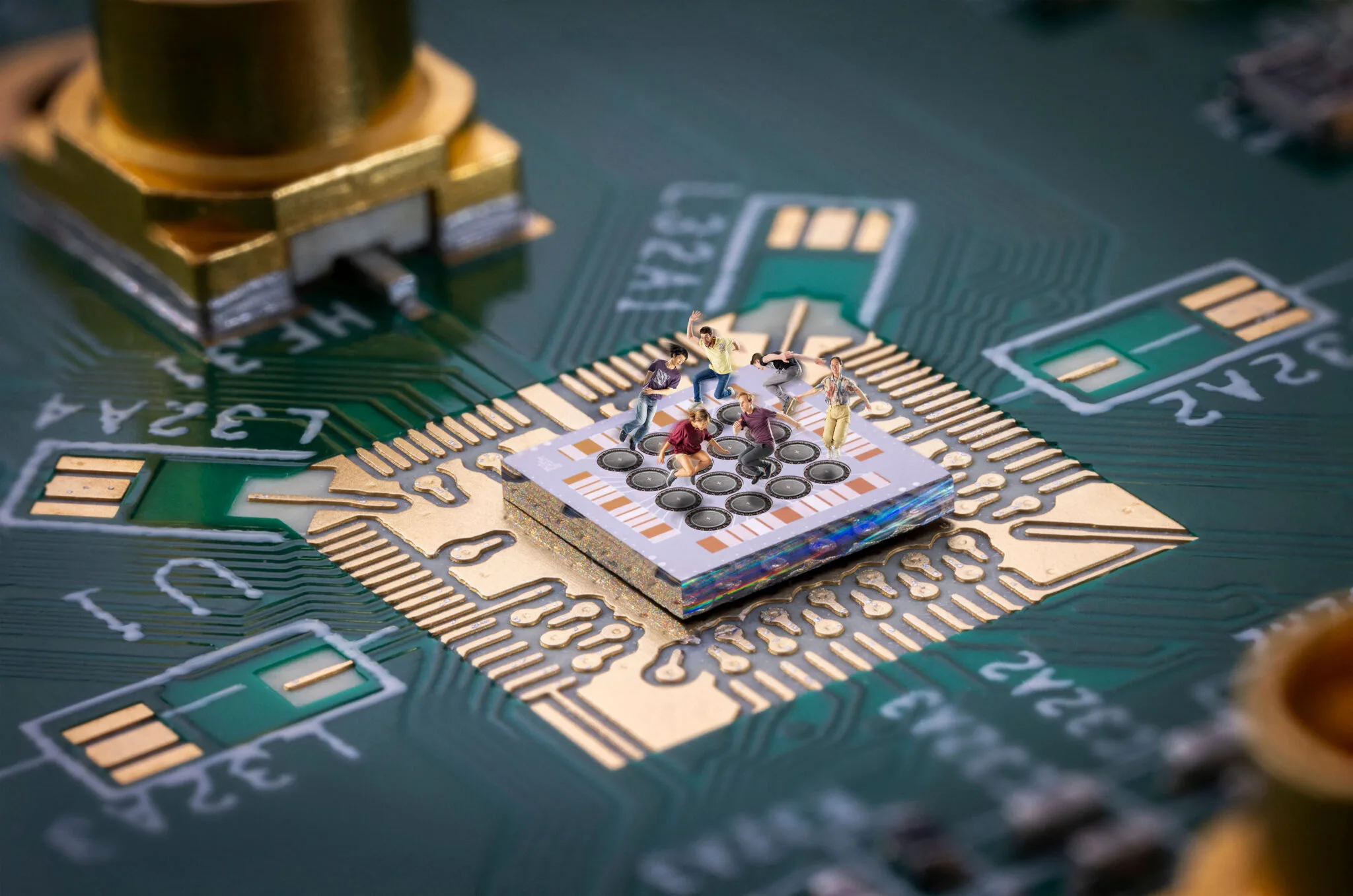
Scaling Up: Somersaulting Qubits in a Trampoline Park
Having established control over two spins in a four-quantum dot system, the team took it a step further by investigating hopping through several quantum dots. This corresponds to a person hopping and somersaulting over many trampolines, where different trampolines result in unique rotations. The researchers have characterized and understood the variability of these rotations, establishing control routines that enable hopping spins to any quantum dot in a 10-quantum dot array.
Team Effort and Future Prospects
The principal investigator, Menno Veldhorst, emphasizes the importance of teamwork in achieving this breakthrough. The observation of qubit rotations due to hopping has become a tool used by the entire group, and they believe it is critical to develop efficient control schemes for operating future quantum computers. This new approach holds promise for the development of practical quantum computers.
External Link: Click Here For More