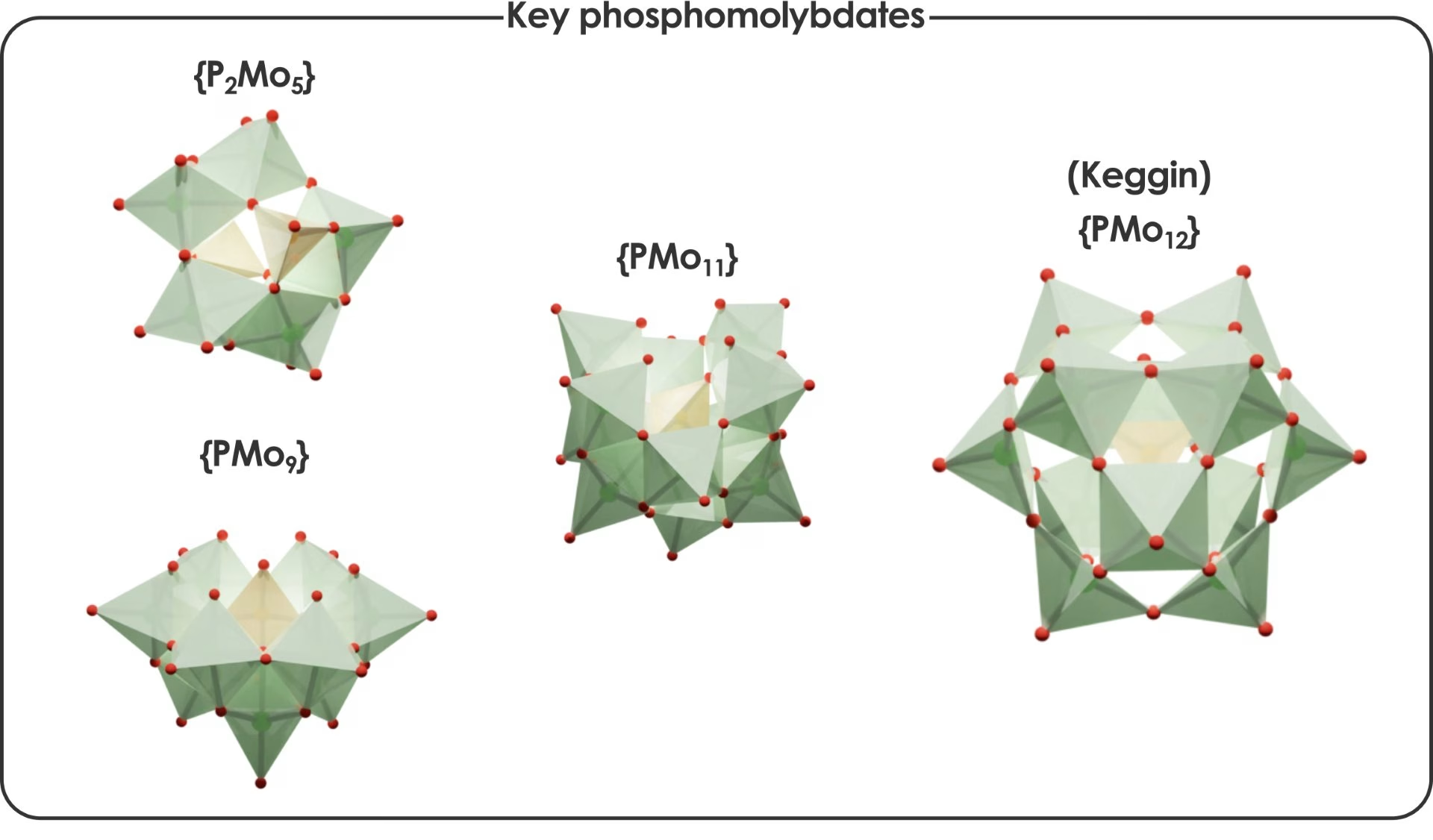
Researchers at the Institute of Chemical Research of Catalonia have developed a new computational methodology to predict the complex formation of nanostructures called polyoxometalates (POMs). These versatile nanostructures, composed of transition metal atoms linked by oxygens, have important applications in catalysis, energy storage, biology, and medicine. Led by Prof. Carles Bo, the team has created an open-source tool, POMSimulator, which simulates complex processes involving different chemical species and diverse conditions.
This allows researchers to predict the effect of various factors on POM formation and identify suitable conditions to produce specific species. The methodology has been enhanced to provide new insights into the distribution of species under different chemical conditions. According to Jordi Buils, a PhD student and first author of the work, this approach takes POMSimulator to the next level of data usage. The research, published in Chemical Science, has the potential to discover experimental conditions needed to create new materials with significant applications.
Predicting the Formation of Complex Nanostructures with Computational Methodology
Researchers from the Institute of Chemical Research of Catalonia (ICIQ-CERCA) have developed a computational methodology that simulates complex processes involving different chemical species and diverse conditions, leading to the formation of nanostructures called polyoxometalates (POMs). These POMs have important applications in catalysis, energy storage, biology, and medicine. The methodology employs statistical methods to facilitate the efficient and scalable processing of numerous speciation models and their corresponding systems of non-linear equations.
The formation of POMs is a complex process that depends on various factors such as pH, temperature, pressure, total metal concentration, ionic force, and the presence of reducing agents and counter-ions. The interplay of these conditions makes it challenging to control the synthesis of POMs. However, with this new methodology, researchers can now predict the effect of these factors and identify the suitable conditions to produce a specific species of POM. This is crucial in catalysis, where POMs are known to accelerate several important reactions.
For instance, using these simulations, it is possible to describe the suitable conditions that lead to the production of a species of POM responsible for catalyzing CO2 fixation. The ability to predict and control the formation of specific POMs can have significant implications for various fields, including energy storage and biology.
The Versatility of Polyoxometalates (POMs)
Polyoxometalates are a distinguished family of nanostructures composed of transition metal atoms linked by oxygens, forming a wide range of well-defined structures of different sizes and shapes. These nanostructures are formed via self-assembly processes of simple metal oxides, depending on various factors such as pH, temperature, pressure, total metal concentration, ionic force, and the presence of reducing agents and counter-ions.
The unique properties of POMs make them suitable for various applications. For example, they can accelerate several important reactions in catalysis, making them potential candidates for developing more efficient catalysts. Additionally, their ability to interact with biological molecules makes them promising tools for biomedical applications.
The POMSimulator: An Open-Source Software Package
The group of Prof. Carles Bo has presented an open-source software package named POMSimulator that helps in understanding the formation mechanisms of polyoxometalates. By releasing a public version of the code, the researchers aim to provide a tool for complementing the discovery of novel polyoxometalates.
The POMSimulator is designed to facilitate the efficient and scalable processing of numerous speciation models and their corresponding systems of non-linear equations. This enables researchers to predict the effect of various factors on the formation of POMs and identify the suitable conditions to produce a specific species of POM.
Enhancements to the POMSimulator: A More Robust Version
The methodology now presented is a more robust version of the POMSimulator that provides new and valuable insights into the distribution of species under different chemical conditions. This enhances the knowledge of complex systems speciation, allowing researchers to better understand the formation mechanisms of polyoxometalates.
In the era of Big Data, Machine Learning, and Artificial Intelligence, it is crucial to use every bit of information available. The enhancements to the POMSimulator have taken the software package to the next level of data usage, enabling researchers to extract more valuable insights from their data.
The publication of this work in Chemical Science, the Royal Society of Chemistry’s peer-reviewed flagship journal, highlights the cutting-edge nature of this research. The selection of this work as a Chem Sci Pick of the Week further underscores its significance and potential impact on the field of polyoxometalates research.
External Link: Click Here For More