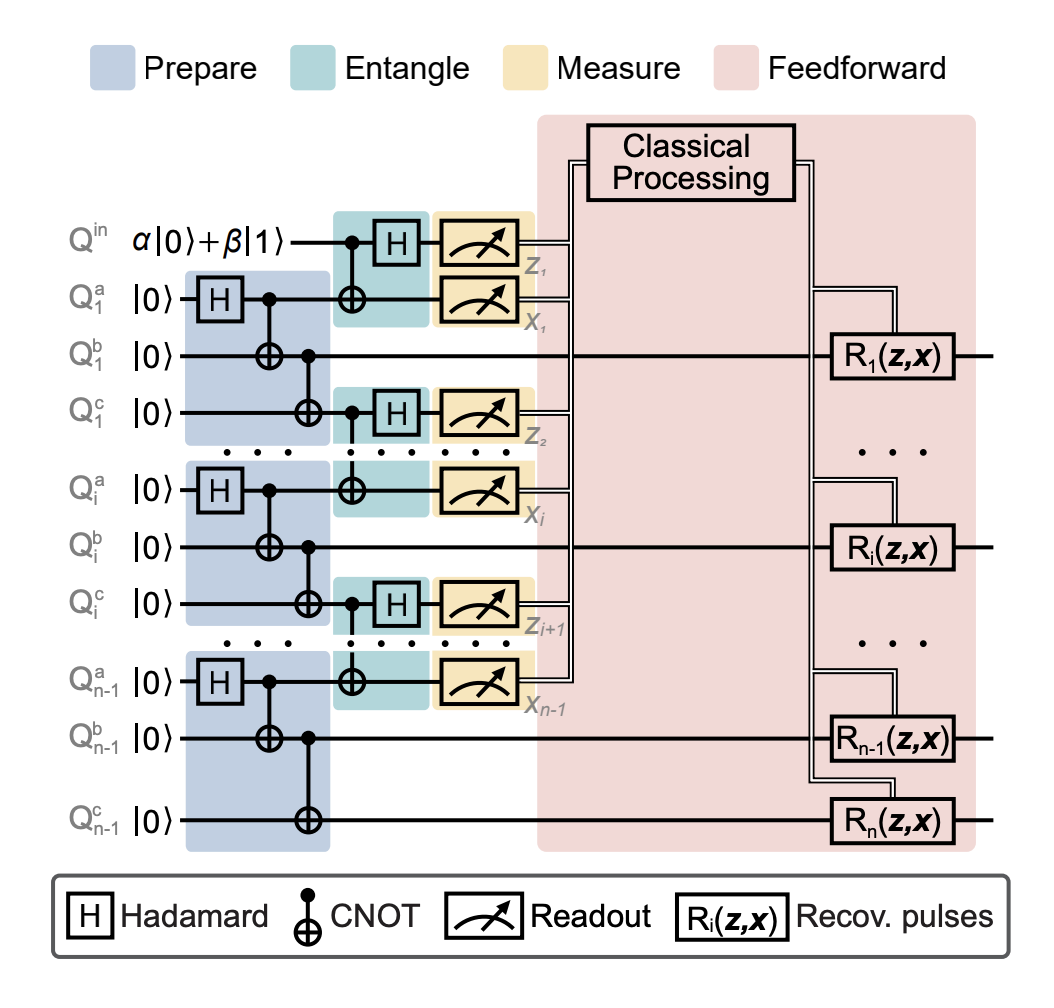
Researchers have made a breakthrough in quantum computing, achieving an independent success rate for each operation with an error rate of ε. This milestone was reached by multiplying the success probability of all elementary operations, including CNOT gates, measurements, and idling times. The team used randomized benchmarking to extract single-qubit errors and characterized single-shot readout to determine measurement errors.
They also assumed that idling errors arise from a depolarizing channel acting on each qubit at their Hahn-echo dephasing rate. This work builds upon previous research in quantum state tomography and was made possible by the development of advanced technologies, including FPGA processing and quantum gate sequences. Companies involved in this work include those specializing in quantum computing hardware and software. The researchers’ findings have significant implications for the development of reliable and efficient quantum computers.
The authors are discussing a method to estimate the total error of a quantum circuit, which is crucial for building reliable quantum computers. They assume that the total error (εtot) can be broken down into three main components: CNOT gate errors (εCNOT), measurement errors (εmeas), and idling errors (εidle). These errors are assumed to be incoherent and uncorrelated, meaning they don’t interact with each other.
The authors propose two equations to estimate the total error. The first equation (C1) is used when all elementary operations have been benchmarked, whereas the second equation (C2) is used to predict the error of a sequence at a larger circuit size than what’s been experimentally tested.
In equation C1, the success probability of the full sequence is calculated by multiplying the success probabilities of each individual operation. This is done by taking into account the number of operations of each type (nCNOT, nmeas, and nidle) and their corresponding error rates (εCNOT, εmeas, and εidle).
To determine these error rates, the authors use various methods:
- CNOT gate errors are estimated as the sum of one CZ gate error and two single-qubit errors, which are extracted from randomized benchmarking.
- Measurement errors are obtained by characterizing single-shot readout (see Appendix A).
- Idling errors arise from a depolarizing channel acting on each qubit at their Hahn-echo dephasing rate for a duration of the corresponding idling time.
In equation C2, individual errors are replaced with average error rates of the same type. This allows for predicting the error of a sequence at a larger circuit size than what’s been experimentally tested.
The authors also provide a table listing the occurrence of each error source for three specific circuits.
Lastly, they describe a 1-to-4 fan-out gate sequence, which is decomposed into single-qubit rotations and CZ gates. The time budget for each step is shown, along with background colors indicating the prepare, entangle, measure, and feedforward steps depicted in Fig. 1.
Overall, this paper presents a valuable method for estimating errors in quantum circuits, which is essential for building reliable and scalable quantum computers.
External Link: Click Here For More