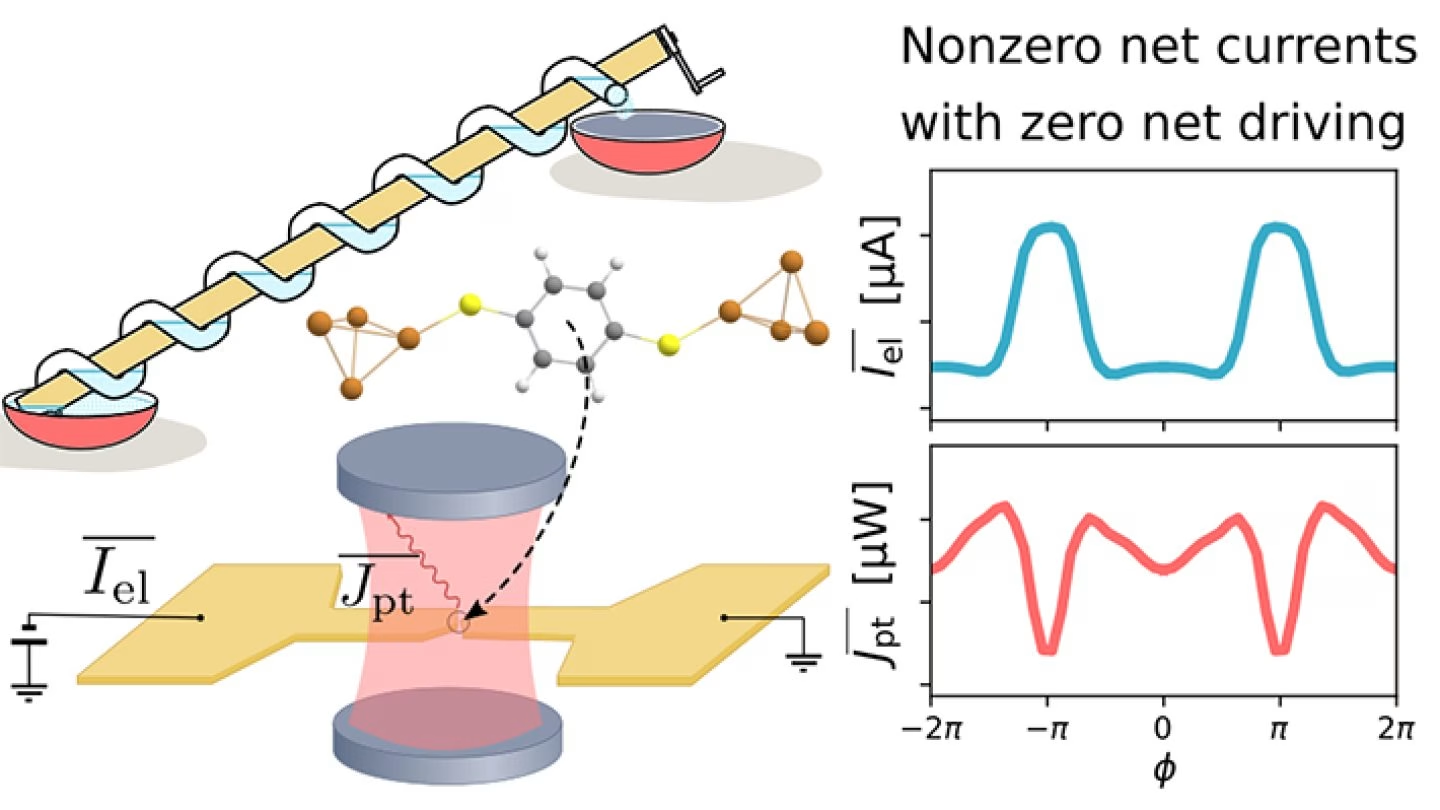
Researchers at the University of Jyväskylä and Wroclaw University of Science and Technology have developed a new theoretical modeling technique that could potentially be used in the development of switches or amplifiers in molecular electronics.
The study, led by Senior Lecturer Riku Tuovinen from the University of Jyväskylä, focuses on the quantum pump effect in a benzenedithiol molecule connected to two copper electrodes and coupled with cavity photons. This new modeling technique provides an experimentally relevant time scale for the study of molecular junctions, which could lead to breakthroughs in molecular electronics.
The researchers found that the molecular system they studied can produce significant light emission and high harmonic generation, similar to what has been observed in solid-state materials. The configuration could potentially be used as a switch or amplifier in molecular electronics, with the efficiency of the molecular quantum pump depending on the magnitude and phase difference of the driving voltages.
Quantum Pumping in Molecular Junctions: A New Theoretical Modelling Technique
The study of molecular electronics, which focuses on the movement of electrons in junctions formed by individual molecules, has long been hindered by the challenge of aligning theoretical models with experimental observations. The time scales of these models are typically very fast compared to those observed experimentally, making it difficult to develop accurate predictions. However, a new modelling technique developed by researchers at the University of Jyväskylä and Wroclaw University of Science and Technology has provided an experimentally relevant time scale for the study of molecular junctions.
The new theoretical method was used to investigate a setup in which a benzenedithiol molecule is coupled to copper electrodes and interacts with light in a cavity. The results show that this molecular system can produce significant light emission and high harmonic generation, similar to what has been observed in solid-state materials rather than in atomic or molecular systems. This phenomenon is attributed to the quantum pump effect, where the driving voltages induce a directional flow of energy.
The researchers refer to the studied setting as a kind of molecular quantum pump, where the efficiency depends on the magnitude and phase difference of the driving voltages. This is analogous to how the efficiency of Archimedes’ screw depends on the tilting angle and spiral step. The configuration could potentially be used as a switch or amplifier in molecular electronics, with symmetries in the configuration capable of either suppressing or enhancing certain light frequencies.
The study, published in Nano Letters on 10 July 2024, provides new insights into the quantum pump effect in molecular junctions and its potential applications in molecular electronics. The development of this new theoretical modelling technique is a significant step forward in understanding the behavior of electrons in molecular systems and could lead to the creation of novel electronic devices.
The Quantum Pump Effect in Molecular Junctions
The quantum pump effect is a phenomenon where a directional flow of energy is induced by driving voltages, resulting in the emission of light or high harmonic generation. In the context of molecular electronics, this effect has been observed in a benzenedithiol molecule coupled to copper electrodes and interacting with light in a cavity.
The study found that the quantum pump effect in this molecular system produces significant light emission and high harmonic generation, similar to what has been observed in solid-state materials rather than in atomic or molecular systems. This is attributed to the strong coupling between the molecule and the cavity photons, which enables the efficient transfer of energy.
The researchers’ results show that the efficiency of the molecular quantum pump depends on the magnitude and phase difference of the driving voltages. This is analogous to how the efficiency of Archimedes’ screw depends on the tilting angle and spiral step. The configuration could potentially be used as a switch or amplifier in molecular electronics, with symmetries in the configuration capable of either suppressing or enhancing certain light frequencies.
The study provides new insights into the quantum pump effect in molecular junctions and its potential applications in molecular electronics. The development of this new theoretical modelling technique is a significant step forward in understanding the behavior of electrons in molecular systems and could lead to the creation of novel electronic devices.
Molecular Electronics: A Promising Field for Novel Electronic Devices
Molecular electronics is a rapidly growing field that focuses on the study of how electrons move in junctions formed by individual molecules. The goal of this field is to develop novel electronic devices that can be used in a wide range of applications, from computing and energy storage to biomedical devices.
The development of molecular electronics has been hindered by the challenge of aligning theoretical models with experimental observations. However, the new modelling technique developed by researchers at the University of Jyväskylä and Wroclaw University of Science and Technology provides an experimentally relevant time scale for the study of molecular junctions.
The study’s results show that molecular systems can produce significant light emission and high harmonic generation, similar to what has been observed in solid-state materials rather than in atomic or molecular systems. This phenomenon is attributed to the quantum pump effect, where the driving voltages induce a directional flow of energy.
The development of this new theoretical modelling technique is a significant step forward in understanding the behavior of electrons in molecular systems and could lead to the creation of novel electronic devices. The potential applications of molecular electronics are vast, and further research in this field could lead to breakthroughs in a wide range of areas.
Theoretical Modelling Techniques: A Key to Understanding Molecular Electronics
Theoretical modelling techniques play a crucial role in understanding the behavior of electrons in molecular systems. These techniques enable researchers to simulate the behavior of molecules and predict their properties, which is essential for the development of novel electronic devices.
The new modelling technique developed by researchers at the University of Jyväskylä and Wroclaw University of Science and Technology provides an experimentally relevant time scale for the study of molecular junctions. This technique enables researchers to investigate the quantum pump effect in molecular systems, which is a key phenomenon that could be used in the development of novel electronic devices.
Theoretical modelling techniques are essential for understanding the behavior of electrons in molecular systems and for predicting their properties. The development of this new technique is a significant step forward in understanding molecular electronics and could lead to breakthroughs in a wide range of areas.
Future Directions: Developing Novel Electronic Devices
The study’s results show that molecular systems can produce significant light emission and high harmonic generation, similar to what has been observed in solid-state materials rather than in atomic or molecular systems. This phenomenon is attributed to the quantum pump effect, where the driving voltages induce a directional flow of energy.
The development of this new theoretical modelling technique is a significant step forward in understanding the behavior of electrons in molecular systems and could lead to the creation of novel electronic devices. The potential applications of molecular electronics are vast, and further research in this field could lead to breakthroughs in a wide range of areas.
Future directions for research in this area include the development of new theoretical modelling techniques that can simulate the behavior of molecules with even greater accuracy. This could involve the use of advanced computational methods, such as machine learning algorithms, to improve the efficiency and accuracy of simulations.
Additionally, researchers could investigate the potential applications of molecular electronics in a wide range of areas, from computing and energy storage to biomedical devices. The development of novel electronic devices that can be used in these areas could have a significant impact on society and could lead to breakthroughs in a wide range of fields.
External Link: Click Here For More