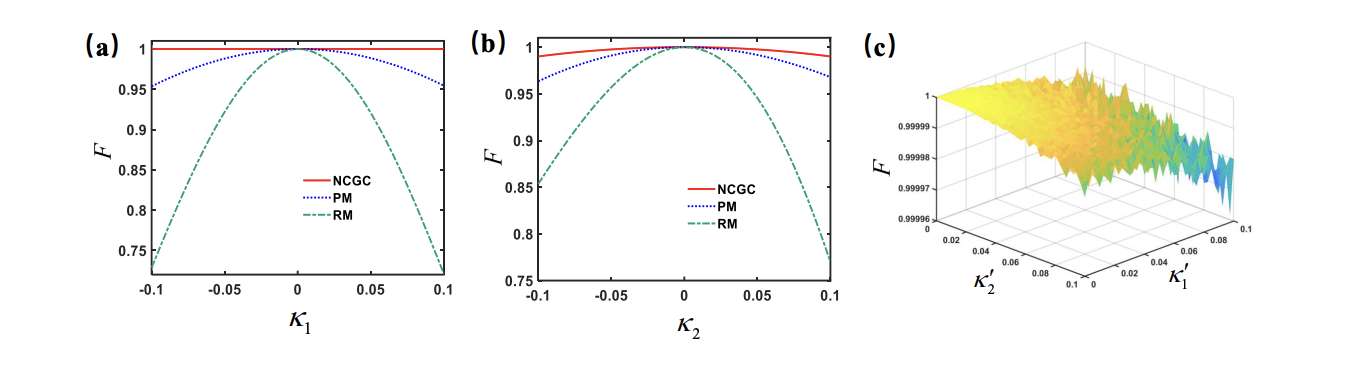
Researchers from various laboratories and research centers in China have developed a method for implementing a two-qubit controlled-phase gate using Rydberg blockade in quantum computing. The team achieved noncyclic geometric control with a single modulated pulse, which is more robust against systematic errors and reduces gate time. The protocol was applied to the algorithm of quantum Fourier transformation, demonstrating its potential for accelerating operations. The researchers also introduced a protocol for realizing controlled-phase gates in atomic arrays with Rydberg interaction, which is robust against random noise and systematic errors.
Introduction to Quantum Computing with Rydberg Atoms
Quantum computing is a rapidly evolving field, and arrays of neutral atoms have emerged as promising platforms for this technology. A significant task in this area is the realization of high-fidelity two-qubit gates with robustness for large-scale operations. A team of researchers from the Key Laboratory of Atomic and Subatomic Structure and Quantum Control Ministry of Education, Guangdong Basic Research Center of Excellence for Structure and Fundamental Interactions of Matter, School of Physics South China Normal University, Guangdong Provincial Key Laboratory of Quantum Engineering and Quantum Materials, and Guangdong-Hong Kong Joint Laboratory of Quantum Matter, Frontier Research Institute for Physics South China Normal University, have presented a convenient approach for implementing a two-qubit controlled-phase gate using Rydberg blockade.
Rydberg Blockade and Noncyclic Geometric Control
The team achieved noncyclic geometric control with a single modulated pulse. This control scheme is more robust against systematic errors due to its geometric characteristic. Importantly, the noncyclic geometric control reduces the gate time for small rotation angles and is more insensitive to the decoherence effect. The researchers accelerated the adiabatic control with the aid of shortcuts to adiabaticity to further shorten the operation time.
Application to Quantum Fourier Transformation
The protocol was applied to the algorithm of quantum Fourier transformation to demonstrate the actual acceleration. The proposed scheme provides analytical waveforms for arbitrary two-qubit gates and may have important use in the experiments of atomic arrays.
Two-Qubit Gates with Rydberg Interaction
Two-qubit gates with neutral atoms can be implemented by driving atoms to highly excited Rydberg states, which utilizes the strong and long-range interactions. Many improvements have been made to improve the two-qubit gate fidelity in the past decade. Recently, high-fidelity parallel entangling gates have been realized on a neutral atomic system. The next stage important task will be the realization of addressable two-qubit gates which would accommodate more robust and faster quantum control.
Controlled-Phase Gates with Noncyclic Geometric Control
The researchers introduced a protocol for the realization of controlled-phase (C-Z) gates in atomic arrays with Rydberg interaction. The geometric control with adiabatic driving would be a natural choice which is robust against random noise and the systematic errors. However, adiabatic evolution is inherently slow and susceptible to dissipation. To expedite the adiabatic process, shortcut to adiabaticity (STA) methods are considered advantageous.
Robustness of the Protocol
The robustness of the protocol against random noise and systematic errors was discussed, and its performance under the influence of decoherence was explored. The operation time of the noncyclic scheme will be much shorter than the cyclic one as long as the rotation angle of the two-qubit gates getting smaller.
Conclusion
The researchers concluded their proposal provides a fast and robust way to realize a two-qubit gate in atomic arrays with analytical control waveforms. The structure of this paper is as follows: In section II, the control model of a two-qubit gate with Rydberg blockade is introduced. Section III presents the proposal of controlled-phase gates with noncyclic geometric control (NCGC) and STA. In section IV, the robustness of the protocol against random noise and systematic errors is discussed, and its performance under the influence of decoherence is explored. Section V compares the time required for the quantum Fourier transform between NCGC and the cyclic case. The paper is summarized and concluded in section VI.
The article titled “Single-modulated-pulse two-qubit gates for Rydberg atoms with noncyclic geometric control” was published on February 1, 2024. The authors of this research are Ziyuan Chen, J.-Q. Liang, Zhenming Fu, Hongzhi Liu, Zhibin He, M. Wang, Zhongchao Han, Jiayi Huang, Qing-Xian Lv, and Yan-Xiong Du. The article was sourced from arXiv, a repository managed by Cornell University. The research can be accessed through the DOI reference https://doi.org/10.48550/arxiv.2402.01113.