

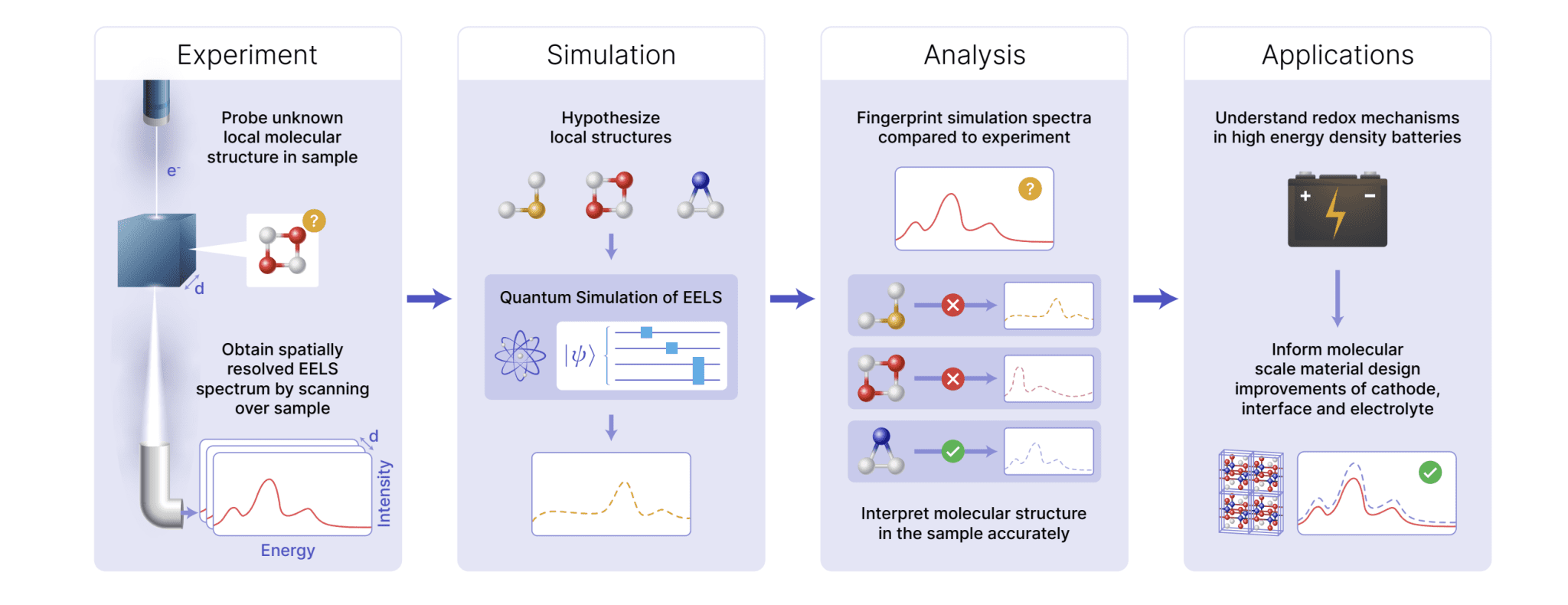
Understanding the dynamic behaviour of electrons within materials is crucial for designing next-generation technologies, particularly improved batteries, but accurately modelling this behaviour presents a significant computational challenge. Alexander Kunitsa, Diksha Dhawan, and Stepan Fomichev, all from Xanadu, alongside colleagues including Juan Miguel Arrazola and Minghao Zhang from the University of Chicago, now demonstrate a new approach using quantum simulation to overcome these limitations. Their work focuses on electron energy loss spectroscopy (EELS), a technique that reveals detailed information about a material’s elemental composition and electronic structure at the nanoscale, and is vital for analysing battery materials. By developing a quantum algorithm to compute the dynamic structure factor, a key quantity in interpreting EELS data, the team successfully simulates the EELS spectrum of lithium manganese oxide, paving the way for more efficient design and optimisation of battery cathodes and beyond.
Considerable challenge exists for classical computational methods when simulating dynamic spectral functions (DSF). This work presents a quantum algorithm and an end-to-end simulation framework to compute the DSF, providing a general approach for simulating momentum-resolved spectroscopies. The team applies this approach to the simulation of electron energy loss spectroscopy (EELS) in the core-level electronic excitation regime, a spectroscopic technique offering sub-nanometer spatial resolution and capable of resolving element-specific information, crucial for analysing battery materials. Researchers derive a quantum algorithm for computing the DSF for EELS by evaluating the off-diagonal terms of the time-domain Green’s function, enabling the simulation.
Electronic Structure Theory and Spectroscopy Simulations
This research focuses on understanding the electronic structure of materials and simulating spectroscopic data, particularly using X-ray and near-infrared techniques. These simulations help researchers probe the composition and electronic behaviour of materials, driving the development of new algorithms and software tools to solve complex electronic structure problems beyond the reach of conventional computers. Much of this work centres on materials like lithium manganese oxide and vanadium pentoxide, which are important for battery technology and catalysis, with continuous improvement of computational methods aiming for greater accuracy, efficiency, and applicability to larger, more complex systems. Several computational methods are employed, including highly accurate, but computationally demanding, techniques like CASPT2 and CCSD for calculating excited states.
DMRG is a powerful method for strongly correlated systems, particularly those with one or quasi-one-dimensional structures, while Quantum Filter Diagonalization offers an efficient way to calculate excited states. Density Functional Theory (DFT), using functionals like PBE0, is also widely used, often with core-valence separation approximations to reduce computational cost. Other techniques include the Block2 DMRG implementation, the Linear Combination of Unitaries (LCU) for simulating quantum Hamiltonians, and Compressed Double-Factorized Hamiltonians for reducing computational demands. The research utilizes various software tools and resources, including Block2, a DMRG implementation, and PennyLane, a Python library for developing hybrid quantum-classical computations.
Researchers employ basis sets, sets of mathematical functions representing atomic orbitals, to perform electronic structure calculations, using software packages for CASSCF/CASPT2 and DMRG calculations. The work focuses on materials like lithium manganese oxide, a layered oxide used in lithium-ion batteries, and vanadium pentoxide, a material used in catalysis and energy storage, investigating their structure, electronic properties, and behaviour in relevant applications. In summary, this research represents a cutting-edge collection of efforts in computational chemistry and materials science. It increasingly leverages quantum computing to tackle complex electronic structure problems, developing new theoretical methods, software tools, and applying them to study important materials for energy storage and catalysis.
Dynamic Structure Factor from Time-Domain Greens Function
Researchers have developed a new quantum algorithm and simulation framework to accurately compute the dynamic structure factor (DSF), a crucial quantity for interpreting materials science experiments, particularly inelastic scattering. This breakthrough addresses a significant challenge for classical computational methods, offering a new approach for simulating momentum-resolved spectroscopies like electron energy loss spectroscopy (EELS). The method enables detailed analysis of materials with sub-nanometer spatial resolution, crucial for understanding complex systems such as battery materials and their oxygen redox mechanisms. The team derived an algorithm for computing the DSF for EELS by evaluating off-diagonal terms within the time-domain Green’s function, paving the way for simulating spectroscopies previously inaccessible to accurate computation, and demonstrated its feasibility and accuracy on lithium manganese oxide, a prototypical cathode material.
For a model oxygen-centered cluster with an active space of 18 orbitals, the algorithm requires a circuit depth of T gates, 100 logical qubits, and roughly shots to operate. Resource estimates indicate that the largest circuit depth requires approximately 10⁸, 10⁹ T gates and 10⁴ shots, utilizing around 100 logical qubits, demonstrating the potential for implementation on early fault-tolerant quantum computers. These estimates were achieved through highly optimized quantum subroutines, including the Sum of Slaters state preparation method and Trotter product formulas for Hamiltonian time evolution, confirming the ability to accurately compute EELS for classically intractable electronic structure models, opening new avenues for materials discovery and optimization.
Simulating Battery Material Spectra on Quantum Computers
This work presents a new quantum simulation framework for computing the dynamic structure factor, a crucial quantity for interpreting data from various inelastic scattering experiments. The researchers developed a quantum algorithm that accurately models the off-diagonal terms of the time-domain Green’s function, enabling the simulation of momentum-resolved spectroscopies, which are essential for understanding the orientation and momentum dependence of spectral features. They successfully applied this method to simulate core-loss electron energy loss spectroscopy (EELS) for lithium manganese oxide, a key material in battery technology. The team demonstrated the feasibility of simulating these complex systems on early fault-tolerant quantum computers by establishing optimized parameters and showing accurate reproduction of spectral features with a moderate number of measurements. A significant aspect of this research involved constructing a validated cluster model of lithium manganese oxide, directly derived from experimental crystal structure, to ensure the physical relevance of the simulations and correctly reproduce known material properties. The authors acknowledge that further research is needed to extend these results to other momentum-resolved spectroscopies and explore broader applications within materials science.
👉 More information
🗞 Quantum Simulation of Electron Energy Loss Spectroscopy for Battery Materials
🧠 ArXiv: https://arxiv.org/abs/2508.15935


