Researchers have developed a quantum algorithm for protein structure prediction utilising a face-centred cubic lattice model, and demonstrated its feasibility on both a simulator and IBM Cleveland and IBM Kingston quantum hardware. The algorithm employs two methods – PolyFit and Variational Quantum Eigensolver with Equality Constraints (VQEC) – to manage computational constraints without requiring additional qubits, with VQEC outperforming PolyFit in tests conducted on a small peptide sequence. This work represents a step towards leveraging quantum computing to address the protein folding problem, though scalability and error mitigation remain key challenges for future research.
Quantum Algorithm for Protein Structure Prediction
The authors present a quantum algorithm for protein structure prediction (QPSP) utilising a face-centred cubic (FCC) lattice model, addressing the balance between lattice complexity and algorithmic efficiency. Two methods, PolyFit and Variational Quantum Eigensolver with Equality Constraints (VQEC), were introduced to manage non-overlapping constraints within the Hamiltonian without requiring additional qubits.
The feasibility of this approach was demonstrated using the small peptide KLVFFA, with both simulation and quantum hardware, specifically IBM Cleveland and IBM Kingston processors. Results indicate that VQEC outperformed PolyFit and that newer hardware (IBM Kingston) yielded improved results compared to older hardware.
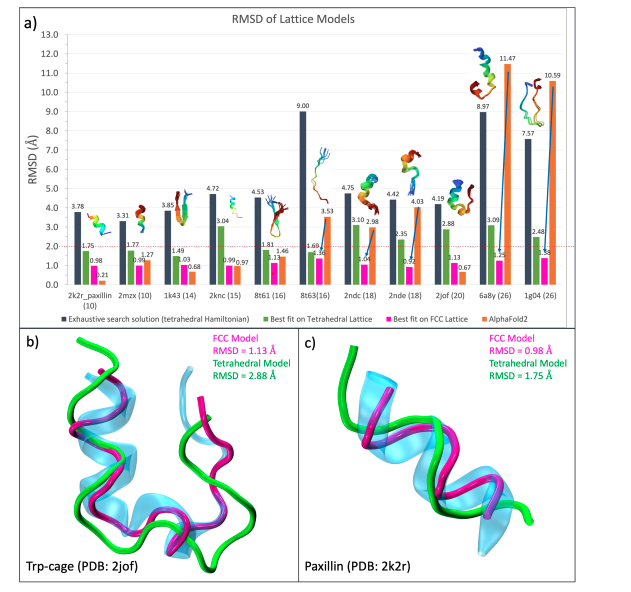
The work contributes a novel lattice model, offering a balance between structural flexibility and computational complexity when compared to previously used cubic or tetrahedral lattices. The paper details the encoding of protein sequence into the Hamiltonian, including contact energies and the non-overlapping constraint, alongside explanations of the PolyFit and VQEC methods.
A comparative analysis was undertaken between PolyFit and VQEC, as well as between the results obtained from different quantum processors, providing valuable insights into algorithmic performance and hardware capabilities. The authors acknowledge the limitations of the study and suggest potential avenues for future research, including scalability to larger proteins and the development of error mitigation techniques.
Lattice Model and Hamiltonian Construction
The lattice model employed is face—centred cubic (FCC), offering a balance between structural flexibility and computational complexity compared to previously used cubic or tetrahedral lattices. The Hamiltonian construction encodes the protein sequence, incorporating both contact energies and a non-overlapping constraint designed to prevent overlap of the protein structure.
Two methods were developed to manage the non-overlapping constraint within the Hamiltonian: PolyFit and Variational Quantum Eigensolver with Equality Constraints (VQEC). These methods were designed to function without requiring additional qubits.
Detailed explanations of both PolyFit and VQEC are provided within the paper, outlining their respective approaches to handling the non-overlapping constraint. The quantum circuits used to implement the algorithm are also described.
Experiments were conducted utilising both simulation and quantum hardware – specifically, IBM Cleveland and IBM Kingston processors – to assess the feasibility of the approach. A comparative analysis was undertaken between the performance of PolyFit and VQEC, as well as between the results obtained from the different quantum processors.
Results and Comparative Analysis
The results of simulations and hardware experiments are presented, utilising figures and tables to convey the data effectively. A comparative analysis was undertaken between PolyFit and VQEC, as well as between results from different quantum processors, providing valuable insights.
The authors acknowledge the limitations of the study and suggest directions for future research, including scalability to larger proteins and the development of error mitigation techniques.
Potential areas for further exploration include investigating techniques for reducing the number of qubits required or for simplifying the Hamiltonian, as this may be crucial for scaling the algorithm to larger proteins.
More realistic potentials, such as those that account for solvent effects or side-chain flexibility, could improve the accuracy of predictions. Combining quantum algorithms with classical molecular dynamics simulations could also leverage the strengths of both approaches.
Exploring different lattice models, incorporating more complex topologies, could lead to improved results. A thorough comparison of the quantum algorithm’s performance against state-of-the-art classical methods would be valuable.
Developing automated methods for optimising the hyperparameters of the VQEC algorithm could improve performance and reduce the need for manual tuning.
Future Research and Scalability
A major challenge lies in scaling the algorithm to larger proteins, with investigation into techniques for reducing the number of qubits required or simplifying the Hamiltonian considered crucial. Incorporating more realistic potentials, such as those accounting for solvent effects or side chain flexibility, could improve the accuracy of predictions.
Combining quantum algorithms with classical molecular dynamics simulations could leverage the strengths of both approaches. Exploring different lattice models, incorporating more complex topologies, could also lead to improved results.
A thorough comparison of the performance of the quantum algorithm against state-of-the-art classical methods would be valuable. Developing automated methods for optimising the hyperparameters of the VQEC algorithm could improve performance and reduce the need for manual tuning.
More information
External Link: Click Here For More