

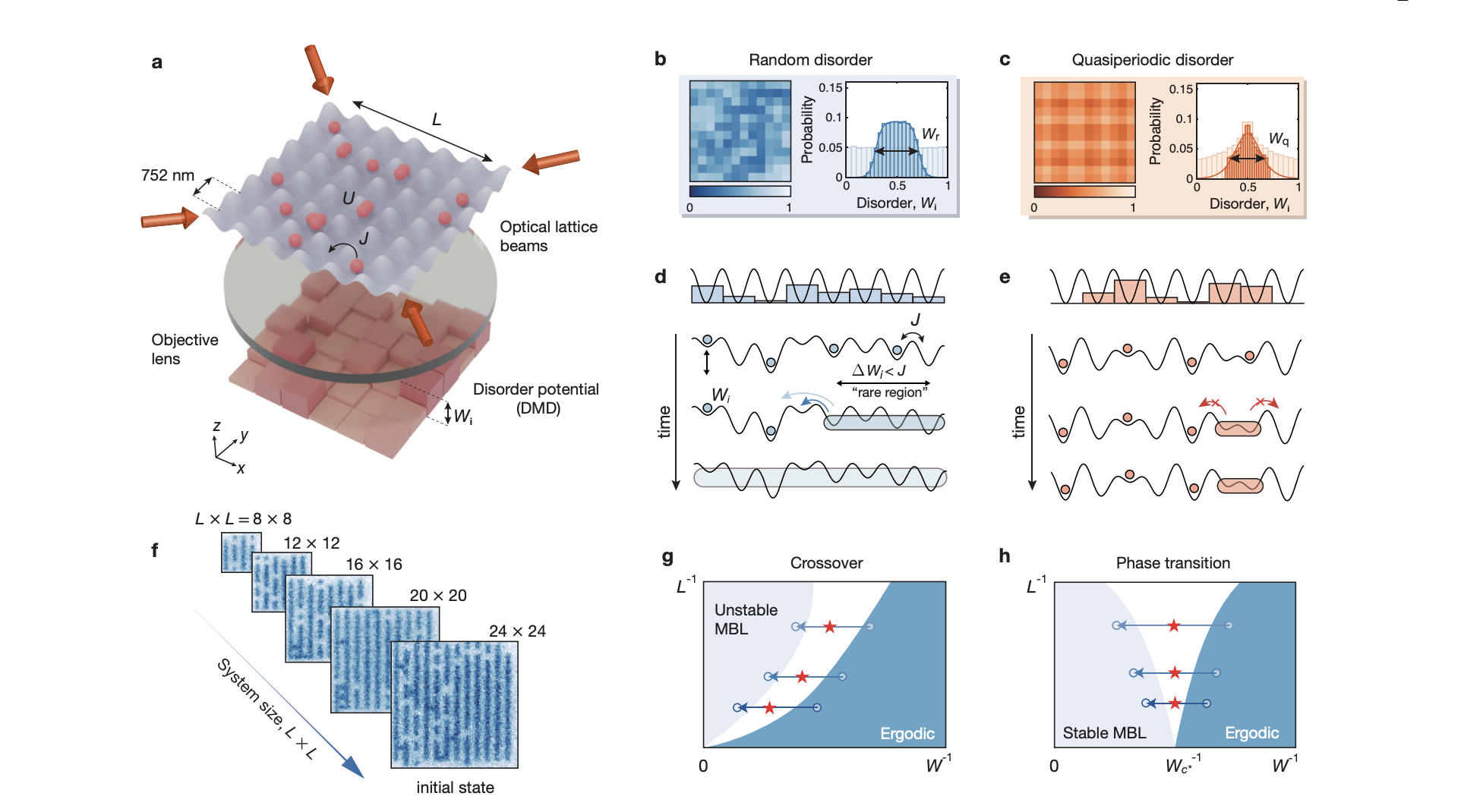
The enduring challenge of understanding disordered systems, which defy traditional computational methods, lies at the heart of modern condensed matter physics and information science. Junhyeok Hur, Joey Li, and Byungjin Lee, along with colleagues at various institutions, investigate the stability of many-body localization, a phenomenon where these disordered systems resist the usual tendency to reach thermal equilibrium. The team explores this behaviour in two dimensions using ultracold atoms, pushing beyond the limits of classical simulation with systems containing a substantial number of sites. Their research reveals that while many-body localization appears fragile under random disorder, becoming less stable as system size increases, it demonstrates remarkable resilience with quasiperiodic disorder, potentially offering a pathway to stable, non-thermalising states in two dimensions.
Many-body localization (MBL), a hypothesized mechanism preventing thermalization, represents a fundamentally new phase of matter arising from the interplay of strong disorder and quantum interactions. This phenomenon sharply contrasts with the expectation that all closed quantum systems eventually reach thermal equilibrium, governed by statistical mechanics. Understanding the precise mechanisms governing MBL and its limitations is therefore crucial for both fundamental physics and potential applications in quantum technologies. Recent theoretical work suggests that the ergodicity breaking inherent in MBL may be fragile, susceptible to even weak perturbations or finite-size effects, prompting a need for rigorous experimental verification and refined theoretical models.
Hubbard Parameters Determined via Calibration Simulations
Researchers meticulously calibrated their experimental setup to ensure accurate and reliable results, precisely determining the on-site interaction energy and the hopping parameter defining the strength of interactions and tunneling within the system. They employed modulation spectroscopy and measurements at varying lattice depths to accurately estimate the interaction energy, carefully monitoring the heating rate to account for temperature fluctuations. The team also demonstrated careful control and characterization of the disorder potential, using time-dependent measurements to observe the system’s evolution. This rigorous calibration and control of external factors demonstrate a commitment to accuracy and reproducibility.
Complementary numerical simulations were performed to support the experimental findings and deepen understanding of the underlying physics. Researchers used the Time-Dependent Variational Principle with Matrix Product States, utilizing the TeNPy library, to systematically analyze the imbalance as a function of time and disorder strength. Comparing these simulation results with experimental data revealed strong agreement, validating the experimental findings and providing independent support for the theoretical models.
MBL Instability and Disorder Strength Scaling
Researchers have achieved a significant breakthrough in understanding many-body localization (MBL) by experimentally probing MBL in two dimensions with ultracold atoms, reaching system sizes far exceeding the capabilities of classical simulations. The team investigated the stability of MBL using two distinct types of disorder, random and quasiperiodic, and discovered markedly different behaviors. Experiments reveal that MBL in random disorder is susceptible to an “avalanche” instability, where rare regions of weak disorder initiate thermalization that spreads throughout the system, shifting the transition point to higher disorder strengths as system size increases. This upward drift of the transition point demonstrates that larger systems require stronger disorder to maintain localization, confirming predictions from avalanche theory.
Specifically, the transition point increases with system size as an exponential function of the logarithm of system size. In contrast, the team found that MBL induced by quasiperiodic disorder remains remarkably stable, exhibiting no significant dependence on system size up to the largest systems tested. This suggests that quasiperiodic disorder fundamentally suppresses the formation of these thermalizing “avalanches”, preserving the localized state. Further analysis of the time-dependence of the transition point confirms these findings, showing that at short times, the size of thermal bubbles is insufficient to fully thermalize the system, resulting in weak system size dependence.
However, at longer times, the avalanche mechanism becomes apparent in the random disorder case, with the transition point exhibiting a clear dependence on system size. These results support a scenario where the nature of the disorder dictates the stability of MBL, with random disorder allowing for thermalizing regions and quasiperiodicity suppressing them. This research opens avenues for exploring the interplay between localization and transport in more complex systems and for quantitatively studying critical phenomena at the ergodic-to-MBL phase transition in quasiperiodic models.
Avalanche Instability Destroys Two-Dimensional MBL
This research investigates the stability of many-body localization (MBL) in two dimensions using ultracold atoms, probing MBL at system sizes exceeding those accessible through numerical simulation. Their results demonstrate that MBL induced by random disorder is susceptible to “avalanche” instability, where the transition to thermalization occurs at increasingly strong disorder as the system size grows. This suggests that random disorder allows for the formation of localized thermal regions that can trigger a cascade leading to overall thermalization. In contrast, the experiments reveal that MBL induced by quasiperiodic disorder remains stable, showing no clear dependence on system size. This suggests that quasiperiodicity effectively suppresses the formation of these thermal regions, preserving the localized state. The findings support a scenario where the type of disorder dictates the system’s behaviour, with random disorder promoting thermalization and quasiperiodicity maintaining localization.
🗞 Stability of many-body localization in two dimensions
🧠 ArXiv: https://arxiv.org/abs/2508.20699


