
The pursuit of highly sensitive and spatially resolved magnetic field detection underpins advances in fields ranging from navigation to medical imaging and space exploration, but current high-precision magnetometers often suffer from limitations in size and energy efficiency. Paolo Pintus, Heming Wang, and Sudharsanan Srinivasan, along with colleagues from institutions including the University of California Santa Barbara and the Massachusetts Institute of Technology, now demonstrate a novel all-optical magnetometer built on a silicon photonic chip. Their device integrates a magneto-optic material with a silicon photonic interferometer, allowing the detection of minute magnetic fluctuations through changes in light’s properties, and achieves a dynamic range exceeding 80 dB with a sensitivity better than 40 picotesla at room temperature. This approach, leveraging the scalability of silicon photonics and ultra-low power consumption, promises a path towards compact, efficient, and widely deployable magnetic field sensors, opening new possibilities for a broad range of applications.
In-memory computing with resistive random access memory
Researchers are exploring new computing methods beyond traditional CMOS technology to develop high-performance, low-power solutions. Emerging non-volatile memory technologies, such as Resistive Random Access Memory (RRAM), offer promising characteristics including high density, fast switching speeds, and low energy consumption. Realising the full potential of RRAM requires overcoming challenges related to device performance, reliability, and system integration. Conventional computer architectures suffer from an energy bottleneck due to constant data movement between processing and memory. In-memory computing, which performs computations directly within the memory array, offers a compelling solution.
This approach leverages the physical properties of memory devices to perform operations, such as multiply-accumulate (MAC), directly within the memory array, eliminating data movement. Implementing accurate in-memory MAC operations in RRAM crossbars is complicated by variations in device conductance and unintended current paths. This work investigates a novel in-memory computing scheme based on RRAM crossbars, aiming to achieve high accuracy and a wide dynamic range for MAC operations through a carefully designed programming strategy and tailored circuit architecture. The team focuses on achieving 99. 99% accuracy for an 8×8 MAC operation, while maintaining a dynamic range of at least 1000x. Achieving this performance requires careful consideration of device characteristics and circuit design, and further optimisation may be necessary to address practical limitations.
Integrated Photonics for Sensitive Magnetic Sensing
Research in integrated photonics, magnetometry, and related sensing technologies is rapidly evolving. Key themes include building optical circuits on chips using silicon and silicon nitride, developing highly sensitive magnetic field sensors including atomic magnetometers and solid-state spin-based sensors, and applying these sensors to gyroscope/inertial sensing, current sensing, radio frequency (RF) sensing, explosives detection, mine/UXO detection, and magnetic communication. Researchers are leveraging quantum phenomena to enhance sensing performance and are focusing on materials science and fabrication techniques for materials like Yttrium Iron Garnet (YIG), silicon nitride, and silicon dioxide. A significant focus is on mitigating the impact of noise, including thermo-refractive effects and thermal fluctuations, on sensor performance.
Key technologies include silicon photonics, silicon nitride photonics, YIG, atomic magnetometers, solid-state spin ensembles, and heterogeneous integration. This bibliography illustrates a rapidly evolving field at the intersection of photonics, magnetism, and quantum sensing. Researchers are working to miniaturize and improve the performance of sensors for a wide range of applications, from navigation and communication to security and environmental monitoring.
Silicon Photonics Detects Subtle Magnetic Fields
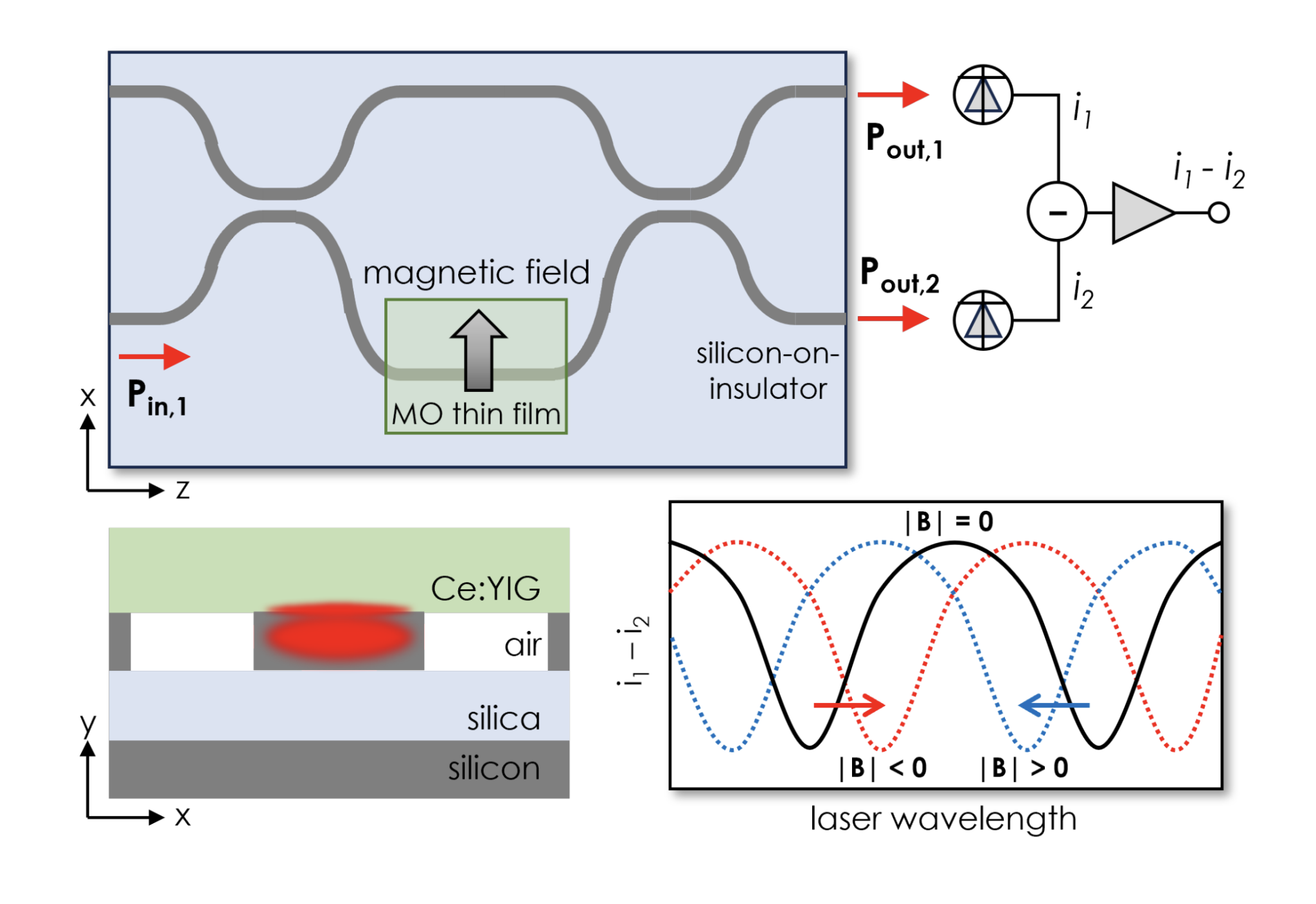
Researchers have developed a new all-optical magnetometer based on silicon photonics and a magneto-optic thin film, offering a potentially transformative approach to magnetic field sensing. This integrated device overcomes limitations of existing high-precision magnetometers by leveraging light manipulation at a microscopic scale. The team successfully demonstrated a device capable of detecting subtle magnetic field fluctuations through changes in the phase of light traveling through a silicon photonic interferometer. The magnetometer operates by bonding a thin layer of cerium-yttrium iron garnet onto an integrated silicon photonic chip, creating a system sensitive to the non-reciprocal phase shift induced by magnetic fields.
This non-reciprocal effect allows the device to detect magnetic fields with a dynamic range exceeding 80 decibels and a sensitivity of 40 picotesla per root Hertz at room temperature. The use of silicon photonics enables scalable manufacturing and minimizes power consumption, paving the way for fully integrated systems. The device functions as an unbalanced Mach-Zehnder interferometer, where light is split into two paths, one interacting with the magneto-optic material and the other serving as a reference. External magnetic fields alter the phase of light in the magneto-optic arm, creating a measurable difference in the interference pattern.
By carefully balancing the signals from the two arms, the system minimizes noise and maximizes sensitivity. Researchers achieved this high performance by controlling the splitting ratio of light and optimizing the optical path length difference. The team also identified and mitigated key noise sources, including temperature fluctuations and laser power variations. This innovative approach promises compact, efficient, and highly sensitive magnetic field detectors with broad applications in geo-positioning, medical imaging, materials science, and space exploration.
Researchers have demonstrated a new approach to building highly sensitive magnetometers using silicon photonics integrated with a cerium-yttrium iron garnet (Ce:YIG) film. The resulting device detects magnetic fields by.
👉 More information
🗞 Integrated magneto-optic based magnetometer: classical and quantum limits
🧠 ArXiv: https://arxiv.org/abs/2508.15914