Understanding the composition of cometary comae, the vast, diffuse atmospheres surrounding comets, requires precise modelling of how molecules interact, and new research addresses a critical gap in that knowledge. Francesca Tonolo from the University of Rennes, alongside Ernesto Quintas-Sánchez and Adrian Batista-Planas from Missouri University of Science and Technology, et al., present the first comprehensive dataset detailing how collisions between hydrogen cyanide (HCN) and carbon monoxide (CO) affect the energy levels within HCN molecules. This work, spanning temperatures found in cometary environments, provides crucial data for accurately simulating the distribution of energy among rotational levels of HCN, and consequently, determining its abundance in comets. By accounting for conditions that deviate from simple equilibrium, this research significantly improves our ability to interpret observations and understand the chemical processes occurring within these distant, icy bodies.
Cometary CO Excitation and Molecular Collisions
This research focuses on understanding the behaviour of gases in cometary atmospheres, specifically how molecules collide and exchange energy to alter their energy levels. Accurate modelling of these collisions is crucial for interpreting observations of comets and unlocking clues about their composition and origins. Researchers employ sophisticated quantum chemistry calculations to determine the potential energy surfaces governing these molecular interactions, requiring substantial computational resources and expertise in theoretical chemistry, astrophysics, molecular physics, and computational science. The resulting data are often compiled into databases, providing a valuable resource for the wider scientific community. This interdisciplinary work addresses complex questions about the origins and evolution of our Solar System, highlighting the importance of accurately representing mechanisms that excite molecules, including rotational and vibrational changes.
HCN-CO Collisions at Cometary Temperatures
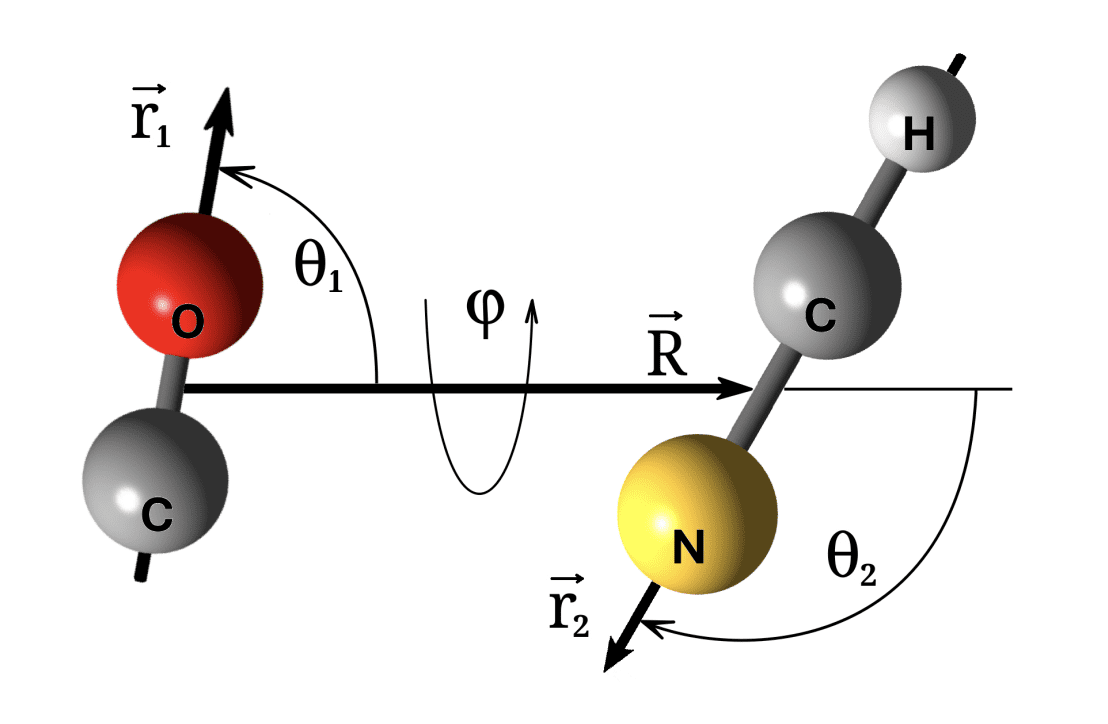
Researchers developed a novel computational method to determine how hydrogen cyanide (HCN) and carbon monoxide (CO) collide and exchange energy in the extremely cold environment of cometary atmospheres. Scientists constructed a highly accurate potential energy surface (PES) describing the interaction between HCN and CO, essential for modelling these collisions with precision. The methodology employs a sophisticated mathematical framework to simplify the complex interaction between the two molecules. Researchers utilized an automated method to create an analytical representation of the PES from calculated energies, strategically sampling the most relevant regions of the potential energy landscape. The resulting PES extends to a significant distance and incorporates energies relevant to cometary conditions, providing a comprehensive description of the intermolecular interaction and serving as the foundation for calculating collisional rate coefficients.
HCN-CO Collision Rates in Cometary Atmospheres
Researchers have, for the first time, calculated collisional rate coefficients describing how hydrogen cyanide (HCN) interacts with carbon monoxide (CO) in the frigid conditions of cometary atmospheres. These calculations span a temperature range of 5 to 50 Kelvin, mirroring the extremely cold environment found in cometary comae. The team determined both state-to-state and thermalized rate coefficients, detailing transitions between specific energy levels and representing the overall energy distribution. The methodology employed a statistical model leveraging a highly accurate interaction potential computed using sophisticated theoretical techniques. This approach proved reliable, with validation against detailed quantum calculations, demonstrating its ability to accurately predict collisional behaviour. The research addresses a significant gap in understanding cometary composition, as previous studies focused primarily on interactions between HCN and water.
HCN-CO Collision Rates at Cometary Temperatures
This study presents a comprehensive dataset of collisional rate coefficients describing how HCN interacts with CO in the cold environment of cometary atmospheres. Researchers calculated these rates, detailing how energy is exchanged between molecules during collisions, using a statistical modelling approach validated against detailed quantum calculations. The resulting data accurately characterise the energy transfer between HCN and CO, improving the ability to model the distribution of energy levels within HCN molecules. These new rate coefficients are essential for accurately simulating cometary atmospheres, where conditions deviate from typical equilibrium. By providing a more realistic picture of energy distribution, this work supports the interpretation of observations of HCN in comets, a molecule considered an important tracer of the early Solar System and a potential building block for prebiotic chemistry. Future work could extend this approach to include collisions with other abundant cometary gases, such as carbon dioxide, to further refine atmospheric models and enhance understanding of cometary composition.
👉 More information
🗞 Collisional excitation of HCN by CO to refine the modeling of cometary comae
🧠 ArXiv: https://arxiv.org/abs/2508.19904