

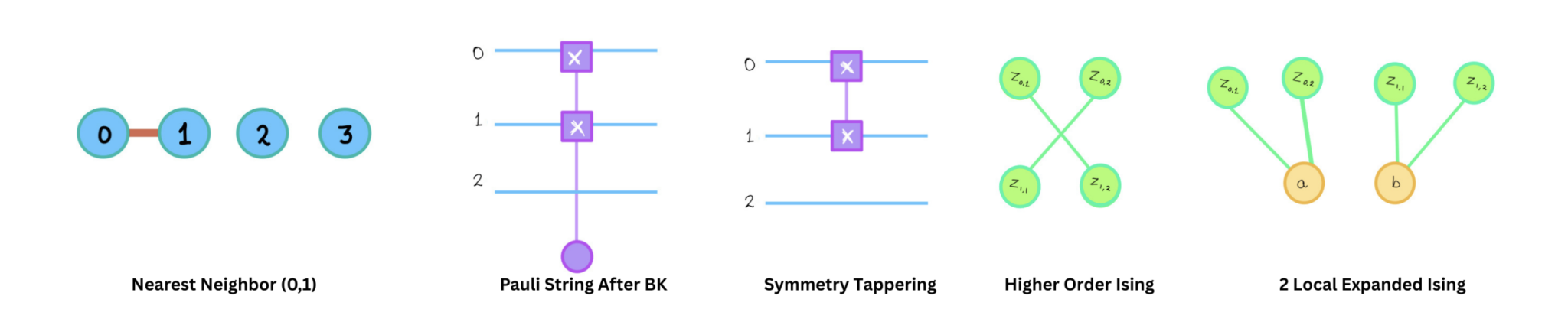
Fermionic systems, crucial to understanding materials and chemical processes, present a significant challenge for current quantum computers, which typically operate using bits. Lakshya Nagpal from the Institute of Mathematical Sciences, Aditya Kumar from the Indian Institute of Science Education and Research Pune, and S. R. Hassan, also from the Institute of Mathematical Sciences, demonstrate a new pipeline that successfully translates the complex behaviour of these fermionic systems into a format compatible with quantum annealers. This method preserves the essential physics of the original system while allowing it to be simulated on existing hardware, a crucial step towards modelling realistic materials and chemical reactions. The team validates their approach across a range of increasingly complex models, achieving results that closely match established theoretical calculations and demonstrating a clear path towards utilising quantum annealers for practical materials science and chemical simulations.
Hybrid Quantum-Classical Molecular Simulation Validation
This supplementary material document provides a detailed exploration of a quantum-classical hybrid approach for molecular simulations. It offers an exhaustive account of the methods, implementation, and validation procedures, crucial for reproducibility and understanding the approach’s limitations. Explanations are generally clear and well-structured, with equations, diagrams, and examples illustrating key concepts. The validation, using the benzene molecule and comparisons with established quantum chemistry methods, provides strong evidence for the approach’s accuracy. The inclusion of GUI development screenshots demonstrates a commitment to accessibility, and the logical organization provides a complete picture of the research.
Potential improvements include adding introductory sections to each appendix outlining key concepts for unfamiliar readers, performing a formal error analysis to quantify uncertainty, discussing scalability to larger molecules, and providing more detailed GUI functionality descriptions. Mentioning code availability would also enhance reproducibility. Ultimately, this document represents a significant contribution to the field, offering a comprehensive overview of the research and solidifying its impact.
Quantum Systems Translated for Quantum Annealers
Researchers have developed a comprehensive pipeline for translating complex quantum systems into a format suitable for quantum annealers, representing a significant step towards simulating materials and phenomena beyond the reach of classical computers. The team successfully converted interacting fermionic and spin models into a compatible form while preserving the essential physics of the original systems. This achievement addresses a critical challenge in quantum simulation, bridging the gap between theoretical descriptions and hardware limitations. The pipeline combines several key techniques, beginning with an encoding method to represent quantum particles as qubits, and crucially, implements exact symmetry reduction and a transformation to simplify the problem for quantum annealers.
Validation across a range of models demonstrates the effectiveness of this approach. The team benchmarked the pipeline using a frustrated 2D Ising model, successfully reproducing known magnetic transitions on a D-Wave Advantage QPU. Further tests on the 1D Ising model recovered expected finite-size effects, and the spin-1/2 XXZ chain matched results from exact diagonalization calculations. Notably, simulations of interacting fermions in 1D rings yielded energies comparable to those obtained through exact diagonalization, exhibiting the predicted behaviour at a specific interaction strength. Experiments quantified the trade-off between accuracy and qubit replication, revealing that error reduction plateaus beyond a certain point, allowing for optimization of the simulation. The pipeline’s portability was demonstrated by applying it to a molecular Hamiltonian for benzene, showcasing its applicability beyond lattice-based systems. These results establish a practical pathway for mapping quantum matter onto current annealers, offering researchers valuable control over fidelity, resource allocation, and embedding strategies.
Fermionic Systems Mapped to Quantum Annealers
The research presents a complete method for translating complex quantum systems, specifically interacting fermionic and spin models, into a format suitable for quantum annealers. This pipeline combines several techniques, including an encoding method, symmetry reduction, a transformation to simplify the problem, and a final conversion to a two-body problem. Validation across increasingly complex models demonstrates the method’s ability to accurately reproduce known results and match the accuracy of exact diagonalization techniques on small systems. The study highlights a trade-off between accuracy and computational resources, particularly the number of qubits required.
Increasing qubit replication initially yields significant improvements, but these gains diminish rapidly beyond a certain point. The authors find that a replication factor of three or four provides a good balance between accuracy and qubit overhead for the systems tested. While the method currently requires more resources than some classical solvers for small problem sizes, the researchers suggest that quantum annealing may become more competitive as problem sizes increase. Future work could focus on extending the method to larger systems and exploring more efficient ways to reduce qubit overhead, potentially unlocking the full potential of quantum annealers for simulating complex materials and quantum phenomena.
🗞 Mapping of Fermionic Lattice Models for Ising Solvers
🧠 ArXiv: https://arxiv.org/abs/2508.17766


