

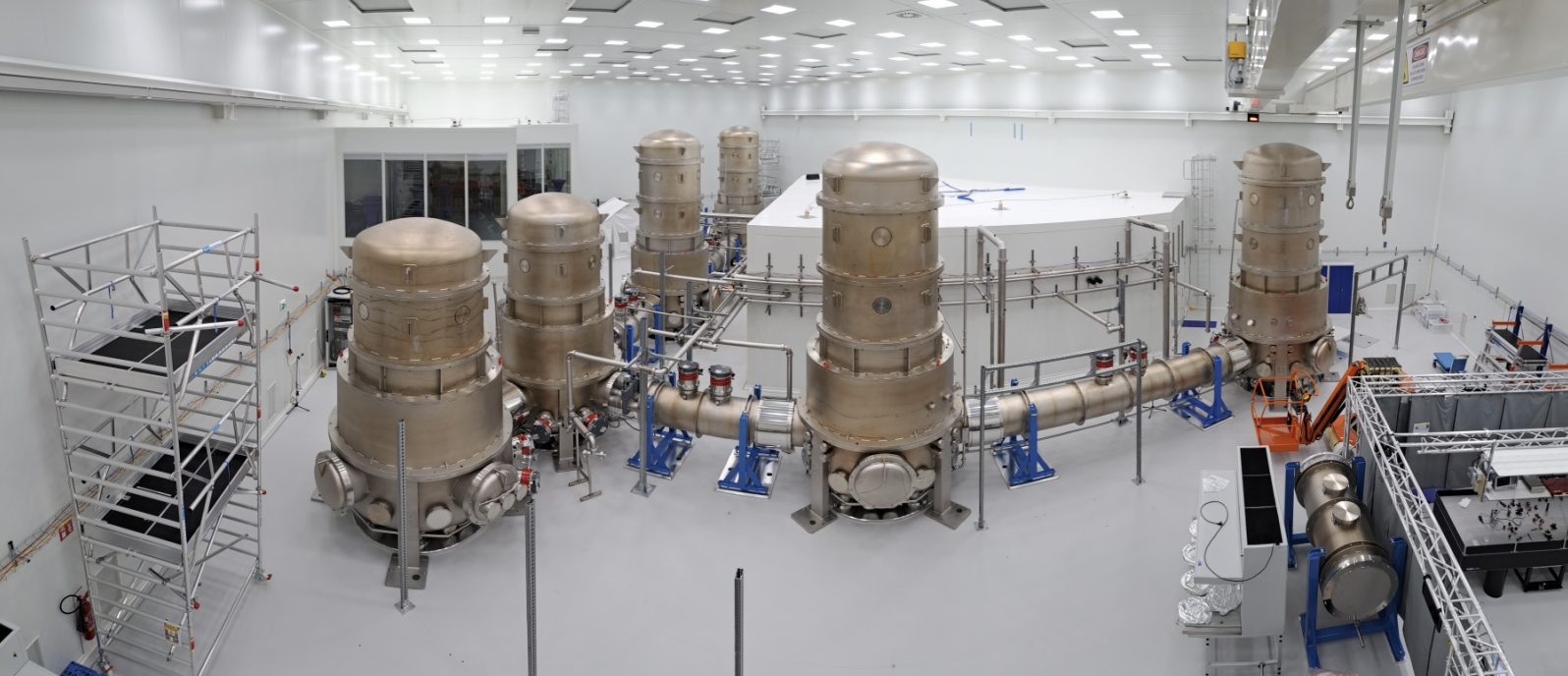
The search for gravitational waves continues to push the boundaries of precision measurement, and the next generation of detectors promises to reveal previously inaccessible cosmic events. Thomas Höhn, Adrian Schwenck, and Thomas Thümmler, from the Karlsruhe Institute of Technology, alongside the Einstein Telescope Pathfinder (ET-PF) collaboration, are developing crucial technologies for this endeavour. Their work focuses on the ultra-high vacuum system required for the ET-PF, a facility designed to test the challenging cryogenic interferometer technology at the heart of the future Einstein Telescope. Achieving the necessary vacuum levels is critical to minimise noise and maximise sensitivity, allowing scientists to detect faint ripples in spacetime and probe the earliest moments of the universe, extending observations beyond the cosmic microwave background. This research details the objectives and progress of their work, representing a significant step towards realising the full potential of next-generation gravitational wave astronomy.
The core goal is to develop and test technologies necessary to surpass the sensitivity of existing gravitational wave observatories by an order of magnitude. Key areas of focus include vacuum systems, cryogenics, and gas adsorption on mirrors.
The development of ultra-high vacuum (UHV) systems is critical for minimizing noise and maximizing detector sensitivity, building on experience from the KATRIN experiment. Cooling the detector to extremely low temperatures is essential for reducing thermal noise. A significant focus is on understanding, monitoring, and controlling gas adsorption on cold mirror surfaces, as this can degrade performance. Dedicated test setups at KIT are being used for this purpose. It serves as a platform for integrating various components and training personnel for the construction and operation of the full observatory. The project is funded by a broad range of sources, including Interreg Vlaanderen-Nederland, provincial and national governments of Belgium and the Netherlands, and research grants from organizations like the ERC, NWO, FWO, and DFG. This ambitious project features a triangular design with 10-kilometer arms, incorporating interferometers operating at both room temperature and cryogenic temperatures as low as 10-15 K. This includes specifying hardware configurations, circuit diagrams, and interlock systems to ensure safe and robust long-term operation. The team aims to reduce vibrational noise on the mirror surfaces to below 10−18 meters per root Hertz at 10 Hz, and plans to operate mirrors at temperatures of room temperature, 123 K, and 10 K. The project focuses on creating a realistic environment for testing key components, including seismically isolated cryogenic mirrors and ultra-high vacuum systems, under conditions that closely mimic those expected in the final observatory. Researchers are developing and testing control systems for the vacuum environment, drawing on expertise gained from the KATRIN neutrino experiment, and investigating methods to monitor and mitigate gas adsorption on the cold mirror surfaces. While the project acknowledges the complexities of maintaining an ultra-high vacuum with cryogenic components, it represents a significant step towards realizing a uniquely European contribution to gravitational wave astronomy and our understanding of the early universe.
👉 More information
🗞 The Einstein Telescope Pathfinder and its Vacuum System
🧠 ArXiv: https://arxiv.org/abs/2508.16461


