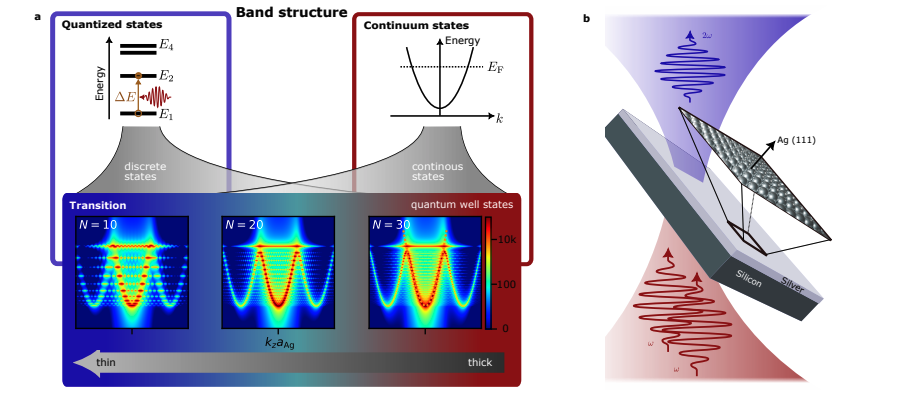
The weak nonlinear optical response of conventional materials hinders progress in photonics and related technologies, but a team led by Philipp K. Jenke from the University of Vienna, Saad Abdullah and Andrew P. Weber from ICFO-Institut de Ciencies Fotoniques, are demonstrating a new approach to overcome this limitation. Their research focuses on ultra-thin crystalline silver films, reduced to just a few atomic layers, to dramatically enhance the generation of second-harmonic light, a key process in nonlinear optics. The team’s findings reveal that as the film thickness decreases, the efficiency of this light generation increases significantly, stemming from quantum confinement effects that alter how light interacts with the material’s electrons. This breakthrough offers a pathway to create more efficient nanoscale optical devices, potentially revolutionising areas such as advanced imaging, sensing, and information processing, by overcoming the limitations of current nanophotonic platforms.
Thin Film Nonlinear Optics and Plasmonics
This research details investigations into nonlinear optical phenomena within ultra-thin metal films, specifically silver and gold, and explores their potential for nanophotonic applications. Researchers are pushing the boundaries of material science by fabricating films only a few nanometers thick, leveraging the unique plasmonic properties of silver and gold to control light-matter interaction. The research combines experimental work with advanced theoretical modeling to understand and optimize film properties for enhanced nonlinear effects, such as second harmonic generation. Achieving highly crystalline, atomically smooth metal films is crucial for maximizing nonlinear optical responses; defects and roughness significantly diminish performance.
Controlling plasmonic resonances within the films further enhances light-matter interaction and boosts nonlinear effects. Theoretical calculations predict and explain the nonlinear optical properties of different film structures and compositions, while the potential of combining metal films with graphene to further enhance these effects is also being explored. The films are grown using molecular beam epitaxy, a technique allowing precise control over thickness and structure. Surface science techniques, such as reflection high-energy electron diffraction, monitor film growth and ensure high crystallinity.
Spectroscopic ellipsometry characterizes the optical properties of the films, while second harmonic generation microscopy maps the nonlinear optical response. This research has implications for a wide range of applications, including the development of new optical devices and circuits at the nanoscale, the creation of highly sensitive sensors, the development of new data storage methods, and the exploration of quantum technologies. By developing and characterizing ultra-thin metal films with enhanced nonlinear optical properties, this work paves the way for new and innovative technologies.
Silver Film Band Structure Engineering for Nonlinear Optics
Researchers have developed a novel approach to enhance nonlinear optical responses by meticulously engineering the electronic band structure within ultra-thin crystalline silver films. Recognizing that conventional materials often exhibit weak nonlinearities, the team focused on manipulating light’s interaction with electrons at the atomic scale, creating films only a few atomic layers thick where quantum confinement effects dramatically alter electron behavior. The process begins with the epitaxial growth of silver directly onto a crystalline silicon wafer, ensuring high structural perfection and scalability. This precise control over the film’s atomic arrangement is crucial for achieving the desired electronic properties and allows for the creation of large-area, high-quality films.
Characterization techniques, including angle-resolved photoemission spectroscopy and scanning tunneling microscopy, verify both the film thickness and crystalline surface topography, confirming the formation of atomically smooth terraces. A passivation layer of silicon then protects the delicate silver films from environmental degradation, ensuring their stability over time. To probe the nonlinear optical properties, the team utilized a modified focus scan setup, directing a pulsed mid-infrared laser beam through the silicon substrate and onto the silver film. By carefully analyzing the resulting second-harmonic generation signal, they could isolate and quantify the nonlinear response.
The experimental configuration minimizes signal absorption by the silicon substrate, and measurements are conducted under ambient conditions, demonstrating the robustness of the fabricated films. Detailed analysis of the second-harmonic generation signal reveals a clear spectral signature and a strong polarization dependence, confirming the coherent nature of the nonlinear process. Crucially, the team observed a quadratic relationship between the excitation power and the generated signal, validating the second-order nature of the nonlinearity. By systematically varying the thickness of the silver films, researchers demonstrated a significant enhancement of the response in the ultra-thin regime, attributable to the quantum confinement of electrons and the resulting modification of the electronic band structure. This innovative approach offers a promising pathway towards efficient nanoscale nonlinear optics with potential applications in photonics and related technologies.
Enhanced Nonlinear Optics in Silver Films
Researchers have developed a new approach to significantly enhance nonlinear optical responses in materials, overcoming a fundamental limitation in photonics. By reducing the film thickness of crystalline silver films to just a few atomic layers, they create a regime where quantum mechanical confinement effects dramatically alter how light interacts with the material. The team successfully grew large-area, high-quality crystalline silver films with thicknesses ranging from 10 to 30 atomic layers on silicon substrates. This precise control over film thickness creates quantum wells for electrons, leading to discrete energy levels that enhance the nonlinear optical response and enable more efficient frequency doubling of light, known as second-harmonic generation.
Measurements confirm the films maintain their crystalline structure and stability even after fabrication and exposure to ambient conditions, thanks to a protective passivation layer. The researchers employed a specialized focus scan setup to isolate and measure the second-harmonic generation signal from the silver films, using mid-infrared laser pulses and collecting the resulting light in transmission. Results demonstrate a clear and spectrally verified nonlinear response, with the generated light being strongly polarized, indicating a coherent process. Importantly, the team observed a quadratic relationship between the input light power and the generated signal, confirming its second-order nature.
Quantitative analysis reveals a significant enhancement in conversion efficiency as the film thickness decreases, with the thinnest films exhibiting the most pronounced effect. This approach focuses on modifying the material’s electronic structure, offering a complementary strategy to conventional nanophotonics for achieving efficient nonlinear optics. The observed enhancement is substantial, and the method is compatible with existing nanolithography techniques, paving the way for the development of new photonic devices with improved performance and functionality. The ability to create stable, high-quality ultra-thin films opens up possibilities for applications in areas such as advanced imaging, optical sensing, and high-speed data communication.
This research demonstrates a significant enhancement of second-harmonic generation in crystalline silver films as their thickness is reduced to just a few atomic layers. By creating a regime where quantum mechanical confinement effects dramatically alter how light interacts with the material, researchers have overcome a fundamental limitation in photonics.
🗞 Atomically thin silver films for enhanced nanoscale nonlinear optics
🧠 ArXiv: https://arxiv.org/abs/2508.15417