

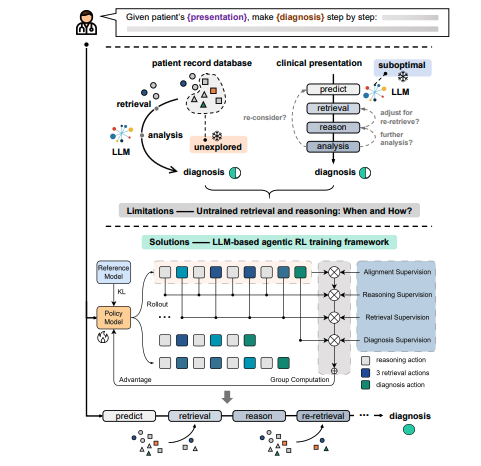
Medical diagnosis frequently suffers from incomplete knowledge and unreliable reasoning, hindering accurate assessments of patient conditions. Qiaoyu and colleagues at MAGIC-AI4Med are tackling this challenge with Deep-DxSearch, a novel system that trains an artificial intelligence agent to perform more effective diagnostic reasoning. The researchers developed a system where the AI learns to retrieve relevant medical information and use it to arrive at diagnoses, guided by a carefully designed reward system that prioritises both accuracy and clear reasoning. Results demonstrate that this end-to-end training approach significantly outperforms existing methods, including leading large language models like GPT-4o and specialised medical frameworks, in diagnosing both common and rare diseases, even when presented with unfamiliar cases. This advancement promises to improve the reliability of preliminary diagnoses and provide clinicians with a more robust tool for patient care.
Knowledge limitations and hallucinations pose significant challenges for current generative models. While retrieval-augmented generation (RAG) and agentic methods offer potential solutions, they often underutilize external knowledge and lack traceable reasoning. To address these issues, researchers introduce Deep-DxSearch, an agentic RAG system trained end-to-end with reinforcement learning that enables steerable, traceable reasoning for medical diagnosis. The system utilizes a large-scale medical corpus, comprising patient records and reliable medical knowledge, to support the diagnostic process.
Agentic Reinforcement Learning for Medical Diagnosis
This text details a novel diagnostic framework called Deep-DxSearch and presents extensive experimental results comparing it to other state-of-the-art methods. The framework leverages agentic reinforcement learning, employing an agent that interacts with medical data and knowledge bases to learn optimal diagnostic strategies. Deep-DxSearch comprises several key components, including access to patient history, a source of medical knowledge about diseases, a broader repository of medical information, and the ability to condense complex medical texts. The goal is to improve diagnostic accuracy, particularly for rare diseases, by mimicking the reasoning process of experienced clinicians.
Evaluations conducted on datasets including MIMIC-III, PMC-Patient, and MIMIC-Rare demonstrate that Deep-DxSearch consistently outperforms existing methods, achieving state-of-the-art results, particularly in diagnosing rare diseases. Ablation studies reveal that each component contributes to the overall performance, with policy reward supervision and documentation summarization having the most significant impact. Analysis of the framework’s performance demonstrates its ability to effectively reason about medical information and associate symptoms with diseases, providing a differential diagnosis. Key metrics, such as accuracy within the top five diagnoses and symptom association, demonstrate the framework’s effectiveness.
The system also exhibits a strong ability to filter out irrelevant information during the diagnostic process. Deep-DxSearch has the potential to be a valuable tool for clinicians, assisting in diagnosis, particularly for complex or rare cases. The framework’s superior performance suggests it can improve diagnostic accuracy and reduce medical errors, potentially leading to more personalized diagnostic approaches. Future research could focus on integrating the system with electronic health records, conducting real-world clinical trials, addressing biases in medical data, and improving the explainability of the framework. In summary, the text presents a compelling case for Deep-DxSearch as a state-of-the-art diagnostic framework with significant potential to improve medical diagnosis and patient care. The combination of agentic reinforcement learning, a multi-component architecture, and a focus on rare diseases makes it a promising advancement in the field of medical AI.
Reinforcement Learning Improves Diagnostic Accuracy Significantly
Researchers have developed a new diagnostic system, Deep-DxSearch, that significantly improves the accuracy of medical diagnoses by leveraging a sophisticated approach to information retrieval and reasoning. The system addresses key limitations in current diagnostic tools, which often struggle with incomplete knowledge and unreliable reasoning processes. Deep-DxSearch functions as an agent, actively searching a vast medical database, comprising patient records, clinical guidelines, and established medical knowledge, to build a comprehensive understanding of each case. The core innovation lies in training the system using reinforcement learning, a technique that allows it to refine its search and reasoning strategies over time.
This process shapes the system’s ability to not only find relevant information but also to interpret it accurately and arrive at a reliable diagnosis. Evaluations demonstrate that Deep-DxSearch consistently outperforms existing diagnostic methods, including advanced large language models and specialized medical frameworks, across both common and rare diseases. Notably, the system excels in challenging scenarios where it encounters cases outside of its initial training data, demonstrating a robust ability to generalize its knowledge. Quantitative results show substantial gains in diagnostic accuracy, measured by its ability to identify the correct diagnosis within the top one and top five possibilities, surpassing the performance of current state-of-the-art approaches. Detailed analysis reveals that the system’s success stems from its ability to effectively utilize the medical database and its refined reasoning process, offering clinicians a powerful tool to enhance diagnostic precision and reliability. The system’s design also allows for interpretability, providing insights into its reasoning process and supporting clinicians in understanding the basis for its diagnoses.
Agentic RAG Improves Diagnostic Accuracy
Deep-DxSearch represents a new approach to medical diagnosis, employing an agentic retrieval-augmented generation (RAG) system trained with reinforcement learning. The research demonstrates that this end-to-end training framework consistently outperforms existing methods, including prompt-engineering and traditional RAG approaches, across a range of diagnostic challenges. Notably, Deep-DxSearch achieves improved diagnostic accuracy for both common and rare diseases, surpassing the performance of strong baseline models such as GPT-4o and specialized medical frameworks, even when tested on unfamiliar data. The system’s effectiveness stems from its ability to learn a diagnostic policy through interaction with a large medical corpus, optimizing not only the final diagnosis but also the reasoning process itself.
Detailed ablation studies confirm the importance of each component within the system, with patient record retrieval proving particularly critical, and demonstrate that the inclusion of document summarization and clinical guidelines further enhances performance. The authors acknowledge that while all components contribute meaningfully, the system’s reliance on high-quality patient data is a key factor. Future work could explore methods to mitigate the impact of noisy or incomplete data, and further investigate the interpretability of the learned diagnostic policies to build trust and facilitate clinical adoption.
🗞 End-to-End Agentic RAG System Training for Traceable Diagnostic Reasoning
🧠 ArXiv: https://arxiv.org/abs/2508.15746


