As the drive for smaller and faster electronics continues, the increasing resistance in nanoscale interconnects poses a significant challenge to continued scaling. Researchers led by Seoung-Hun Kang and Youngjun Lee from Kyung Hee University, along with Sangmoon Yoon from Gachon University, now demonstrate a promising alternative to traditional copper wiring. Their work focuses on a layered material called palladium cobalt oxide (PdCoO2), and reveals its superior ability to maintain conductivity at dimensions below 7 nanometres. By meticulously modelling electron behaviour within these nanoscale wires, the team shows that PdCoO2 exhibits significantly reduced resistance compared to copper at these extreme scales, offering a viable pathway for future generations of nanoelectronic devices and a new framework for evaluating potential interconnect materials.
The primary goal is to understand how its electrical conductivity changes with size, particularly in thin films, and to assess its viability as a replacement for or complement to copper. Researchers are investigating whether PdCoO2 can overcome limitations of current materials, exhibiting remarkably high electrical conductivity, comparable to or exceeding that of copper in certain configurations. This high conductivity is attributed to a long electron mean free path, indicating reduced scattering and efficient electron transport.
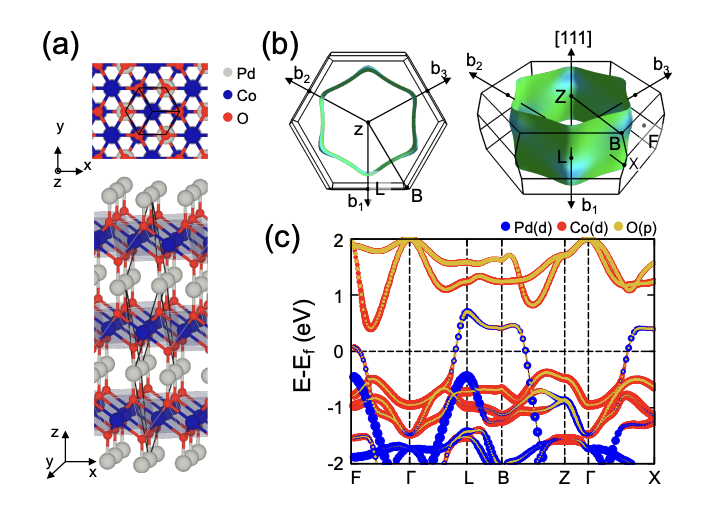
Researchers employed density functional theory calculations to model the electronic structure and transport properties of PdCoO2, allowing them to predict conductivity and understand the underlying mechanisms. Thin films of PdCoO2 were synthesized and characterized using electrical resistivity measurements to directly measure conductivity, X-ray diffraction to confirm crystal structure, and transmission electron microscopy to analyze microstructure. The theoretical predictions from calculations were validated by comparing them with experimental measurements on the synthesized thin films. PdCoO2 presents a promising candidate for next-generation metallization schemes in microelectronics, potentially leading to faster, more energy-efficient electronic devices. The material’s high conductivity and stability are particularly beneficial for highly scaled devices where interconnect resistance is a major concern, suggesting that PdCoO2 could potentially replace or complement copper in certain applications, addressing limitations of copper in advanced technologies.
Palladium Cobalt Oxide Maintains Nanoscale Conductivity
As semiconductor devices continue to shrink below 5 nanometers, maintaining efficient electrical conductivity in interconnects becomes increasingly challenging. Traditional materials like copper experience a significant increase in electrical resistance at these ultra-thin dimensions due to increased scattering of electrons. Researchers have investigated palladium cobalt oxide (PdCoO2) as a potential replacement for copper, demonstrating a substantial advantage in maintaining conductivity at the nanoscale. The study reveals that PdCoO2 exhibits remarkably stable electrical conductivity even as its thickness is reduced to just a few nanometers, significantly outperforming copper under similar conditions.
This resilience stems from the material’s unique layered structure and quasi-two-dimensional electron transport, where electrons move efficiently along the material’s planes. Calculations show that electrons in PdCoO2 travel with high velocities within these planes and experience longer mean free paths compared to copper. Importantly, PdCoO2 maintains near-bulk conductivity down to a thickness of 2 nanometers, while copper’s conductivity degrades much more rapidly. PdCoO2 intrinsically incorporates stable oxide layers, eliminating the need for additional layers and maximizing conductive area. The research identifies distinct changes in the material’s electrical behavior at thicknesses of approximately 35 and 7 nanometers, linked to the anisotropic mean free paths of electrons, establishing PdCoO2 as a promising material for overcoming the nanoscale resistivity bottleneck and enabling continued advancements in semiconductor technology.
Palladium Cobalt Oxide Beats Copper at Nanoscale
This research systematically investigates the electrical resistivity of palladium cobalt oxide (PdCoO2) and copper (Cu) as potential materials for nanoscale interconnects in electronic devices. The findings demonstrate that PdCoO2 significantly outperforms Cu in maintaining conductivity as the materials are scaled down to extremely small dimensions. Through detailed modelling of electron behaviour, researchers reveal that PdCoO2 exhibits a strong anisotropy and suppressed scattering of electrons at boundaries. This anisotropy leads to a slower increase in resistivity for PdCoO2 compared to Cu as the materials become thinner, preserving near-bulk conductivity even at dimensions below 30 nanometres.
The modelling identifies distinct transitions in resistivity for PdCoO2 linked to its anisotropic mean free paths, contrasting with the single transition observed in Cu. These results establish PdCoO2 as a promising alternative to copper for future nanoelectronic applications, offering a pathway to more efficient and reliable devices. The authors acknowledge that further research into Pd-based delafossites and related layered oxides could yield further innovations in energy-efficient nanoelectronics.
🗞 Overcoming Quantum Resistivity Scaling in Nanoscale Interconnects Using Delafossite PdCoO2
🧠 ArXiv: https://arxiv.org/abs/2508.13573