

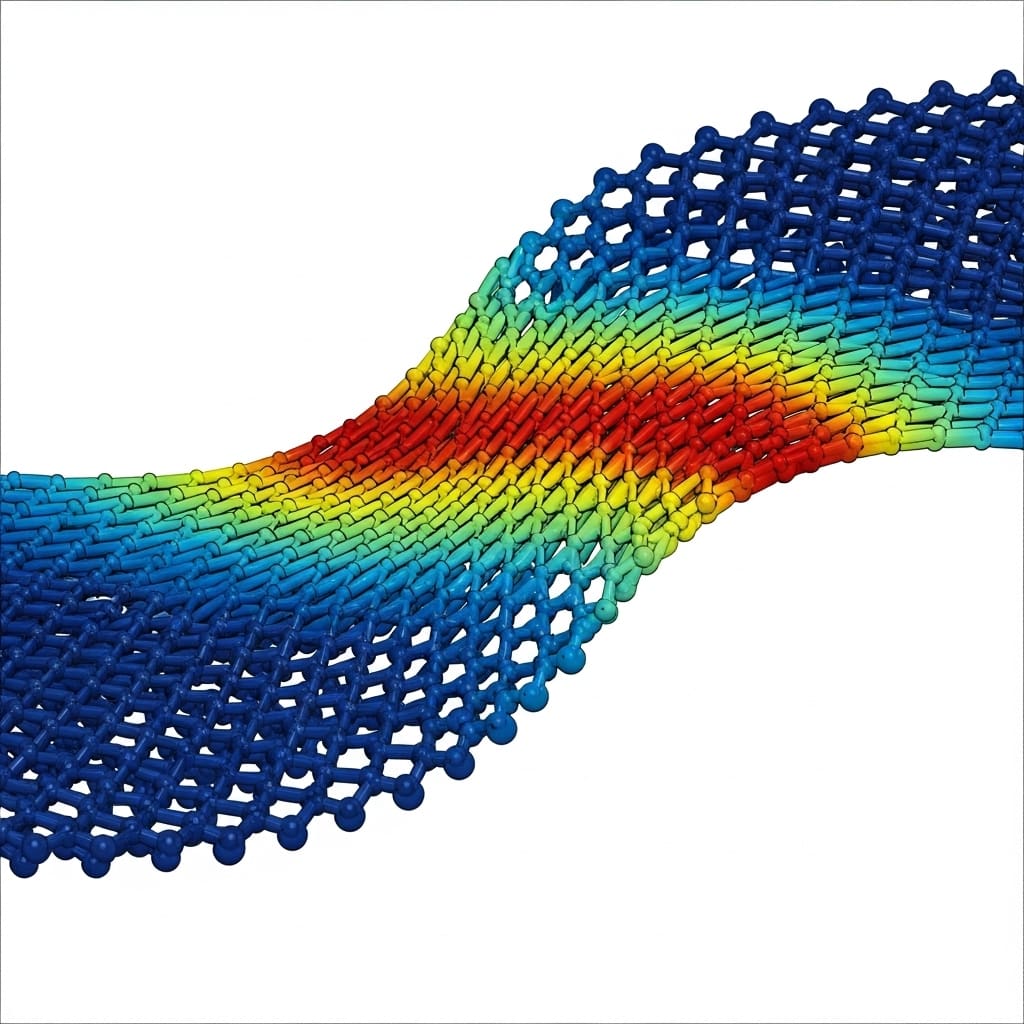
Graphene bilayers, layered sheets of carbon atoms, exhibit complex behaviour influenced by thermal fluctuations and interlayer interactions, and understanding these effects is crucial for designing advanced materials. L. Delzescaux and D. Mouhanna, working on this problem, employ a powerful theoretical technique called the nonperturbative renormalization group to investigate these fluctuations in a bilayer system. Their work builds upon previous research, but importantly establishes a framework that accounts for a crossover in the material’s rigidity, shifting from behaviour dominated by in-plane elasticity at high energies to bending rigidity at lower energies. This approach offers a more complete and systematically improvable method for analysing bilayer graphene, potentially unlocking a deeper understanding of its mechanical properties and paving the way for novel applications in nanotechnology and materials science.
Two continuum polymerized membranes, separated by a distance l, exist in their flat phase and are coupled by interlayer shear, compression/dilatation, and elastic terms. Researchers retain only the contributions that generate a pronounced crossover of the effective bending rigidity along the renormalization group flow, achieved through a controlled truncation of the effective average action. At high running scale k, the rigidity is dominated by the in-plane elastic properties, with κeff approximately equal to l2(λ+2μ)/2. Conversely, at low k, the rigidity is controlled by the bending rigidity of two independent monolayers, where κeff approximately equals 2κ. This crossover resembles that observed as a function of the wavevector scale q.
Membrane Fluctuations and Renormalization Group Analysis
Research in membrane physics focuses on understanding how membranes, such as lipid bilayers and graphene, fluctuate due to thermal energy and how these fluctuations affect their behavior. The renormalization group is a key tool used to analyze these fluctuations at different length scales, identifying relevant and irrelevant fluctuations and determining critical behavior. This work connects to broader areas like polymer physics, disordered systems, and quantum field theory, offering insights into diverse physical phenomena. Scientists have applied these techniques to study phase transitions in membranes, such as the transition from a smooth state to a crumpled one. Effective field theories are developed to simplify the complex microscopic details of membranes, focusing on the most important degrees of freedom. Recent studies have particularly focused on graphene and other two-dimensional materials, modeling them as membranes to understand their unique properties.
Membrane Rigidity Crossover via Renormalization Group Analysis
Scientists have achieved a detailed understanding of thermal fluctuations in bilayer membranes using a nonperturbative renormalization group approach. The research explores how the combined bending rigidity of two membranes, separated by a specific distance, changes under varying conditions. Results reveal a crossover in effective bending rigidity as the scale of observation changes, transitioning from dominance by in-plane elastic properties at high scales to being controlled by the bending rigidity of independent monolayers at low scales. The team’s method allows for the inclusion of nonlinearities present in the elastic theory, a significant advancement over previous approaches.
Results demonstrate that the bilayer problem can be effectively modeled as an extension of the monolayer case, utilizing flow equations with a consistent structure and bilayer-specific adjustments. Measurements confirm a crossover from correlated to uncorrelated out-of-plane fluctuations between the two layers at a wavevector of approximately 3 nanometers⁻¹, highlighting the crucial role of interlayer coupling in the long-wavelength flexural response. Analysis of height fluctuations indicates reduced out-of-plane corrugations in the bilayer compared to a monolayer, consistently supporting an enhanced effective bending rigidity.
Bilayer Rigidity Crossover via Renormalization Group
This research presents a detailed investigation of elastic bilayers, specifically focusing on how their effective bending rigidity changes with scale. Scientists employed a nonperturbative renormalization group approach to model the behavior of two interacting membranes, revealing a crossover in rigidity. At short distances, the system’s rigidity is governed by in-plane elastic properties, while at larger distances, it is dominated by the bending rigidity of individual membrane layers. This crossover, previously observed using a different method, is now demonstrated within a more robust renormalization group framework.
The team’s work significantly advances understanding of bilayer mechanics by explicitly incorporating nonlinear elastic effects, which were previously neglected in simpler models. Modeling a bilayer is achieved by extending existing monolayer theory, simplifying the conceptual framework needed for analysis. Future work could relax the assumption of a common field renormalization for both membrane layers to investigate the renormalization of symmetric and antisymmetric modes independently and to assess the stability of the observed crossover scenario.
👉 More information
🗞 Renormalization group approach to graphene bilayers
🧠 ArXiv: https://arxiv.org/abs/2512.23349


