

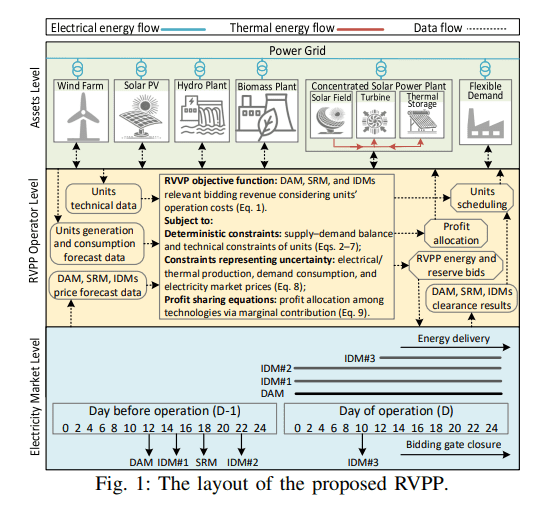
The increasing integration of renewable energy sources demands innovative approaches to power system management, and virtual power plants (VPPs) offer a promising solution. Researchers Hadi Nemati, Álvaro Ortega, and Pedro Sánchez-Martín, along with colleagues at the Institute for Research in Technology, ICAI, Comillas Pontifical University, investigate how to enhance the reliable participation of renewable-based VPPs in complex energy markets. Their work addresses a critical challenge, namely managing the inherent uncertainties in renewable generation, consumption patterns, and fluctuating electricity prices. By employing a novel robust optimization approach and analysing the contribution of diverse flexible resources, including solar, hydro, biomass, and demand response, the team demonstrates how strategic decisions and resource availability significantly improve VPP profitability, market participation, and efficient unit scheduling, ultimately paving the way for a more sustainable and resilient power system.
VPP Bidding and Profit in Multiple Markets
This research investigates how Renewable-based Virtual Power Plants (VPPs) can maximize profitability when participating in multiple electricity markets, including those for energy and reserve capacity. The study addresses the challenges of integrating renewable energy sources, such as wind, solar, and hydro, while accounting for inherent uncertainties. Scientists propose a framework for VPPs to strategically bid in these markets, optimizing operations based on forecasted renewable generation and prevailing market prices. The team employs a robust optimization approach, ensuring the VPP remains profitable even under unpredictable conditions.
A novel profit allocation method distributes additional profit generated by the VPP among its Distributed Energy Resources (DERs), based on each resource’s contribution to energy and reserve provision. The research highlights the importance of coordinating diverse renewable resources and dispatchable loads within the VPP to enhance flexibility and reliability. The study demonstrates that conservative bidding strategies, reducing energy sales and increasing purchases, are necessary to mitigate risks associated with renewable generation uncertainty, with hydro plants and concentrated solar power consistently proving crucial for compensating for energy shortages from intermittent renewables.
Robust Optimization for Renewable Virtual Power Plants
Scientists developed a detailed methodology to assess the viability of Renewable-based Virtual Power Plants (RVPPs) within complex energy markets, focusing on the strategic integration of flexible resources. The study employed a two-stage robust optimization approach to address uncertainties in renewable generation, electricity consumption, and fluctuating market prices, enabling the RVPP to make resilient decisions despite unpredictable conditions. The researchers meticulously modelled an RVPP located in southern Spain, simulating its operation across the Day-ahead Market, Secondary Reserve Market, and Intra-day Market to comprehensively evaluate its performance. To accurately determine the contribution of each technology to overall RVPP profitability, the team implemented a marginal contribution method, quantifying the value of individual resources, including concentrated solar power plants, hydro plants, biomass plants, and flexible demand, by measuring the reduction in profit when a specific unit is excluded from operation. This ensures a fair allocation of profits among participants, reflecting their actual role in providing energy and reserve capacity across multiple markets. Extensive simulations evaluated how strategic decisions and the availability of flexible resources influence RVPP viability, market participation, and unit scheduling, providing valuable insights into the optimal configuration and operation of RVPPs for more sustainable and resilient energy systems.
RVPP Profitability Via Market Co-Optimization
This work details a comprehensive study of Renewable-based Virtual Power Plants (RVPPs), demonstrating how strategic decisions and flexible resources impact their viability and market participation in southern Spain. Researchers developed a robust optimization framework to analyze the contribution of different technologies, including concentrated solar power, hydro, biomass, and flexible demand, to RVPP profitability while accounting for uncertainties in generation, consumption, and electricity prices. The optimization framework successfully co-optimizes energy and reserve bids across multiple markets, including the Day-Ahead Market (DAM), the Short-Running Market (SRM), and several Intraday Markets. The study reveals that the RVPP objective function maximizes total profit by balancing revenues from energy and reserve markets against operating expenses, demonstrating how the RVPP can adapt its bidding strategy depending on market conditions.
Researchers formulated constraints to accurately represent the supply-demand balance of the RVPP units, considering scenarios of upward, downward, and no reserve activation. Detailed analysis of unit-level constraints shows how dispatchable resources, such as biomass, are bounded by commitment variables, while non-dispatchable resources, like wind, are limited by their inherent variability. The results demonstrate the effectiveness of the two-stage robust optimization approach in handling multiple uncertainties and providing a flexible framework for conducting simulations in a computationally efficient manner.
Renewable Virtual Power Plant Profitability and Flexibility
This research demonstrates how renewable-based Virtual Power Plants can effectively participate in energy and reserve markets, addressing a key challenge in integrating renewable energy sources. Through a robust optimization approach incorporating uncertainties in generation, consumption, and market prices, the study analyzes the contribution of various flexible resources, including concentrated solar power, hydro plants, biomass, and demand flexibility, to overall profitability. Results indicate that increasing demand flexibility consistently enhances RVPP profit, with the effect being most pronounced under more conservative operational strategies. The analysis further reveals the distinct roles of different resources, with non-renewable dispatchable resources, concentrated solar power, and demand flexibility demonstrating the highest contributions to profitability. Importantly, the team developed a marginal contribution method to fairly allocate profits among the participating units based on their actual contribution to energy and reserve provision. The authors acknowledge that the specific results are based on a simulation of an RVPP located in southern Spain, and future work could explore the applicability of these findings to different geographical locations and market structures, suggesting that further investigation into the integration of advanced forecasting techniques could improve the accuracy of predictions and enhance the overall performance of RVPPs.
👉 More information
🗞 Enhancing Robust Multi-Market Participation of Renewable-Based VPPs through Flexible Resources
🧠 ArXiv: https://arxiv.org/abs/2510.12589


