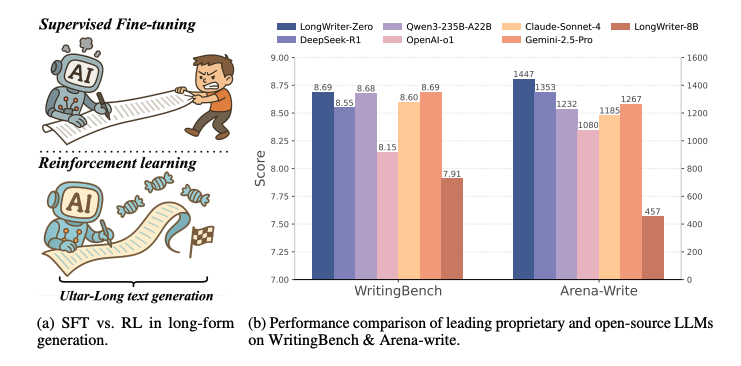
Researchers develop LongWriterZero, a reinforcement learning approach enabling large language models to generate exceptionally long, high-quality text without relying on synthetic training data. Trained from Qwen2.5-32B, it surpasses supervised fine-tuning methods and outperforms models exceeding 100 billion parameters on writing benchmarks like WritingBench and Arena-Write.
The capacity of large language models (LLMs) to generate extended, coherent text remains a considerable challenge, frequently limited by both maximum sequence length and a discernible decline in quality as output increases. Researchers are now exploring methods to circumvent these limitations without relying on extensive, pre-prepared datasets. A team comprising Yuhao Wu and Zhiqiang Hu from the Singapore University of Technology and Design, alongside Yushi Bai and Juanzi Li from Tsinghua University, and Roy Ka-Wei Lee from the former, detail their approach in a paper entitled ‘LongWriter-Zero: Mastering Ultra-Long Text Generation via Reinforcement Learning’. Their work presents a reinforcement learning framework, initiating training from a base model without any annotated data, to cultivate the capacity for generating lengthy, high-quality text, and demonstrates performance exceeding existing supervised fine-tuning methods and, notably, models with significantly larger parameter counts.
Researchers present a novel methodology for ultra-long text generation, moving beyond supervised fine-tuning (SFT) which relies on synthetic datasets. They demonstrate that reinforcement learning (RL), a technique where an agent learns to make decisions by receiving rewards or penalties, effectively cultivates the capacity for generating extended, high-quality text directly within large language models (LLMs), beginning with a base model and without any pre-annotated or artificially constructed data. This incentivisation-based technique addresses a significant challenge in the field: the degradation of text quality and coherence as sequence length increases, a limitation inherent in many LLMs.
The team implemented RL training on a Qwen2
The team implemented RL training on a Qwen2.5-32B base model, guiding it to develop reasoning skills that facilitate both planning and refinement during the writing process. Crucially, they designed specialised reward functions, algorithms that assign numerical values to model outputs based on desired characteristics, that encourage improved length control, enhanced writing quality, and consistent structural formatting. These rewards actively shape the model’s behaviour, steering it towards generating longer, more coherent, and better-organised text.
Evaluations on established benchmarks, including WritingBench and Arena-Write, reveal that LongWriter-Zero, the resulting model, consistently outperforms traditional SFT methods. Notably, it achieves state-of-the-art results across all measured metrics, even surpassing the performance of significantly larger models, such as DeepSeek R1 and Qwen3-235B, which contain over 100 billion parameters. This demonstrates the efficacy of the RL approach in unlocking the potential of smaller models to generate exceptionally long-form content.
The researchers make their data and model checkpoints openly available via Hugging Face, fostering further research and development in the field of ultra-long text generation. This open-source release allows the wider community to replicate, validate, and build upon their findings, accelerating progress towards more capable and versatile language models. The work represents a shift towards leveraging intrinsic learning mechanisms within LLMs, reducing reliance on costly and potentially biased synthetic datasets.
The core innovation lies in guiding the language model through reasoning processes that facilitate planning and refinement during text creation. This contrasts with traditional SFT methods, which require pre-defined examples of long-form content, limiting adaptability and potentially introducing biases present in the training data.
Evaluations confirm LongWriter-Zero’s capability to outperform even substantially
Evaluations confirm LongWriter-Zero’s capability to outperform even substantially larger models, despite being based on a 32 billion parameter foundation. This suggests that the incentivisation-based RL approach effectively unlocks latent capabilities within the base model, enabling it to generate coherent and high-quality text over extended lengths. The model’s performance across multiple metrics highlights its robustness and generalisability.
Future work focuses on exploring the transferability of the learned reasoning and planning skills to other natural language generation tasks. Investigating the impact of different reward function designs and RL algorithms promises further optimisation of the model’s performance. Additionally, research will extend to analysing the model’s internal representations to better understand the mechanisms driving its ability to maintain coherence and quality over ultra-long sequences.
The open-sourcing of both the training data and model checkpoints facilitates further research and development within the community. This commitment to open science encourages collaborative innovation and accelerates progress in the field of long-form text generation. The availability of these resources allows researchers to replicate, extend, and adapt the methodology for diverse applications.
🗞 LongWriter-Zero: Mastering Ultra-Long Text Generation via Reinforcement Learning
🧠 DOI: https://doi.org/10.48550/arXiv.2506.18841