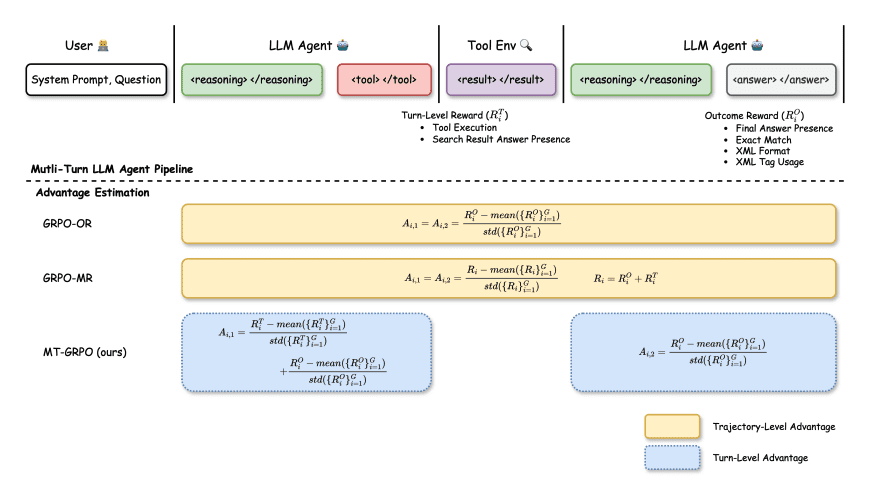
Researchers enhanced the reasoning abilities of large language model agents through reinforcement learning, specifically by improving credit assignment across multiple decision steps. Implementing a turn-level advantage estimation strategy within a Markov Decision Process framework yielded 100% successful tool execution and 50% exact answer matching, exceeding baseline performance of 20-30%.
The capacity of large language models (LLMs) to perform complex, sequential tasks remains a significant challenge in artificial intelligence. Researchers are now focusing on methods to improve an LLM’s ability to reason through multiple steps, particularly when utilising external tools. A new study details an approach to refine this process by improving how ‘credit’ is assigned to each step within a multi-stage decision-making process. Siliang Zeng, Quan Wei, and Mingyi Hong from the University of Minnesota, alongside William Brown from Prime Intellect and Oana Frunza and Yuriy Nevmyvaka from Morgan Stanley, present their findings in the paper “Reinforcing Multi-Turn Reasoning in LLM Agents via Turn-Level Credit Assignment”. Their work demonstrates a method for more precise evaluation of each step in a sequence, leading to substantial improvements in both tool utilisation and answer accuracy.
Enhanced Training Improves Reasoning in Large Language Model Agents
Recent research details a refined methodology for training large language model (LLM) agents to navigate complex, multi-turn interactions, addressing a critical limitation in current approaches to reinforcement learning. The core challenge lies in accurately attributing success or failure to specific actions within a sequence of decisions. Existing methods often struggle to discern which individual steps contributed most to a favourable outcome, hindering learning efficiency.
Researchers tackled this problem by modelling interactions as Markov Decision Processes (MDPs). An MDP is a mathematical framework for modelling decision-making in situations where outcomes are partly random and partly under the control of a decision maker. This allows for a more precise evaluation of the contribution of each action to the overall result.
The innovation centres on a fine-grained, turn-level credit assignment strategy. Rather than assigning a single reward at the conclusion of an interaction, the algorithm now evaluates the impact of each decision within the sequence. This granular approach enables the system to identify which actions were most crucial for achieving success, and conversely, which actions led to setbacks.
This strategy was integrated with the Group Relative Preference Optimisation (GRPO) algorithm. GRPO is a reinforcement learning technique that improves sample efficiency by learning from comparisons between different action sequences. Combining GRPO with the turn-level credit assignment creates a synergistic effect, accelerating learning and improving performance.
Experimental results demonstrate substantial gains. The system achieved a 100% success rate in utilising external tools – a common requirement for complex tasks – significantly exceeding the 20-30% accuracy of baseline models. Furthermore, the new approach attained 50% accuracy in providing exact answers to complex queries, a marked improvement over the performance of existing systems.
These findings suggest that a more precise credit assignment strategy is vital for training LLM agents capable of robust reasoning and effective decision-making in multi-step interactions. The ability to accurately attribute outcomes to specific actions allows the algorithm to learn more efficiently and achieve higher levels of performance.
👉 More information
🗞 Reinforcing Multi-Turn Reasoning in LLM Agents via Turn-Level Credit Assignment
🧠 DOI: https://doi.org/10.48550/arXiv.2505.11821