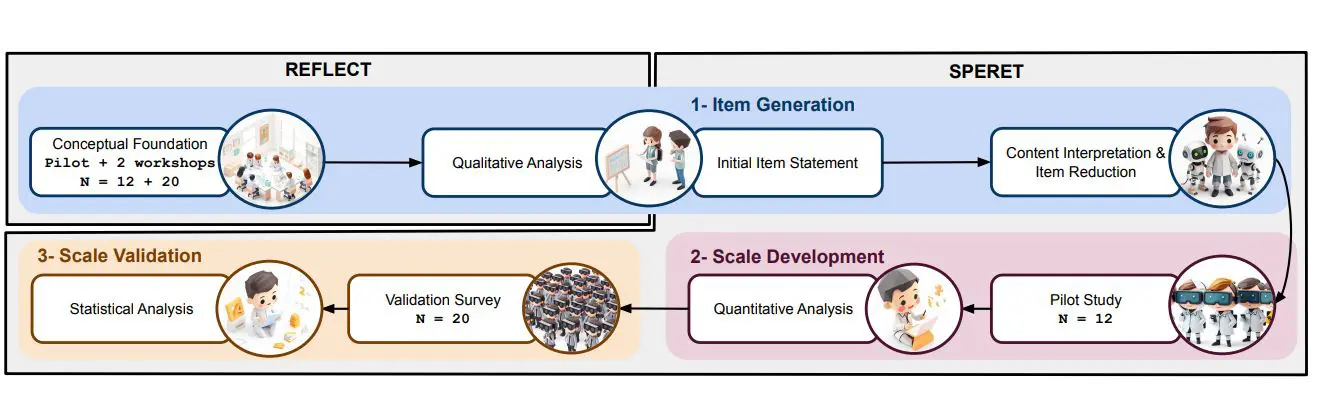
The increasing use of eye-tracking technology in sensitive areas like healthcare, marketing and surveillance demands careful consideration of ethical and privacy implications, yet systematic understanding of how researchers address these concerns remains limited. To address this gap, Susanne Hindennach, Mayar Elfares, Céline Gressel, and Andreas Bulling, from the Universities of Stuttgart and Tübingen, developed two novel instruments, REFLECT and SPERET, to measure and promote ethical and privacy reflexivity within the eye-tracking research community. Their work, informed by input from over 70 researchers, reveals a strong awareness of user privacy and methodological limitations, alongside a developing sense of ethical responsibility as projects progress. These tools and the associated analyses offer a comprehensive examination of current practice and provide a promising outlook for fostering more privacy and ethics-conscious research in this rapidly evolving field.
These tools allow researchers to assess how deeply colleagues consider the ethical implications of their work. To understand researcher perspectives, the team conducted workshops involving 20 participants, including students, professors, and postdoctoral researchers, who completed the REFLECT questionnaire covering ten key themes designed to encourage critical self-assessment. The questionnaire, refined through testing and expert review, explored areas such as fundamental beliefs about humanity, the relevance of research to society, and the quality of data used in machine learning systems.
Analysis of responses revealed a research community actively considering potential harm to participants and acknowledging responsibility for system errors, while also prompting researchers to articulate their assumptions about target groups and consider unintended uses of their work. Researchers intentionally used a pen-and-paper format to encourage slower, more deliberate reflection, and participants responded positively to this approach. The team identified key themes from the qualitative data, informing the development of the SPERET scale designed to quantitatively measure privacy and ethics reflexivity.
Reflexivity Scale for Eye-Tracking Ethics and Privacy
This research delivers a comprehensive set of materials related to a scale designed to measure ethical and privacy awareness in eye-tracking research. The core goal is to develop a reliable scale to assess how researchers think about the ethical, social, and privacy implications of their work, encouraging proactive consideration of potential harms and awareness of the complex ethical landscape of eye-tracking. The research began with an initial 40-item scale, a questionnaire with statements designed to capture different facets of ethical and privacy concerns, covering areas like data privacy, data security, responsible handling, and awareness of potential bias resulting from relying heavily on participants from Western, Educated, Industrialized, Rich, and Democratic societies. The scale also addressed concerns about potential misuse of eye-tracking research for surveillance or manipulation, and beliefs about responsibility for addressing ethical concerns.
A workshop version of the questionnaire, refined with added questions and thematic blocks based on initial feedback, aimed to elicit deeper reflection. The original questionnaire was translated and modified for use in an English-speaking context, and statistical analysis, specifically item-total correlation, was used to identify and remove items that did not contribute significantly to the overall measurement. Key concepts underpinning the research include reflexivity, the awareness of one’s own biases and assumptions, data ethics, the principles governing data collection and use, privacy, the right to control personal information, social justice, ensuring research benefits all members of society, and responsible innovation, guiding technological development with ethical principles. The scale is intended for use with eye-tracking researchers, who respond to statements using a scale to provide an overall measure of ethical and privacy awareness, with potential applications in training, education, research ethics review, benchmarking ethical awareness over time, promoting an ethical research culture, and informing the development of ethical guidelines. The strengths of this approach lie in its focus on reflexivity, comprehensive coverage of ethical concerns, rigorous development using established methods, and practical applications. Future research should validate the scale with a larger and more diverse sample, test its applicability across cultures, track changes in ethical awareness over time with longitudinal studies, and evaluate the effectiveness of training programs designed to improve ethical awareness.
Ethical Reflexivity Tools for Eye-Tracking Research
This research presents a novel investigation into ethical and privacy awareness within the academic eye-tracking community, yielding both a qualitative questionnaire, REFLECT, and a quantitative scale, SPERET, to assess these crucial considerations. Analyses utilising these tools reveal a research community demonstrably concerned with user privacy and aware of methodological limitations such as potential sample bias, with a growing sense of ethical responsibility that evolves alongside project development. The findings demonstrate a nuanced understanding of ethical considerations among researchers, although differences exist between basic and applied research contexts regarding anticipatory ethics. Collectively, these new tools and the associated analyses offer a systematic evaluation of awareness in eye-tracking research and establish a framework to promote practices more attentive to privacy and ethical considerations.
The authors acknowledge that the study focuses on the academic community and further research could broaden this understanding to include industry practitioners. They emphasise the tools are designed to guide discussion and learning, rather than to measure moral virtue, and advocate for their confidential, non-punitive use within facilitated interdisciplinary reflection sessions to cultivate ethical awareness. This work represents a significant step towards responsible development and application of eye-tracking technology by prioritising the ethical mindset of its creators.
🗞 REFLECTing SPERET: Measuring and Promoting Ethics and Privacy Reflexivity in Eye-Tracking Research
🧠 ArXiv: https://arxiv.org/abs/2511.18965