Reconfigurable metasurfaces, artificial materials engineered to control electromagnetic waves, promise breakthroughs in areas like wireless communication and holographic imaging, but achieving continuous and efficient control of these waves remains a significant challenge. Alexandros Pitilakis, Alexandros Katsios, and Alexandros-Apostolos A. Boulogeorgos, all from the University of Western Macedonia, address this challenge by designing and analysing a metasurface based on chalcogenide phase-change materials, substances that alter their optical properties when switched between different states. Their work demonstrates how carefully designed patterns using these materials allow precise tuning of the metasurface’s resonance frequency, enabling continuous reconfiguration in the near and mid-infrared spectrum, and paving the way for dynamically controllable infrared devices. The team’s analytical predictions, validated by detailed simulations, confirm the potential of this approach for creating advanced holographic metasurfaces with unprecedented control over light.
The device utilizes a germanium-antimony-tellurium alloy, a phase-change material, which thermally switches between highly distinct amorphous and crystalline phase-states. Simple conductive patterns tune its resonance frequency, and researchers analytically predicted the unit cell response using transmission line theory and equivalent circuits.
Dynamically Reconfigurable Metasurface with Phase-Change Material
Scientists engineered a reflective reconfigurable metasurface architecture for wireless communications, employing a germanium-antimony-tellurium alloy to dynamically alter its properties. The device utilizes the distinct amorphous and crystalline phase-states of the material, thermally toggled to control the reflection of electromagnetic waves. Researchers analytically predicted the unit cell response using transmission line theory and equivalent circuits, allowing for precise control over the metasurface’s behavior. Scientists computed the complex reflection coefficient spectra of this unit cell using transmission line modeling, employing matrices to analyze its behavior, and utilized equivalent circuit models to accurately assess dispersion near the main resonance for various angles of incidence and polarizations.
This framework enabled both computation of the response for given cell parameters and optimization of those parameters for a target response. The team computed the frequency-dependent relative permittivity of the alloy across a broad spectrum from visible to mid-infrared wavelengths, first calculating the imaginary part using a combined Drude and Tauc-Lorentz model for both amorphous and fully crystallized states, and fitting parameters to existing experimental measurements. Subsequently, they computed the real part using Kramers-Kronig relations and integration involving the imaginary part, and then calculated the spectra for partially crystallized states using the Lorentz-Lorenz formula, naturally positioning them between the extreme spectra. Characteristic spectra for the complex refractive index were computed for eleven crystallization ratios, ranging from zero to one, and used to design multi-bit, digitally-encoded metasurfaces.
Dynamically Tunable Metasurface with Phase-Change Material
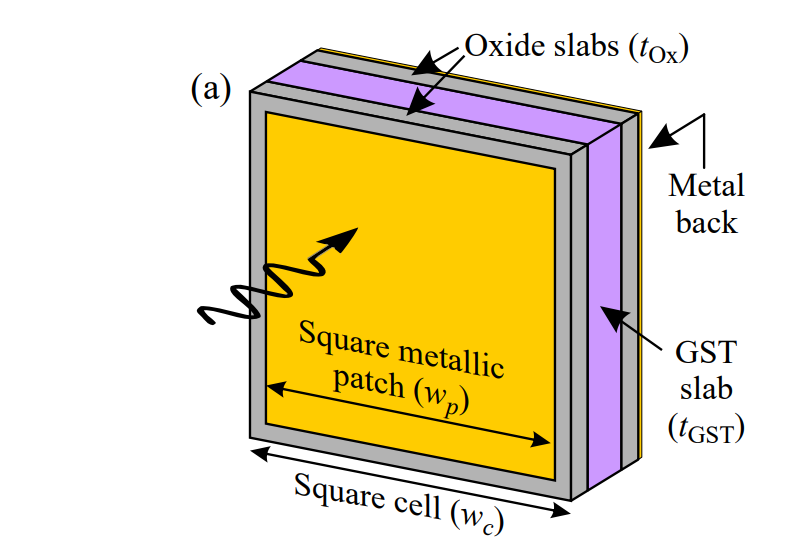
Scientists have achieved a breakthrough in reconfigurable metasurface technology, demonstrating a device capable of dynamically altering its optical properties using a phase-change material. The research centers on a metasurface architecture built from germanium-antimony-tellurium, a material that transitions between distinct amorphous and crystalline states when heated, enabling precise control over light manipulation in the infrared spectrum. The team designed a unit cell consisting of an alloy slab sandwiched between silicon dioxide layers, atop a metallic ground plane, and patterned with square metallic patches to tune resonance. The core of the achievement lies in the accurate modeling of the alloy’s optical properties, specifically its complex refractive index, across a broad spectral band.
Researchers employed a combined Drude-Tauc-Lorentz model and Lorentz-Lorenz formula to compute the material’s response, fitting parameters to existing experimental data to ensure accuracy. This modeling accurately predicts the refractive index for eleven different crystallization ratios, ranging from fully amorphous to fully crystallized states, and provides a pathway to multi-bit, digitally-encoded metasurfaces. Characteristic spectra reveal the complex refractive index, demonstrating how the material’s properties change with varying degrees of crystallization. Using transmission line modeling and equivalent circuit models, the team optimized the metasurface’s geometry, oxide and alloy slab thicknesses, cell width, and patch dimensions, to achieve exceptional performance at a wavelength of 1550 nanometers. The resulting design delivers phase coverage exceeding 180 degrees, meaning the metasurface can effectively manipulate the phase of reflected light across a wide range. This level of control enables the creation of tailored meta-mirrors, gratings, and phased arrays, paving the way for arbitrary wavefront shaping and advanced optical functionalities.
Dynamically Tunable Metasurfaces with Phase Change Alloys
This research demonstrates a novel reconfigurable metasurface architecture utilising a germanium-antimony-tellurium alloy, a phase-change material, for potential applications in wireless communications. By carefully designing conductive patterns and leveraging the material’s ability to switch between distinct amorphous and crystalline states, the team achieved tunable resonance frequencies and demonstrated the possibility of creating continuously reconfigurable holographic metasurfaces operating in the infrared bands. Analytical modelling, grounded in transmission line theory and equivalent circuits, accurately predicted the behaviour of the unit cells. The work successfully establishes a pathway towards dynamically controlling light and shaping wavefronts, offering promising capabilities for next-generation optical wireless communication systems. While the simulations indicate minimal thermal crosstalk between adjacent cells, the authors acknowledge the need for comprehensive two and three-dimensional multiphysical simulations to fully evaluate performance limitations and accurately assess reconfiguration efficiency and speed. Future research will focus on optimising the thermoelectric aspects of the reconfiguration process, further refining the design and enhancing its practical viability.
🗞 Analysis and Design of a Reconfigurable Metasurface based on Chalcogenide Phase-Change Material for Operation in the Near and Mid Infrared
🧠 ArXiv: https://arxiv.org/abs/2510.00950