Topological materials represent a potential revolution in device technology, promising robust performance even with imperfections, but their sensitivity to heat has remained a significant obstacle. Jiefei Wang, Jianhao Dai, and Ruosong Mao, along with their colleagues, now demonstrate a room-temperature realisation of the celebrated Haldane model, a fundamental concept in topological physics, overcoming this limitation. The team achieves this breakthrough by utilising atomic ensembles within momentum-space superradiance lattices, a system naturally resistant to thermal noise, and reveals the topological properties through analysis of superradiant emission. This approach not only deepens understanding of exotic topological states, but also establishes a reconfigurable and robust platform that bridges the gap between fundamental simulation and practical technological applications, potentially unlocking a new era of resilient devices.
Superradiant Lattices and Topological Phase Transitions
This research details the creation and exploration of a novel platform for quantum simulation using superradiance lattices, essentially patterned light emitted from cold atoms. The team built a system capable of creating and manipulating these superradiance lattices, periodic structures of light formed by the collective emission of atoms. By carefully controlling the atomic arrangement and light properties, they demonstrate the ability to induce and observe topological phase transitions, changes in the fundamental properties of the system related to its band structure, allowing them to simulate condensed matter physics phenomena, specifically topological insulators, in a new and potentially advantageous way. Key findings include the successful observation of these topological phase transitions, establishing superradiance lattices as a promising new platform for quantum simulation, and developing a method to directly measure a crucial property called the Zak phase, providing direct evidence of the topological transitions. The platform operates at room temperature, simplifying experimental requirements compared to many other quantum simulation approaches. This research opens up new avenues for exploring topological physics and simulating complex quantum systems, with the room-temperature operation and potential scalability of superradiance lattices making them particularly attractive for future experiments.
Velocity Selection Reveals Topological Superradiance Contrast
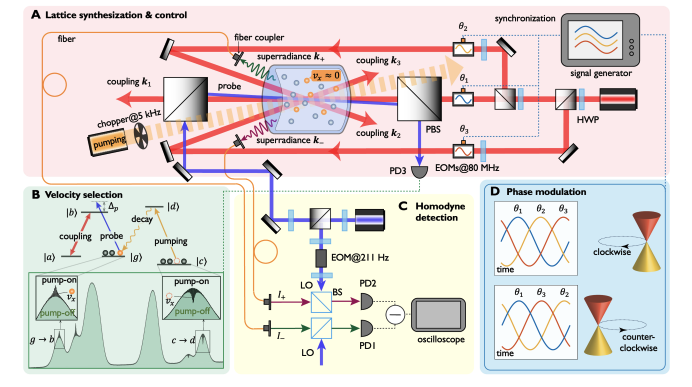
Scientists engineered a room-temperature platform to investigate topological phenomena, overcoming limitations imposed by cryogenic requirements in traditional models. The study pioneered a method employing atomic ensembles within momentum-space superradiance lattices, intrinsically resilient to thermal noise, to reveal topological properties through superradiant emission contrast. Experiments employed a specific arrangement of coupling lasers to establish a linear potential within the lattice, though the thermal distribution of atomic velocities initially obscured observation of the topological phase transition. To address this, researchers implemented a velocity-selective transfer technique combined with homodyne detection to isolate and measure emissions from atoms with near-zero velocity.
A pulsed laser at 5kHz filtered noise and ensured a steady state, selectively exciting zero-velocity atoms and increasing their ground-state population. This velocity-selective transfer process was evidenced by absorption peaks in the atomic spectra. Scientists then developed a homodyne detection module to retrieve superradiant field amplitudes before comparison, allowing them to realize topological phases with varying properties by tuning the modulation depth and phase of the coupling fields, inducing circular motion of excitations within the lattice. This modulation created an effective model governing the band structure, opening gaps at specific points and enabling determination of properties based on the chirality of those points.
Topological Superradiance Lattices Realized at Room Temperature
Scientists have demonstrated a room-temperature realization of a key model in topological physics, using a novel platform based on superradiance lattices constructed from atomic ensembles. The team engineered a momentum-space honeycomb lattice by coherently coupling three laser fields to rubidium atoms, effectively breaking time-reversal symmetry and inducing topological phases. Experiments revealed directional superradiant emissions along specific momentum channels, which serve as a direct signature of the topological state, arising from the collective excitation of atoms into specific states where phase factors define the momentum transfer from the probe field. The core of the experiment involved a vapor cell containing rubidium atoms, where the superradiance lattice was constructed using an electromagnetically induced transparency configuration.
By modulating the phases of the three coupling laser fields, researchers introduced interactions essential for realizing the model. Measurements confirm that the phase correlations of the excited atomic states precisely match those of the emitted light, resulting in the observed directional superradiant emissions. The intensity of these emissions directly correlates with the topological phase transitions within the lattice, providing an in-situ observable. Furthermore, the platform uniquely enables strong modulation, allowing the generation of longer-range interactions and access to complex diagrams featuring higher properties, and the velocity scanning tomography technique selectively detects emissions from zero-velocity atoms, achieving cold-atom spectroscopic resolution even in room-temperature atoms.
Room-Temperature Haldane Model via Superradiance Lattices
This research successfully demonstrates a room-temperature realization of a key model in topological physics, using atomic ensembles within momentum-space superradiance lattices. The team revealed topological characteristics through analysis of superradiant emission, establishing a platform inherently resistant to thermal noise, a common limitation in these types of studies. Importantly, this approach not only replicates the fundamental features of the model without the need for extremely cold temperatures, but also extends beyond it, accessing regimes with higher properties, previously difficult to achieve. The findings establish a robust and versatile platform for exploring topological phases at ambient temperatures, offering potential for advancements in quantum simulation and topological photonics. While determining the precise topological property requires further investigation using methods like Zak phase analysis, their current results demonstrate exceptional tunability and thermal stability, and future work may involve generalizing the method to simulate other quantum states and scaling it to higher dimensions using interactions, potentially enabling the investigation of interactions in exotic phases of matter and paving the way for dynamic, reconfigurable quantum technologies such as enhanced quantum sensors and routers.
🗞 Realizing the Haldane Model in Thermal Atoms
🧠 ArXiv: https://arxiv.org/abs/2509.08411