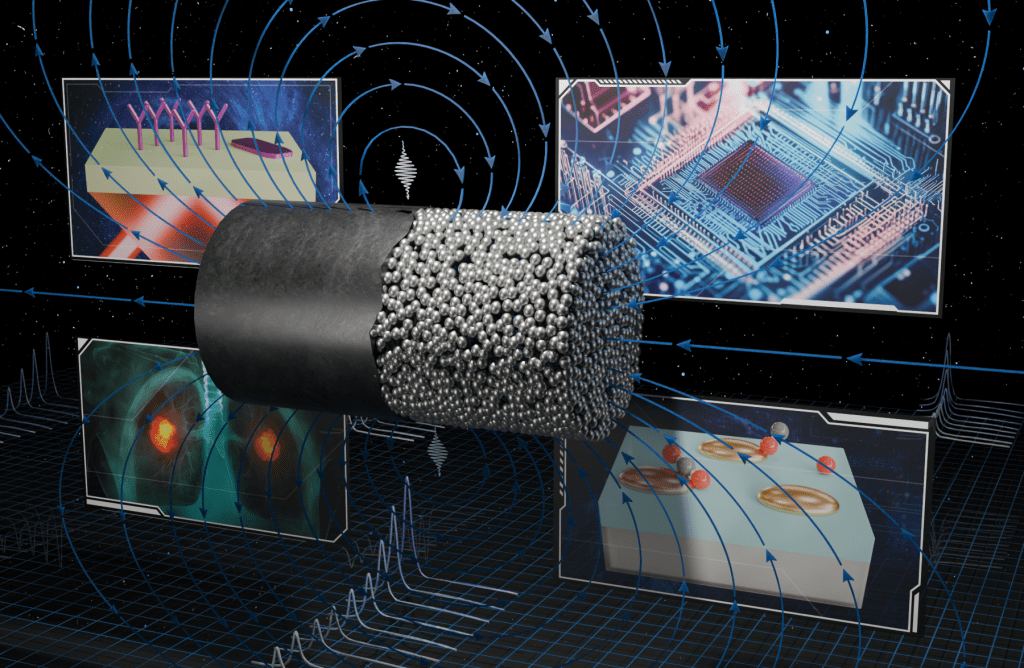
Researchers at Oak Ridge National Laboratory, in collaboration with North Carolina State University, have developed a computational capability to model the behaviour of up to 24,000 electrons in materials in real time, utilising the exascale Frontier supercomputer and an open-source code called Real-space Multigrid. This real-time time-dependent density functional theory, or RT-TDDFT, allows scientists can now simulate how electrons respond to stimuli, such as light, within nanoscale materials. This achievement, enabled by the Department of Energy’s Frontier supercomputer and an open-source code, RMG, is vital for designing new technologies including advanced photovoltaic cells and emerging information systems, and was published in the Journal of Chemical Theory and Computation.
Real-time Simulation of Electron Dynamics
Modelling electron dynamics has direct implications for a range of applications, including optimising biosensing and advancing catalysis. Understanding how electrons interact with light in metallic nanoparticles also improves the efficiency of photothermal therapies, offering potential advancements in medical treatments. Furthermore, accurate modelling of electron behaviour is essential for designing advanced cells and emerging systems, including those based on principles.
The development of real-time time-dependent density functional theory (RT-TDDFT) capabilities within the Real-space Multigrid (RMG) code represents a methodological advance in simulating electron dynamics. RT-TDDFT is a computational method used to model how electrons behave over time, crucial for understanding material properties. This work extends the scale of accessible systems to 24,000 electrons, approximating the complexity of systems containing thousands of carbon or water molecules, and allows researchers to model ultrafast electron behaviour in nanoscale materials directly in real-time, rather than relying on computational time. The ability to accurately represent these interactions is crucial for understanding the fundamental properties of materials at the atomic level.
Scaling these simulations necessitated leveraging the exascale computing power of the Frontier supercomputer, enabling calculations previously considered intractable. The RMG code’s flexible grid structure efficiently utilises such architectures, representing electron behaviour.
Future research will focus on simulating even more complex scenarios to uncover novel physics in systems, pushing the boundaries of science. Enhancing the efficiency and accuracy of these simulations will allow for the modelling of larger, more intricate materials, providing valuable insights into their properties. This work aims to provide a computational guide for experimental efforts, accelerating progress in areas such as and science.
More information
External Link: Click Here For More