

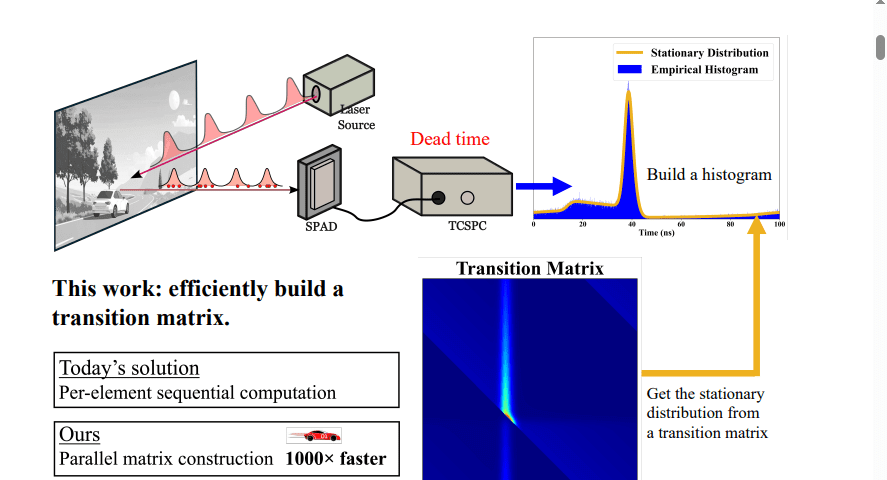
Single-photon LiDAR is increasingly vital for detailed 3D imaging and navigation, but accurately modelling the timing of detected photons remains a significant challenge, particularly when the system experiences dead time, a period where it cannot register further photons. Weijian Zhang, Hashan K. Weerasooriya, Prateek Chennuri, and Stanley H. Chan from Purdue University present a novel approach to this problem, introducing the first non-sequential Markov model for single-photon LiDAR timestamp distributions. Their innovation lies in a reformulated mathematical framework that separates the effects of dead time, allowing for dramatically faster computation of the model and achieving substantial acceleration compared to existing methods. The resulting model closely matches the accuracy of complex Monte Carlo simulations, but requires far less processing time, and a new theoretical analysis reveals previously unrecognised factors influencing the model’s stability and accuracy.
Modeling Timestamp Distributions in Single-Photon LiDAR
This research introduces a new framework for accelerating the modeling of timestamp distributions in asynchronous Single-Photon LiDAR (SP-LiDAR) systems, addressing a key challenge in high-flux environments. SP-LiDAR systems experience effects like dead time and pile-up, which distort timestamp data and complicate analysis. Accurately modeling these distortions has traditionally been computationally expensive, hindering real-time processing. The authors developed a method to significantly speed up this process by formulating the problem as a Markov chain, allowing them to model the probability of photon detections over time.
They reduced complex integral calculations to simpler calculations involving cumulative flux differences and cleverly interpreted dead time as a permutation of photon arrival times, enabling parallel computation. This new method delivers a substantial acceleration in modeling SP-LiDAR timestamp distributions compared to existing techniques, allowing for new analyses of stationary distributions and spectral convergence previously computationally infeasible. The authors also analyzed the eigenvalue magnitude and phase of the Markov chain to understand the convergence behavior of the system, revealing oscillatory dynamics. This research has the potential to improve SP-LiDAR performance, advance 3D imaging, and enable real-time processing of SP-LiDAR data, crucial for applications like autonomous driving.
Non-Sequential Markov Modeling of Photon Timestamps
Scientists have developed a novel method for modeling timestamp distributions in single-photon LiDAR (SP-LiDAR) systems, addressing a significant computational challenge in high-quality 3D imaging and navigation. Researchers demonstrated that the sequence of relative timestamps can be described using a Markov chain, but constructing the transition matrix traditionally involves computationally expensive integrals dependent on signal flux, background flux, and dead time duration. To overcome this limitation, the team pioneered a non-sequential Markov modeling approach, introducing a new formulation that decouples the effect of dead time from the core system dynamics. This involved reparameterizing integral bounds and demonstrating that dead time functions as a deterministic row-wise permutation of a base matrix, enabling efficient, vectorized matrix construction and achieving up to a 1000-fold acceleration.
The technique allows for rapid computation of the stationary distribution, essential for depth estimation and system simulation. The study employed an inhomogeneous Poisson process to model photon arrivals, and scientists validated the accuracy of the predicted stationary probability density functions against gold-standard Monte Carlo simulations across diverse flux conditions. Furthermore, the research revealed that the phase of the second-largest eigenvalue governs oscillatory behavior, a finding enabled by the computational efficiency of the new method. This efficient formulation unlocks new capabilities for large-scale analysis and provides a foundation for advanced SP-LiDAR applications.
Dead Time Modeling with Markov Permutations
Scientists have developed a new method for modeling timestamp distributions in single-LiDAR systems, achieving a breakthrough in the efficiency of 3D imaging and navigation technologies. Previous approaches relied on computationally expensive methods involving complex matrix construction, limiting their scalability. This work introduces a novel non-sequential Markov modeling technique that significantly accelerates the process. The key innovation lies in reformulating the problem to separate the effect of dead time as a simple row permutation of a base matrix, allowing for efficient vectorized matrix construction.
Experiments demonstrate this new method achieves up to a 1000-fold speedup compared to existing techniques, without sacrificing accuracy. The team validated the method against gold-standard Monte Carlo simulations, confirming its ability to produce nearly exact stationary distributions in a fraction of the time. Further analysis revealed critical insights into the convergence behavior of the model, discovering that the magnitude and phase of the second-largest eigenvalue of the transition matrix play a crucial role in determining how quickly the model reaches a stable solution. This understanding allows for more precise control and optimization of the modeling process.
Fast Stationary Distribution Prediction for LiDAR Systems
This research presents a significant advancement in modeling timestamp distributions for single-LiDAR systems, which are crucial for high-quality 3D imaging and navigation. Scientists developed a novel framework that accelerates the construction of the Markov chain transition matrix used to represent these distributions, overcoming computational challenges associated with existing methods. The key innovation lies in a new formulation that effectively separates the impact of detector dead time, enabling parallel matrix assembly and achieving substantial speed improvements. The resulting model delivers highly accurate stationary distribution predictions, closely matching those obtained through computationally intensive Monte Carlo simulations, but in a fraction of the time. Furthermore, this work reveals the importance of both the magnitude and phase of the second-largest eigenvalue in determining the convergence behaviour of the system, a factor previously overlooked in the literature. This deeper understanding of spectral convergence supports the design of faster and more accurate LiDAR systems.
👉 More information
🗞 Real-Time Markov Modeling for Single-Photon LiDAR: Acceleration and Convergence Analysis
🧠 ArXiv: https://arxiv.org/abs/2509.20500


