Generating realistic and controllable human motion holds immense promise for applications ranging from virtual reality to robotics, but current vision-language-motion models struggle with practical deployment due to limitations in responsiveness and precision. Researchers Bin Cao from the Chinese Academy of Sciences, Sipeng Zheng from BeingBeyond, and Ye Wang from Renmin University of China, along with colleagues, address these challenges by introducing Being-M0. 5, a new model capable of real-time, controllable motion generation. This advancement stems from the creation of HuMo100M, a uniquely comprehensive dataset containing millions of motion sequences and detailed annotations, and a novel technique for precisely controlling individual body parts during motion creation. The resulting model demonstrates superior performance across multiple benchmarks, offering a significant step towards practical and versatile motion generation systems with broad real-world impact.
Controllability remains a primary bottleneck in the field, manifesting in five key aspects: inadequate response to diverse human commands, limited pose initialisation capabilities, poor performance on long-term sequences, insufficient handling of unseen scenarios, and lack of fine-grained control over individual body parts. To overcome these limitations, researchers present Being-M0. 5, the first real-time, controllable Vision-Language Motion Model (VLMM) that achieves state-of-the-art performance across multiple <a href=”https://quantumzeitgeist.com/bbc-micro-how-a-british-computer-inspired-a-generation-of-programmers/”motion generation tasks. This approach is built upon HuMo100M, the largest and most comprehensive human motion dataset to date, comprising over 5 million self-collected motion sequences and 100 million instructional instances, alongside detailed annotations. The development of Being-M0. 5 addresses critical shortcomings in existing models, paving the way for more nuanced and responsive human motion generation
HuMo100M Dataset and Instruction Generation Details
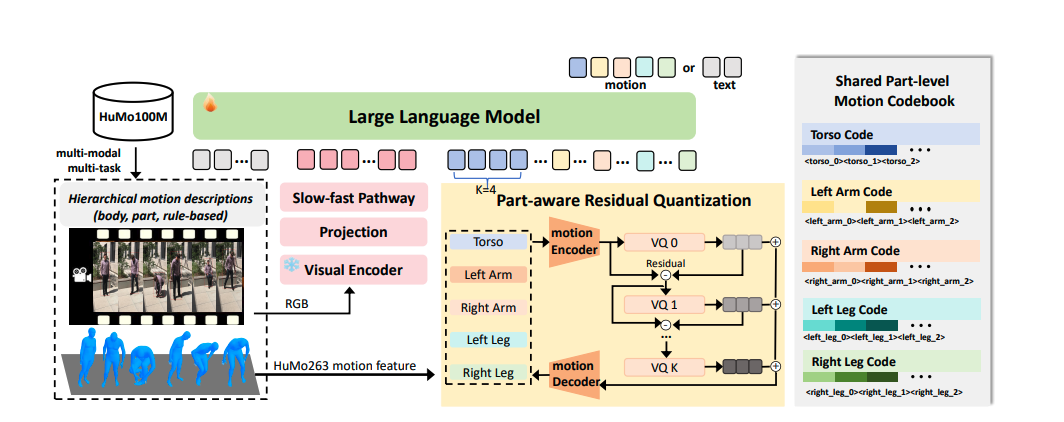
This research details a large-scale human motion dataset, HuMo100M, and a novel motion generation technique. It provides a comprehensive overview of the dataset’s construction, annotation process, and technical details. The dataset combines existing resources with new data extracted from web videos, resulting in a diverse collection of motion sequences with varying lengths and detailed annotations. Instructions are generated using both advanced multimodal models and rule-based methods, ensuring comprehensive and detailed descriptions of the motions. A key innovation is Part-level Residual Quantization (PRQ), a technique that decomposes human motion into five anatomical regions, left hand, right hand, left leg, right leg, and torso, to improve motion generation quality and control.
The inclusion of visual aids and justification of design choices strengthens the credibility of the work, while the emphasis on multimodality highlights the importance of diverse annotation types. To improve the appendix, the authors could streamline content by removing redundancy and include quantitative results. Addressing challenges encountered during data collection, annotation, or model training would demonstrate a realistic assessment of the research. A table of contents would aid navigation, and explicitly stating what is novel about HuMo100M compared to existing datasets would highlight its contributions. Overall, this is a well-written and comprehensive appendix that provides a wealth of information about the HuMo100M dataset and the method used.
Realistic Human Motion from Language Instructions
Researchers have developed Being-M0. 5, a new model that generates realistic and controllable human motion in real time, representing a significant step forward in the field of motion generation. Existing methods often struggle with generating motions that respond accurately to instructions, initiating movements correctly, maintaining consistency over longer sequences, adapting to new situations, or controlling individual body parts with precision. Being-M0. 5 addresses these limitations directly by leveraging the vast new dataset, HuMo100M, containing over 5 million motion sequences and 100 million instructional instances, providing a comprehensive foundation for learning complex human movements and their associated language descriptions.
A key innovation lies in the model’s ability to precisely control individual body parts, achieved through a novel part-aware <a href=”https://quantumzeitgeist.com/keysight-unveils-industry-first-quantum-circuit-simulation-with-flux-quantization/”residual quantization technique for motion tokenization. This allows for granular control over movements, enabling the generation of highly specific and nuanced actions, a capability lacking in previous systems. The model utilizes a 7 billion parameter architecture, built upon established vision-language model designs, and incorporates a slow-fast processing strategy to efficiently handle extended motion sequences without sacrificing temporal information. This design allows Being-M0.
Being-M0. 5 demonstrates superior performance across a range of motion generation benchmarks, achieving a level of control and realism previously unattainable. The system’s real-time capabilities, combined with its precise control over individual body parts, open up new possibilities for applications in areas such as animation, virtual reality, robotics, and human-computer interaction. By addressing critical limitations in controllability and efficiency, Being-M0. 5 and the HuMo100M dataset represent a substantial advancement, accelerating the adoption of motion generation technology in practical, real-world scenarios.
Precise Human Motion Control with Being-M0. 5
This research presents Being-M0. 5, a new model for generating realistic and controllable human motion, alongside HuMo100M, a large dataset of over five million motion sequences with detailed annotations. The team addressed limitations in existing models by focusing on controllability, specifically improving the ability to respond to diverse commands, initialize poses, handle long sequences, manage unseen scenarios, and control individual body parts. Through the development of a part-aware residual quantization technique, Being-M0. 5 decomposes motion into meaningful body-part representations, enabling precise control during generation.
Experimental results demonstrate that Being-M0. 5 achieves state-of-the-art performance across multiple motion benchmarks while maintaining real-time capabilities, a significant step towards practical applications. The authors acknowledge that further research is needed to fully explore the potential of this approach, and the project provides design insights and and some
🗞 Being-M0.5: A Real-Time Controllable Vision-Language-Motion Model
🧠 ArXiv: https://arxiv.org/abs/2508.07863