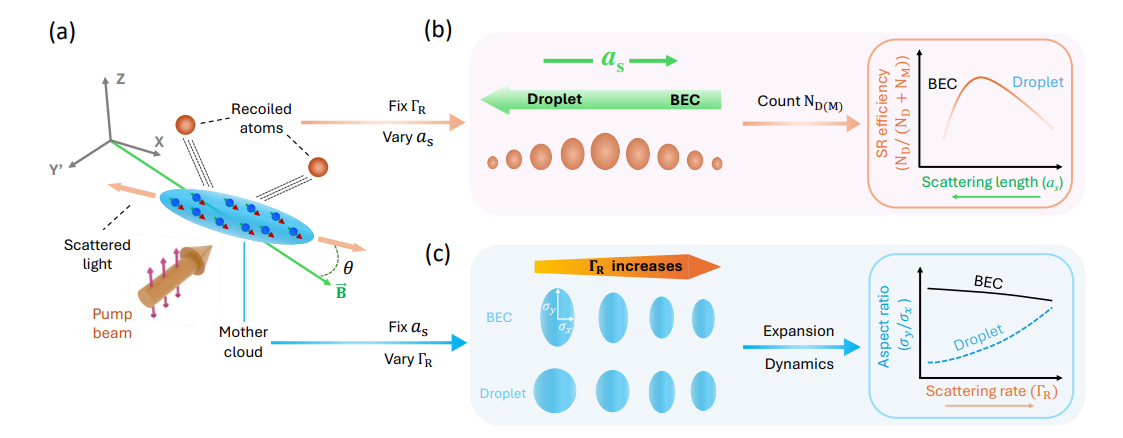
The transition between a Bose-Einstein condensate and an emergent molecular droplet represents a fascinating shift in quantum matter, and researchers are continually seeking new ways to observe and control this phenomenon. Mithilesh K. Parit, Mingchen Huang, and Ziting Chen, all from The Hong Kong University of Science and Technology, alongside Yifei He and Haoting Zhen from the same institution, and Gyu-Boong Jo, demonstrate a novel approach using superradiant light scattering to both probe and manipulate this transition in a dipolar gas. Their work reveals that the efficiency of this scattering changes in a predictable way as the gas shifts between a condensate and a droplet, offering a sensitive indicator of the system’s state. By carefully controlling atom depletion with superradiance and analysing the resulting expansion, the team successfully identifies and tracks the characteristics of this transition, opening up new possibilities for studying these exotic quantum states and their underlying coherence properties.
Quantum Droplets in Dipolar Bose-Einstein Condensates
Scientists are unraveling the complex behavior of quantum droplets, self-contained structures emerging within dipolar Bose-Einstein condensates. These droplets arise from a delicate balance between fundamental interactions and many-body effects, prompting researchers to investigate the transition from a conventional condensate to this unique droplet regime and to develop methods for controlling and characterizing these structures. Theoretical modeling, employing a variational approach, plays a crucial role in understanding the underlying physics of this transition. The research centers on a detailed theoretical framework designed to model the system’s behavior.
The team utilizes a variational method to simplify the complex equations governing the Bose-Einstein condensate, employing a Gaussian wave function to approximate the shape of the condensate and streamline calculations. By solving a set of differential equations derived from this energy functional, scientists can predict the system’s behavior and map out the conditions under which the transition to a quantum droplet occurs. Key to understanding these systems are quantities like the chemical potential, which describes energy changes with particle number, and the release energy, a measure of the droplet’s binding energy. Through careful mathematical derivations, they establish a comprehensive understanding of the system’s properties and predict its behavior under varying conditions. This theoretical work provides a foundation for interpreting experimental observations and gaining deeper insights into the physics of quantum droplets.
Superradiance Probes and Controls Quantum Droplet Formation
Scientists have pioneered a new approach to study the formation of quantum droplets in a gas of erbium atoms, utilizing superradiant light scattering as both a sensitive probe and a precise control mechanism. This technique allows researchers to not only observe the transition from a Bose-Einstein condensate to a quantum droplet, but also to actively manipulate the atomic sample during this process, revealing key characteristics of the quantum phase transition. Observations reveal a non-monotonic relationship between the efficiency of superradiant scattering and the rate at which the sample expands, directly linking this behavior to the initial quantum state of the system. To precisely characterize the transition, the team implemented a controlled atom depletion method using superradiance, circumventing complications arising from atomic collisions, a common challenge in ultracold atom experiments.
By carefully adjusting the amount of atom depletion, scientists analyzed the sample’s expansion dynamics and aspect ratio, allowing them to distinctly identify the Bose-Einstein condensate and droplet phases. These experimental observations are supported by calculations using a Gaussian variational ansatz, confirming the accuracy of the phase identification. Measurements of the recoiled atom fraction and expansion velocity revealed a shift in the transition point as the dipole angle increased, indicating a change in the conditions required for droplet formation. Theoretical calculations, plotting scattering length as a function of dipole orientation and atom number, corroborated the experimental findings, confirming the system’s self-bound property and the minimum expansion velocity at the transition point.
Superradiance Reveals BEC to Droplet Transition
Scientists have demonstrated a novel method for probing and controlling quantum states in a Bose-Einstein condensate using superradiant light scattering, revealing detailed characteristics of the transition to a quantum droplet state in a gas of erbium atoms. Experiments reveal a non-monotonic relationship between the efficiency of superradiant scattering and the rate of sample expansion during the transition, indicating sensitivity to the initial quantum state. Through controlled atom depletion using superradiance, the team analyzed expansion dynamics and aspect ratio to distinctly identify the Bose-Einstein condensate and droplet phases, supported by calculations using a Gaussian variational ansatz. Measurements of the aspect ratio demonstrate a clear distinction between the two phases; in the droplet regime, depletion of the atomic cloud leads to a rapid increase in aspect ratio, while in the Bose-Einstein condensate regime, the aspect ratio decreases.
This change in aspect ratio is attributed to the release of energy during the transition. Numerical calculations, solving the extended Gross-Pitaevskii equation with a time-dependent variational Gaussian ansatz, confirm these observed expansion dynamics, showing strong agreement with experimental data. Further investigation involved constructing a phase diagram in terms of scattering length and atom number, revealing a distinct transition between the Bose-Einstein condensate and droplet phases.
Superradiant Control of Quantum Droplet Formation
Researchers have demonstrated a novel technique using superradiant light scattering to both probe and control the properties of a Bose-Einstein condensate transitioning into a quantum droplet state in a gas of erbium atoms. The team observed that the efficiency of this light scattering process changes in a predictable way as the condensate transforms, mirroring the expansion rate of the sample and revealing details of this phase transition. By carefully controlling atom depletion using superradiance, they were able to analyze the sample’s expansion and identify the distinct characteristics of the transition between these two quantum states. Furthermore, the researchers mapped how the points of lowest expansion shift under varying magnetic field orientations, providing insights into the behaviour of these quantum systems under external influence. This work establishes superradiant scattering as a powerful tool for investigating quantum droplets and supersolids, and for examining phase coherence in low-dimensional dipolar systems. The rapid depletion of atoms induced by superradiance also offers a unique opportunity to study droplet formation while minimizing losses due to atomic collisions.
🗞 Unveiling the BEC-droplet transition with Rayleigh superradiant scattering
🧠 ArXiv: https://arxiv.org/abs/2510.21211