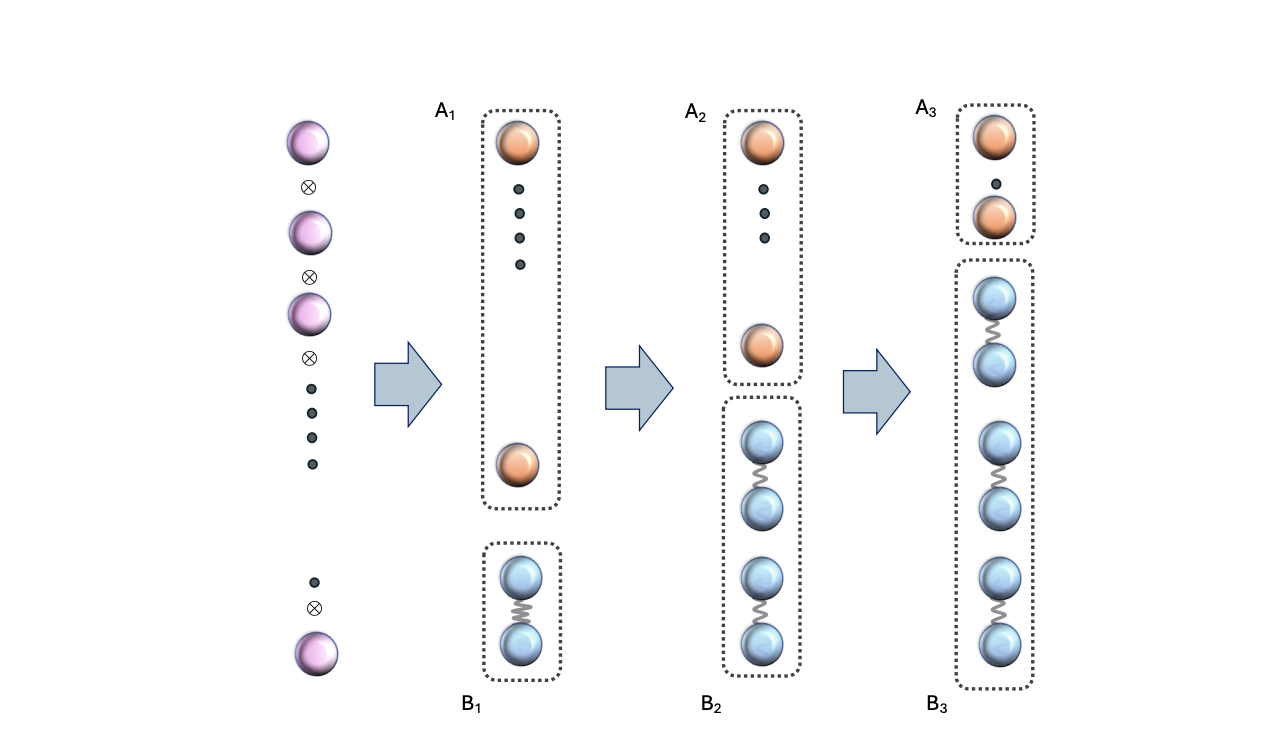
The pursuit of reliable quantum computation demands methods to refine imperfect quantum bits, or qubits, and extract useful information from noisy systems. Shrigyan Brahmachari, Austin Hulse, and Henry D. Pfister, all from the Duke Quantum Center at Duke University, alongside Iman Marvian, demonstrate a surprisingly simple protocol for achieving this, using only fundamental two-qubit operations called SWAP tests. Their work reveals that this method, based on repeatedly testing pairs of qubits, performs as effectively as the complex Schur transform, a benchmark for optimal qubit purification. This breakthrough not only streamlines the process of creating higher-fidelity qubits, but also provides a lossless way to gather information invariant to qubit order, offering a powerful tool for tasks such as fully characterizing quantum states and advancing quantum technologies.
Coherent Purification Distills Entanglement Without Measurement
This research details a quantum algorithm designed to refine and purify entangled quantum states, a crucial step in building practical quantum computers. The algorithm focuses on state purification or entanglement distillation, aiming to remove noise and improve the quality of quantum information. This innovative approach achieves purification without directly measuring the qubits involved, making it a fully reversible process and potentially more efficient than traditional methods. This reversibility stems from tracking information about discarded qubits in auxiliary registers, allowing for complete recovery of the purified state.
The algorithm leverages the “SWAP test,” a fundamental quantum operation that determines if two qubits share a specific entangled connection. By repeatedly applying this test to randomly selected qubit pairs, the algorithm identifies and removes noisy connections, while preserving essential quantum information. This process effectively decomposes the quantum state into different symmetry channels, separating useful information from noise. The core innovation lies in performing this process coherently, meaning without destructive measurements. The team demonstrated that by repeating the SWAP tests and carefully tracking the results in auxiliary registers, the algorithm converges towards a highly purified state, allowing for the extraction of maximum entanglement from the initial qubits. This method’s efficiency is noteworthy, as it achieves comparable results to the complex Schur transform, a standard technique for purifying quantum states, but with a simpler approach. This simplicity translates to reduced experimental complexity and a lower potential for errors, suggesting it could be a valuable building block for quantum error correction, long-distance communication, and advanced simulations.
Qubit Purification via Repeated SWAP Tests
Researchers have developed a remarkably simple yet effective method for refining the quality of qubits, the fundamental units of quantum information. This purification process focuses on extracting clearer signals from noisy inputs, a critical challenge in building reliable quantum computers. The team’s innovative approach relies solely on repeatedly applying the “SWAP test” to randomly selected pairs of qubits, a surprisingly elementary quantum operation that identifies and removes noisy connections, progressively refining the overall quantum state. The algorithm operates by repeatedly applying the SWAP test until no further noisy pairs are detected, converging after a number of tests proportional to the number of qubits, resulting in a purified state containing only essential quantum information.
Remarkably, the performance of this simple protocol matches that of the significantly more complex “Schur transform,” a standard technique for extracting information invariant to the order of qubits. Mathematical proofs confirm that the difference between the results obtained with this method and the Schur transform is negligible, given a sufficient number of SWAP tests. This breakthrough offers a significant advantage in practical quantum information processing by simplifying experimental requirements and reducing the potential for errors. The method’s efficiency stems from its ability to achieve the same results as more complex techniques with a minimal increase in the number of operations needed, making it a promising tool for improving the accuracy of quantum state measurements and enhancing the fidelity of quantum computations.
Random SWAP tests purify quantum information effectively
Researchers have unveiled a novel method for purifying quantum information, achieving results comparable to the most effective existing techniques. This purification process focuses on improving the quality of qubits by extracting clearer signals from noisy inputs, a crucial step towards building practical quantum computers. The team’s innovative approach relies on performing random “SWAP tests” between pairs of qubits, a surprisingly simple quantum operation that identifies and isolates noisy connections. The algorithm operates by repeatedly applying the SWAP tests until nearly all problematic pairs are identified and removed, converging after a number of tests proportional to the number of qubits, resulting in a purified state with significantly improved fidelity.
Remarkably, this efficiency matches that of the complex “Schur transform,” a previously established optimal method, but with a simpler approach. The error rate associated with this new method decreases exponentially as the number of SWAP tests increases, demonstrating its robustness. This breakthrough has significant implications for various quantum technologies. When applied to multiple copies of a noisy qubit, the protocol can generate a single qubit with dramatically improved fidelity, a measure of how closely it resembles the desired quantum state. The simplicity of relying solely on SWAP tests opens doors for more efficient and scalable quantum information processing, potentially reducing the resources needed for tasks like quantum computation and communication. This lossless approach is particularly powerful for states exhibiting specific symmetries, allowing for complete recovery of the original information after the purification process.
Lossless Qubit Purification via Weak Sampling
This research demonstrates a qubit purification protocol that achieves fidelity comparable to the optimal Schur transform, a benchmark for purifying quantum states. The protocol relies on performing random SWAP tests, elementary two-qubit operations, to identify and isolate qubit pairs, progressively refining the overall state. The team shows that after a specific number of SWAP tests, the probability of finding additional suitable pairs drops exponentially, and the remaining qubits approach the maximum achievable fidelity. The protocol’s efficiency is highlighted by its convergence towards the ideal Schur transform as the number of SWAP tests increases.
While the fidelity is limited by the initial state’s purity, the difference between the achieved fidelity and the optimal value diminishes exponentially with the number of tests performed. Comparisons with existing purification methods reveal that this protocol can achieve comparable fidelity with fewer qubit copies, potentially offering advantages in terms of resource requirements. This research offers a promising pathway towards more efficient and scalable quantum information processing, paving the way for more robust and reliable quantum technologies.
🗞 Optimal Qubit Purification and Unitary Schur Sampling via Random SWAP Tests
🧠 ArXiv: https://arxiv.org/abs/2508.05046