Understanding strongly correlated materials often requires new theoretical frameworks, and topological gauge theories offer a promising approach by describing complex systems in terms of simpler, interacting components. Claudio Iacovelli, Josep Cabedo, Leticia Tarruell, and Alessio Celi now demonstrate a method for realising a one-dimensional topological gauge theory, specifically the chiral BF theory, within a ring-shaped Bose gas. The team achieves this by reducing a more complex Chern-Simons theory to the chiral BF form and then encoding it into a Hamiltonian that links angular momentum and density. This innovative approach allows for the observation of how the topology of the theory interacts with the topology of the physical space, potentially offering new insights into the behaviour of strongly correlated matter and opening avenues for exploring exotic quantum phenomena.
Rotating Bose Gas and Bogoliubov Excitations
This research presents a detailed theoretical model of a quasi-one-dimensional Bose gas confined to a ring-like geometry, investigating its collective excitations and behavior. Scientists aim to understand how interactions, a static gauge potential, and rotation influence the system’s properties. The study establishes the system’s context by focusing on understanding the collective excitations within the Bose gas, deriving a Hamiltonian describing the interactions between bosons and their kinetic energy, while accounting for the condensate’s angular momentum within a rotating frame of reference. The core of the research involves deriving the Bogoliubov spectrum, which describes the energy of the collective excitations, or phonons, within the condensate.
This derivation reveals how the spectrum is influenced by interactions, the static gauge potential, and the rotating frame, with scientists calculating the group velocities of these excitations to provide insights into their propagation through the system. This work highlights the significant influence of the static gauge potential on the Bogoliubov spectrum and the group velocities of the excitations. This sophisticated theoretical investigation provides a detailed understanding of collective excitations and the influence of various parameters on the system’s behavior, contributing valuable insights to condensed matter physics and quantum many-body theory.
Chiral BF Theory in a Bose-Einstein Condensate
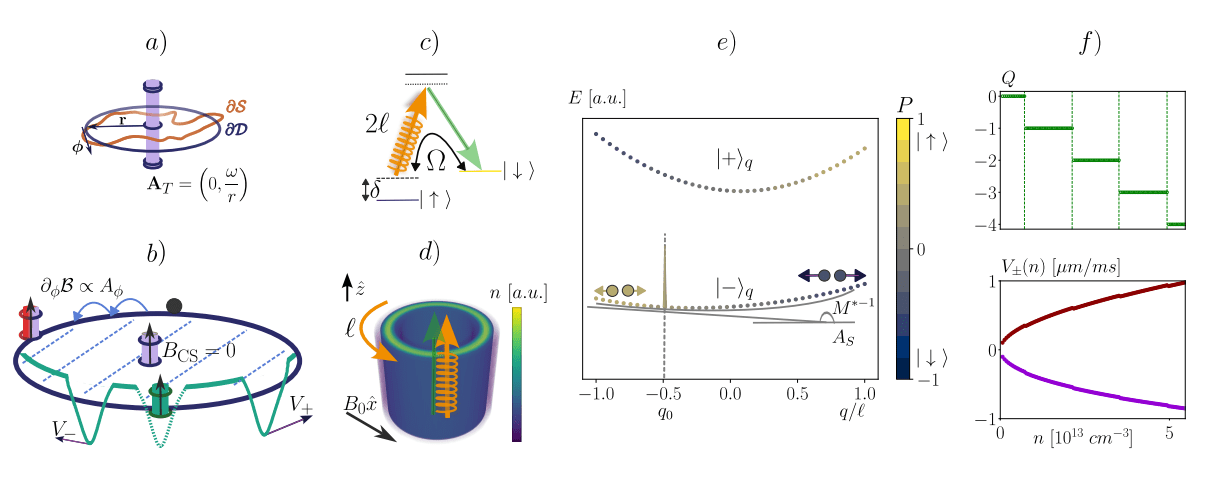
Scientists developed a novel method to realize a one-dimensional topological gauge theory, specifically the chiral BF theory, within a Bose-Einstein condensate confined to a ring-shaped trap. This work pioneers a pathway to observe the interplay between topology in theoretical physics and the topology of physical space, reducing a Chern-Simons theory to formulate the chiral BF theory on the ring geometry, effectively encoding topological properties into the behavior of the Bose gas. This encoding process involved a complex series of mathematical transformations, employing the Faddeev-Jackiw method to circumvent challenges posed by the first-order time derivatives within the chiral BF Lagrangian. This resulted in a set of equations governing the behavior of the Bose gas and the gauge field, which describes the topological properties of the system, with field redefinitions and transformations crucial for obtaining a Hamiltonian describing the total energy of the system. A key outcome is the emergence of a density-dependent magnetic flux, a direct consequence of the ring geometry and the topological nature of the underlying theory, directly linked to the total number of particles and their density distribution, providing a measurable signature of the topological gauge theory. This innovative approach enables the observation of topological phenomena in a condensed matter system, opening new avenues for exploring fundamental physics.
Chiral BF Theory From Chern-Simons Reduction
This research demonstrates a pathway to realize a one-dimensional topological gauge theory, specifically the chiral BF theory, through a reduction of Chern-Simons theory. Scientists successfully showed how to transition from a two-dimensional system described by Chern-Simons theory on a disk to a chiral BF theory defined on the ring-shaped boundary of that disk, introducing a boundary term to maintain gauge invariance, resulting in the emergence of the B field as an additional degree of freedom. The team established a crucial connection between the non-trivial topology of the space and an additional flux variable, demonstrating that this flux is density-dependent and manifests as a measurable quantity related to the system’s angular momentum. This encoding process revealed that the resulting theory can be expressed as a chiral boson action, directly linked to the boundary condition κB = αβ. By imposing specific boundary conditions, zero radial current and covariant momentum, the team eliminated additional terms, ultimately arriving at a concise chiral BF action. This achievement provides a robust theoretical foundation for future experimental investigations into topological gauge theories and their potential applications.
Chiral BF Theory with Ultracold Atomic Gases
This research demonstrates a method for realizing a topological gauge theory, specifically the chiral BF theory, using ultracold atoms confined within a ring-shaped trap. Scientists successfully showed how this theory arises from a reduction of Chern-Simons theory, and can be implemented by encoding gauge degrees of freedom into a two-component, Raman-coupled gas, identifying observables, quantized current and chiral sound velocity, which uniquely characterize the chiral BF theory on the ring. The work quantifies the interplay between the topology of the theoretical model and the topology of the physical space, revealing a density-dependent magnetic flux generated by the gas itself, with results closely matching predictions from theoretical models, with velocities and asymmetry increasing alongside density and ring radius. This proposal opens avenues for exploring novel quantum phases with ultracold atoms, potentially enabling the investigation of chiral solitons and providing a step towards engineering systems exhibiting Chern-Simons-like physics.
👉 More information
🗞 Encoding a topological gauge theory on a ring-shaped Raman-coupled Bose gas
🧠 ArXiv: https://arxiv.org/abs/2510.06089