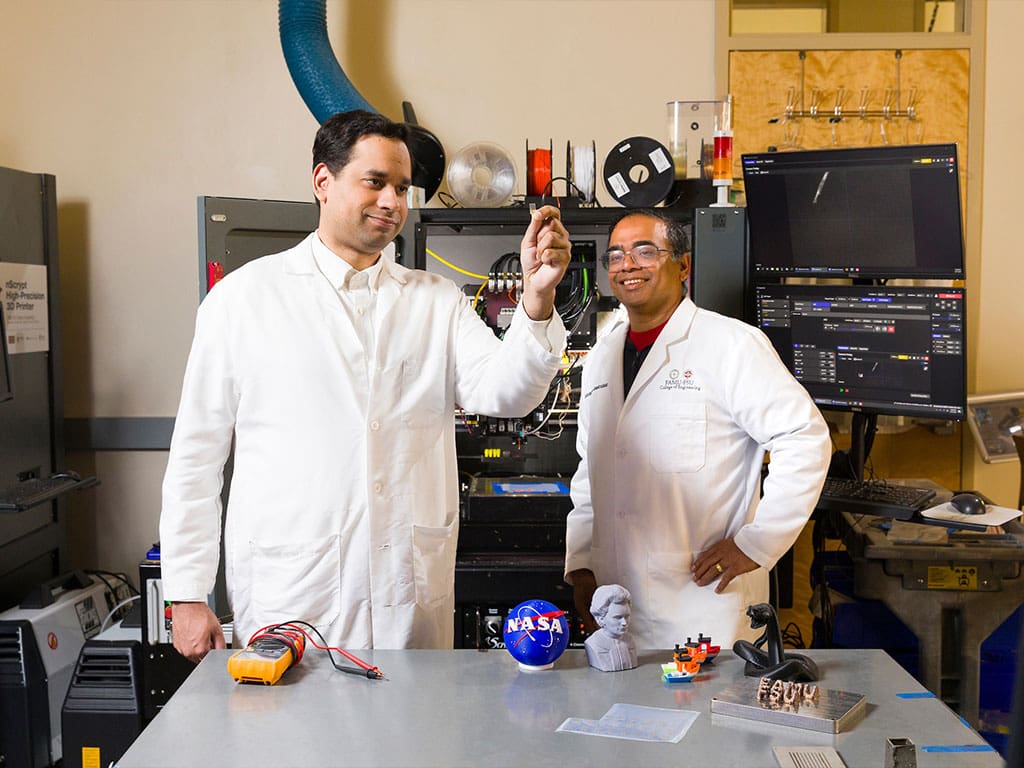
Professor Subramanian Ramakrishnan and his team at the Department of Chemical and Biomedical Engineering, FAMU-FSU College of Engineering, are developing advanced inks for 3D printing in extraterrestrial environments, funded by a $5 million NASA grant. The research focuses on utilising 2D materials, specifically MXenes, in conjunction with metallic and semiconducting nanoparticles, to facilitate in-space manufacturing (ISM). These specialised inks are designed to enable the on-demand production of functional components, including sensors for gas and strain detection, antennas, radiation shielding, and flexible electronic circuits, thereby reducing reliance on Earth-supplied materials during long-duration space missions. This work represents a critical advancement towards establishing self-sufficiency and adaptability for future space exploration endeavours.
Advancing In-Space Manufacturing: Florida A&M University Pioneers Novel 3D Printing Techniques for Long-Duration Space Missions
A research initiative at Florida A&M University (FAMU), led by Professor Subramanian Ramakrishnan of the Department of Chemical and Biomedical Engineering at the FAMU-FSU College of Engineering, is poised to fundamentally alter the logistical constraints of extended space exploration. The project, bolstered by a $5 million grant from NASA, focuses on the development of advanced materials and 3D printing methodologies specifically tailored for in-space manufacturing (ISM). This capability aims to diminish, and ultimately eliminate, reliance on Earth-based resupply missions, offering a pathway towards self-sufficiency for future long-duration space endeavours.
The core of the research lies in the formulation of novel inks composed of two-dimensional (2D) materials known as MXenes, combined with metallic and semiconducting nanoparticles. MXenes are a relatively new class of materials – discovered in 2011 at Drexel University – characterised by their single- or few-layer structure and exceptional electrical conductivity, mechanical strength, and tunable surface chemistry. These properties render them ideally suited for a range of applications within the harsh environment of space. Professor Ramakrishnan elucidates the potential impact, stating, “Imagine while on a space mission having the ability to print sensors, radiation shields, or even functional tissues as the mission progresses.” This vision underscores the transformative potential of on-demand fabrication in addressing unforeseen challenges and adapting to evolving mission requirements.
The team’s approach centres on overcoming the inherent difficulties of 3D printing in microgravity and under the influence of cosmic radiation. Traditional 3D printing processes rely on gravity to ensure consistent material deposition and layer adhesion. In the absence of gravity, controlling the flow and solidification of printing materials becomes significantly more complex. The research addresses this through careful manipulation of ink rheology – the study of flow – and the incorporation of nanoparticles to enhance inter-layer bonding. These nanoparticles, precisely engineered for compatibility with the MXene matrix, act as cross-linking agents, strengthening the printed structure and improving its resistance to mechanical stress and radiation damage.
The resulting inks are designed to facilitate the printing of a diverse array of components crucial for space missions. These include highly sensitive sensors capable of detecting trace gases and structural strain, essential for monitoring habitat integrity and life support systems. Furthermore, the team is developing printable antennas for communication and data transmission, as well as radiation shielding materials to protect astronauts and sensitive equipment from harmful cosmic rays. A particularly ambitious aspect of the research involves the exploration of bioprinting techniques, aiming to create functional tissues for medical applications during long-duration missions, potentially reducing the need for extensive medical supplies from Earth.
The significance of this work extends beyond simply reducing logistical burdens. The ability to manufacture components on demand allows for greater mission flexibility and adaptability. Damaged or malfunctioning parts can be quickly replaced, and new components can be created to address unforeseen challenges or enhance mission capabilities. This represents a paradigm shift in space exploration, moving away from a reliance on pre-fabricated components and towards a more agile and self-sufficient approach.
The NASA funding will support a multi-faceted research program encompassing materials synthesis, ink formulation, 3D printing process optimisation, and rigorous testing under simulated space conditions. The team will leverage advanced characterisation techniques, including scanning electron microscopy, X-ray diffraction, and mechanical testing, to evaluate the performance and durability of the printed components. The research builds upon prior work in nanomaterials and additive manufacturing, integrating expertise from chemical engineering, materials science, and aerospace engineering. The ultimate goal is to develop a robust and reliable in-space manufacturing system capable of meeting the demanding requirements of future long-duration space missions, paving the way for sustained human presence beyond Earth orbit.
More information
External Link: Click Here For More