The behaviour of information released during black hole evaporation represents a fundamental challenge to modern physics, and recent research by Yipeng Liu, Wei Xu, and Baocheng Zhang from China University of Geosciences sheds new light on this process. The team investigates radiation entropy, a measure of information carried by outgoing particles, within the complex environment of black holes existing within a specific gravitational theory known as f(Q) gravity. Their work reveals a modified understanding of how information escapes a black hole, demonstrating that the standard calculations require correction and that the amount of information diverges under certain conditions. Importantly, the researchers show that the final radiation entropy, and even the timescale for information retrieval, are directly linked to the specific details of the underlying gravitational model, suggesting a powerful new way to probe the nature of gravity itself.
The team employs the island rule, a concept linking gravity to quantum information, to investigate how entropy calculations are altered when gravity deviates from Einstein’s general relativity. Their analysis reveals that the standard calculation of entropy requires modification to accurately reflect the specific gravitational model, offering new insights into black hole thermodynamics and the enduring information paradox, which concerns how information escapes from black holes through Hawking radiation. The findings contribute to the ongoing effort to reconcile general relativity with quantum mechanics, providing a deeper understanding of spacetime and gravity under extreme conditions.
AdS Black Holes Probe Quantum Field Theories
This research builds upon the AdS/CFT correspondence, a powerful theoretical tool that connects gravity in Anti-de Sitter (AdS) space to conformal field theories on its boundary. Black holes within AdS space provide a simplified setting for studying quantum gravity, allowing physicists to explore fundamental questions about spacetime and information. The team investigates Hawking radiation, the thermal emission predicted to originate from black holes, and the associated information paradox, which arises from the apparent loss of information as a black hole evaporates. Understanding entanglement entropy, a measure of quantum correlations, and the recently proposed concept of islands, regions contributing to entanglement, are central to resolving this paradox.
This paper investigates the information paradox in the context of black holes within Anti-de Sitter (AdS) space, specifically within the framework of f(Q) gravity. The authors are exploring whether the island proposal can resolve the paradox in this modified gravity theory by studying the formation and properties of islands in the spacetime around the black hole, crucial for recovering information that falls into the black hole. They calculate the Page curve for the Hawking radiation emitted by the black hole, aiming to demonstrate that information is indeed released over time. By performing these calculations within f(Q) gravity, the team explores how modifications to general relativity affect the island structure and the behaviour of the Page curve, and considers different black hole solutions to observe these effects.
Demonstrating the formation of islands and a correctly behaving Page curve in f(Q) gravity would provide strong evidence that the island proposal is a viable solution to the information paradox. This work provides a way to test the predictions of f(Q) gravity in a strong gravitational regime, potentially offering insights into the nature of spacetime at the Planck scale and deepening connections to quantum information theory. The study of modified gravity theories like f(Q) gravity is crucial for understanding the universe and its evolution.
Island Rule Reveals Gravity’s Entropy Modification
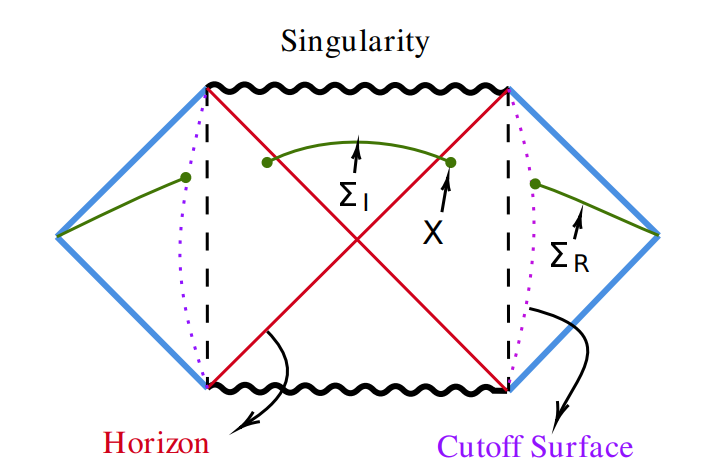
This research investigates the behaviour of radiation entropy around black holes within a modified theory of gravity known as f(Q) gravity. By applying the island rule, a tool connecting gravity and quantum information, the team discovered that the standard calculation of entropy requires modification to accurately reflect the underlying gravitational model. This implies that geometric properties associated with quantum effects are influenced by the details of the gravitational theory. For an eternal black hole, the island rule yields a time-independent entropy, but this calculation diverges as the observational boundary expands, suggesting limitations in the approximations used.
However, for a collapsing black hole, the research successfully demonstrates a logarithmic correction to the expected area law of entropy, aligning with both established principles of entanglement and predictions from quantum gravity. Importantly, the calculated radiation entropy and the Page time both depend on the specific f(Q) model employed, providing a novel theoretical pathway for constraining the form of this function and refining our understanding of gravity. The authors acknowledge that the s-wave approximation, used to simplify calculations, remains invalid even when considering a thermal bath surrounding the black hole, due to the presence of incoming modes, and suggest future research could focus on refining approximations or exploring alternative methods to address this limitation.
🗞 Radiation Entropy in asymptotically AdS Black Holes within f(Q) Gravity
🧠 ArXiv: https://arxiv.org/abs/2510.17528